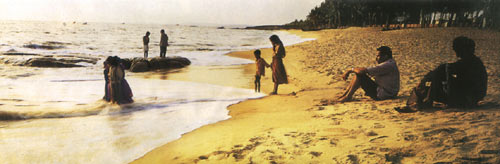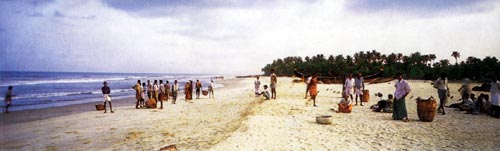
All the magic of the Kerala waterlands was distilled in the burnished hour before dusk. Skinny boatmen poled long canoes with cargoes of coconuts, fish, bicycles, chickens and tired people. My own boat, whispering through the skein of creeks and jungled islands, was an unobtursive platform from which I observed the seamless lives of amphibious people as they fished and played and planted and endlessly whashed themselves, their babies and bright garments. In the shallows, beneath doffing palms, fishermen stood motionless with arrows in taut bowstrings; and, as swift as arrows, kingfishers dived in sudden electric flashes. Egrets studied the noble heads of buffaloes, picking off ticks like attentive valets.
Kerala has always fitted Western notions of Eden: the soil deep red, beaches bone-white, vegetation dense green and the sea sparkling blue for much of the year. Forests, farms and plantations, watered by more than 40 rivers, ascend from the sea to the great ramparts of the Western Ghats. ...I submitted, for the first time, to an Ayurvedic oil massage, for which Kerala is renowned. The skills of Ayurvedic medicine and massage are often passed down through families, and the masseur, a stocky scrum-half of a man with a jolly smile, showed me a pot of oil that, he said, was a traditional recipe with his own herbal additions. It was the colour of dark honey, and its smell was tantalising, reminding me of the virol my mother spooned into me so that I should grow into a big boy, and then créme brûlée The masseur closed his eyes in prayer, then sprang into action, vigorously rubbing oil into my scalp, neck, shoulders, back, thighs and buttocks. This latter part, I reflected, is what man-eating tigers eat first, as an hors d' oeuvre; or so I was once told by an Indian game warden. Back at the massage, my legs were tugged and stretched, my knees and ankles loosened. I was flipped over and strong fingers located the tea I had drunk earlier. It gurgled loudly. At last, the masseur bowed his head and set me free: the whole thing lasted nealry an hour and I glowed like a lamp. We anchored at twilight, some distance from the shore and untroubled by flies or mosquitoes. The crew lit oil lamps, and I drank a beer and read. Dinner was a fish curry with coconut and rice, followed by pineaple and banan fritters. I stretched out on the foredeck mattress and watched the swarming stars. A cool breeze blew into the cabin. I rose at 5am to watch the sunrise. The crew jumped over the side for their bath, then brought me tea and a peppery omellete. We embarked on another voyage of enchanting hours, visiting a Hindu temple and a church, both of them crowded with worshippers. Because Kerala is a crossroads of faith, the place where Christians, Muslims and Jews put down their first markers in India, it is full of churches, mosques and temples. |

|
Condé Nast Traveller
The widely read and circulated travel magazine published from UK, Condé Nast Traveller Brought out the exotic fragrance of Kerala in its March 2002 issue. |
October 1999
April 2001
March 2002
London January 2001
February 2002
April 2000