Geothermal power (from the Greek words geo, meaning earth, and therme, meaning heat) is energy generated by heat stored beneath the Earth's surface. Prince Piero Ginori Conti tested the first geothermal power plant on 4 July 1904, at the Larderello dry steam field in Italy. The largest group of geothermal power plants in the world is located in The Geysers, a geothermal field in California.[2] As of 2007, geothermal power supplies less than 1% of the world's energy.
Advantages
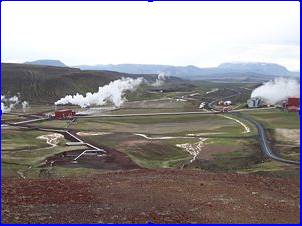
The Nesjavellir Geothermal Power Plant in IcelandGeothermal energy offers a number of advantages over traditional fossil fuel based sources. From an environmental standpoint, the energy harnessed is clean and safe for the surrounding environment. It is also sustainable because the hot water used in the geothermal process can be re-injected into the ground to produce more steam. In addition, geothermal power plants are unaffected by changing weather conditions. Geothermal power plants work continually, day and night, making them base load power plants. From an economic view, geothermal energy is extremely price competitive in some areas and reduces reliance on fossil fuels and their inherent price unpredictability. Given enough excess capacity, geothermal energy can also be sold to outside sources such as neighboring countries or private businesses that require energy. It also offers a degree of scalability: a large geothermal plant can power entire cities while smaller power plants can supply more remote sites such as rural villages.
Disadvantages
There are several environmental concerns behind geothermal energy. Construction of the power plants can adversely affect land stability in the surrounding region. This is mainly a concern with Enhanced Geothermal Systems, where water is injected into hot dry rock where no water was before. Dry steam and flash steam power plants also emit low levels of carbon dioxide, nitric oxide, and sulfur, although at roughly 5% of the levels emitted by fossil fuel power plants. However, geothermal plants can be built with emissions-controlling systems that can inject these gases back into the earth, thereby reducing carbon emissions to less than 0.1% of those from fossil fuel power plants.
Although geothermal sites are capable of providing heat for many decades, eventually specific locations may cool down. It is likely that in these locations, the system was designed too large for the site, since there is only so much energy that can be stored and replenished in a given volume of earth. Some interpret this as meaning a specific geothermal location can undergo depletion, and question whether geothermal energy is truly renewable, but if left alone, these places will recover some of their lost heat, as the mantle has vast heat reserves. The government of Iceland states: "It should be stressed that the geothermal resource is not strictly renewable in the same sense as the hydro resource." It estimates that Iceland's geothermal energy could provide 1700 MW for over 100 years, compared to the current production of 140 MW.
GO TO----- Home Hydro Wind Biomass Geothermal Solar

