HOME PAGE BG001 BG002 BG003 BG004 BG005 BG006 BG007 BG008 BG009 BG010 BG011 BG012 BG013 BG014 BG015 BG016 BG017 BG018
01/09/2004
Kundalini
Power
Simple Kundalini Pranayama is for the modern man who has no time for contemplation, meditation or the real McCoy, Kundalini Yoga. The following is modified and based on the recommendation of Swami Sivananda. (Page xxiii, Kundalini Yoga)
Pranayama consists of Puraka, Kumbhaka and Rechaka: Inspiration, Retention and Exhalation of breath. Swami Sivananda says that positive attitude and dedication (Bhava) are more important than the time ratio of three components of Pranayama. Sit in Padma Asana pose looking East or North. Perform a short prayer in worship of your Guru or Ishta Devata. Take a deep breath without snorting, hissing etc. As you inhale, imagine that Kundalini Devi is rising from Muladhara to Sahasrara Chakra through all the intermediary chakras. Retain your breath for five to ten seconds (Kumbhaka Phase). As you retain your breath mentally chant Pranava (OM) or your own chosen Mantra. Feel that you are suffused with "LIGHT, POWER AND WISDOM" during Kumbhaka phase. Next comes exhalation (Rechaka phase). Imagine that Kundalini is descending stepwise from Sahasrara, to Ajna, to Visuddha, to Anahata, to Manipura and finally to Muladhara Chakras. As you are exhaling imagine that you are exhaling all Tamasic qualities (sloth and slumber) out of your system.
As you take a breath, imagine that you are
inhaling all the auspicious cosmic powers into your system, for the breath
(Prana or power) spreads all throughout your body and takes all the cosmic
powers to each cell. During Kumbhaka phase, all the cosmic powers take their
residence in each cell. In exhalation phase, imagine that you are getting rid
of all unwanted qualities from your system. During Kumbhaka phase, you can
chant OM or any other mantra and also pray for the welfare of you, your
family, your community, your nation and the world. Kumbhaka phase is the most
important. Hold the breath as long as you possibly can.
When soldiers are stressed out during battle, they are advised to take Pranayama exercises consisting of Puraka, Kumbhaka and Rechaka. If it works for them, it should work for us. You can do this any number of times a day wherever and whenever it is feasible. End
Kunda-lin means coiled or snake. Kundalini
is a goddess and her power remains latent in Kanda, urogenital triangle between the anus and the genitals. Kanda
means a bulbous or tuberous root. Kanda is the junctional point or knot
(Granthi Sthana), where Susumna channel takes its origin and the gated portal
of entry in Susumna for Kundalini is known as Brahma Dvara -Brahma's
gate or aperture, which is said to be closed by the mouth of Kundalini.
72,000 Nadis or channels spring from Kanda, which is the point of confluence
and branching and where Maya holds its sway. Kundalini lies coiled three
and half times like a serpent at the base of the vertebral column,
ready to spring. The three coils stand for A U M; three gunas, sattva, Rajas,
and Tamas; and three states of consciousness, waking, dream sleep and
deep sleep. The half coil stands for transcendence above all the triads. This energy goes through nodal points along the spine called Chakra or wheel, which is represented by lotus petals, which always point
towards the goddess Kundalini where she is active. Where Kundalini sakti is
active (dynamic aspect of Sakti), that chakra is hot and becomes cold when the energy leaves that chakra
or plane. Once the ascent is complete, the whole body except the crown is as
cold and rigid as a corpse. It is my understanding that the nectar
released by the union of Sakti and Siva pervades and sustains the whole body. The energy
(sakti) goes through channels from Muladhara chakra at the base
of the spine (Adhara Chakra or Support) to the Sahasrara plane at the crown by channels known as Nadis,
which are subtle and not physical. Nada is flow and Nadi is channel. Kundalini’s
purpose is for the Yogi to attain Samadhi. All the senses including the sexual
impulse are suppressed and sublimated into prana or energy that ascends the
Susumna Nadi from Muladhara Chakra to Sahasrara chakra where goddess Kundalini
and the Yogi
achieve Mithuna (union) with Siva. The Yogi's soul departs the body and
escapes through Brahma Randhra, the anterior fontanel area, to merge with
Brahman. This area is said to be 12 inches above the crown and is called
Dvâtasântam
(Dvatasantam / dvadasanta), where absorption of Yogi's consciousness into the
Pure Consciousness of the Lord takes place. It is Turiya and Turiyatita state,
4th and 5th state of consciousness. Brahma Randhra
in the skull is the entry and exit point for the soul. The Sadhakas or aspirants have to follow the
eight point observance, known as Ashtanga Yoga. Please read TMTM 01-09 for
more details.
Note: The bones that you sit on are the Ischial tubercles which form the base and the root of the phallus forms the top of the triangle. See the triangle and the Kanda in the bottom of the diagram.
Woodroffe states, "It is not to be supposed that simply because the Serpent Fire has been aroused that one has thereby become a Yogi or achieved the end of Yoga. Though much is here gained, it is not until the Tattvas of this centre are also absorbed, and complete knowledge of the Sahasrara is gained, that the Yogi attains that which is both his aim and the motive of his labour, cessation from rebirth which follows on the control and concentration of the Citta on the Sivasthanam, the Abode of Bliss."
For a beginner, Kundalini fire should be raised gradually from one chakra to the next over years until she reaches Ajna Chaka. It is hot where the kundalini fire is active and this can be verified by external observer. Each chakra (plane) of body, base of spine, genital area, navel area, heart area turn cold as the power leaves that plane. Kundalini fire, if unreglated, is Kali; if regulated, it is Durga, the giver of boons. Unregulated and undirected Kundalini fire is like Kali trampling Siva on the burial ground.
When the kundalini power reaches the Sahasrara chakra, the whole body is cold "like a corpse" and the crown is a little warm. The yogi can bring down the Kundalini power from the cerebral plane and snap out of it.
One in a thousand aspirants may succeed in Kundalini yoga; guidance from a qualified Guru-Yogi is a must, for he alone can save you from attendant risks.

Chitra Nadi's lower end is called Brahma Dvara, the aperture or door of Brahman, through which Kundalini enters; it ends in cerebellum.
creation-saiva-view.gif
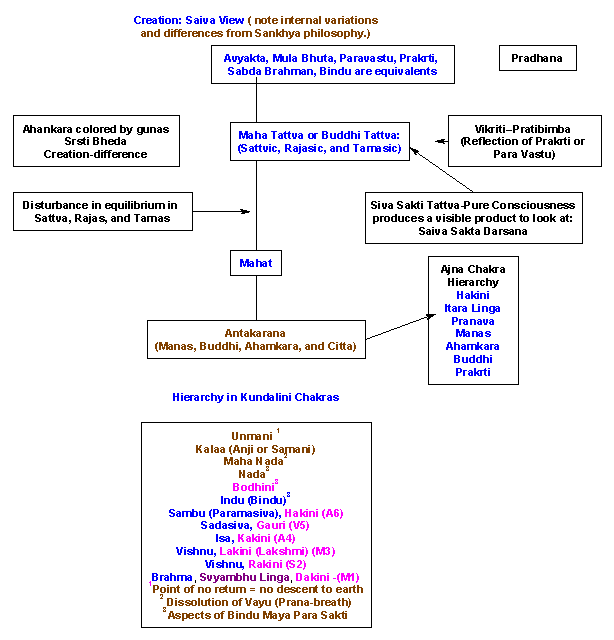
Note: M1 = Muladhara, S2 = Svadisthana and so on.
Goddess Kundali has two states one on earth at human level and one
at Supreme level. The lower Kundali stays coiled in Muladhara chakra. She is
Paramatama at higher level. When
all Tattvas have manifested right down to the last tattva, the earth, she goes
to rest and sleep in the Muladhara chakra as Kundalini Sakti (static aspect of
Sakti). Sakti has two aspects; Static and Dynamic. A battery on the shelf is
Static Sakti or power. When the battery is connected to the car's ignition and
turned on, it becomes dynamic. When Kundalini Devi rests in Muladhara, she is
static and when she is roused (turning the
ignition keys) she becomes dynamic. It is said
that the Yogi should use the key to open the lock on the door and force the
door open and wake up Kundalini in Muladhara. Cosmic Sakti is an aggregate (Samashti)
of all Saktis, while kundalini Sakti in a body is a separated aggregate (Vyashti).
Look at the Pomegranate fruit: The whole fruit is an aggregate (Samasthi) of
all individual fleshy seeds (Vyasthi).

pome·gran·ate
(Random House dictionary description.)1. a chambered, many-seeded, globose fruit, having a tough, usually red rind and surmounted by a crown of calyx lobes, the edible portion consisting of pleasantly acid flesh developed from the outer seed coat.
Man is a microcosm (Kshudra Brahmanda) of macrocosm of the universe. Kshudra = minute, tiny, diminutive. Brahmanda = Brahma's egg, macrocosm. "What you see here is out there." All Tattvas that went into the creation of this universe exist in our body. Likewise What is in our body exists in the universe: Bhuloka at Muladhara, Bhuvah at Svadisthana, Svah at Manipura, Tapa at Anahata, Jana at Visuddha, Maha at Ajna and Satya at Sahasrara.
She is both Avidya Sakti and Vidya Sakti :Ignorance and wisdom. She is above both; she gives wisdom and liberation to Yogi and ignorance to the ignorant who remains in bondage roiling in Samsara. Ignorance refers here to spiritual ignorance. She is Prana (breath) Herself for she sustains this world of beings with inspiration and expiration. Prana moves through Susumna because of her. Katha Upanishad describes mother Goddess as follows: She is Aditi, the Boundless. She is born as Prana (breath or life) from the Absolute genderless Brahman, the nameless, and the formless. She is the Devatamayi (Mother of gods) and the soul of all beings. She stands in the inner recesses of the heart. --Verse 2.1.7 Mother Goddess is Prana; thus, taking Prana from Muladhara to Sahasrara Chakra is the goal of Sadhaka.
She is the origin of letters; She is Sabda Brahman and origin of mantras, which rouse her. She is Brahma Vidya (Brahman knowledge, the Highest knowledge). Her body is made of six parts: the six centers, sakti, and Sadasiva, her Lord. As the Supreme Kundali Goddess, MahaKundali, she wraps around the Supreme Siva-Linga (Svayambhu-Linga). Each chakra represents one gross element: Muladhara for earth, Svadhisthana for water, Manipura for fire, Anahata for air and Vishuddhi for ether. Click here>>Of all the five elements.The sixth chakra, Ajna, is the mind center. Sahasrara, which is above all other centers, is at the crown, known as Brahma Randhra, the area of anterior fontanel. It has a thousand inverted lotus petals, meaning that the 50 Sanskrit letters are multiplied twenty-fold in here. The other centers have fewer petals starting from Muladhara: 4, 6, 10, 12, 16, 2 respectively. Each petal is inscribed with a Sanskrit letter, all amounting to 50, which when multiplied by 20 becomes 1000 petals (infinity) of Sahasrara. The Chakras are crossing junctions for the Nadis like the highway crossings, so the numbers indicate the number of Nadis that intersect at a particular chakra. The Susumana Nadi, when it reaches the cerebral cortex, divides into multiple channels; that is the reason why the Sanskrit letters in the lower channels are multiplied so many times in Sahasrara. The base of the brain with half-moon shaped gyri (convolutions) corresponds to Chandrakala. The upper cerebral convolutions correspond to Mount Kailas. This is Sivasthana (Abode of Siva), Point Bliss and the seat of Sakti also.
Svayambhu-Linga also means Linga-shaped (obelisk) outcropping from earth in its natural state. They are sacred even before consecration. They served as the nucleus around which temples were built.
Muladhara, Svadhisthana, Manipura, Anahata and Visudhha Chakras are the lower centers (Bhutas). Ajna Chakra is mental Center or Vijnanamaya Kosa. Sahasrara Chakra is the cerebral center which opens the way to Supreme Siva Sakti or Pure Consciousness, which is the first of Suddha Tattvas.

Each Chakra has its own dominant tattva and animal that represents the tattvas and gunas of that center.
| Chakra |
Muladhara |
Svadhisthana |
Manipura |
Anahata |
Visuddha |
Ajna |
| Causal Regions | Causal Bhurloka | Causal Bhuvarloka | Causal Svarloka | Causal Maharloka | Causal Janaloka | Chandraloka |
| Animal |
Elephant |
Makara |
Ram |
Black Antelope |
White Elephant |
-- |
| Sense |
Smell,
feet, Gandha Tattva |
Taste,
hands, sense of taste, Rasa Tattva. |
Vision,
anus, sense of sight, Rupa Tattva. |
Touch,
Phallus, sense of touch, Sparsa Tattva. |
Hearing,
Speech, sense of hearing, Sabda Tattva |
-- |
| Mandala |
Earth,
Bhu Mandala |
Water,
Jala Mandala |
Fire,
Vahni Mandala |
Air,Vayu
Mandala |
Ether,
Nabho Mandala |
Mind |
| Presiding element |
Prithvi |
Varuna |
Agni |
Vayu |
Akasa |
Manas |
| Sound |
|
|
Pasyanti.
Visual Sound |
Madhyama,
mental Sound |
Vaikhari,
Articulate speech |
|
| |
|
|
|
|
|
|
| |
|
|
|
|
|
|
| |
8
spears |
|
|
|
|
|
| Sign/form/color |
Square-yellow |
|
|
|
|
|
| Petals |
4 |
6 |
10 |
12 |
16 |
2 |
| Letters |
4 |
6 |
10 |
12 |
16 |
2 |
| Color of petal |
Red |
Vermillion |
Cloud-color |
Vermillion |
Purple |
White |
| Yantra |
Square |
Circle |
Triangle |
2
Triangles |
Triangle |
Triangle |
| God |
Brahma
with Savitri |
Vishnu |
Vishnu |
Isa |
Sadasiva |
Sadasiva |
| Goddess |
Dakini |
Rakini |
Lakini |
Kakini |
Sakini/Gauri |
Hakini |
| resides in |
Skin |
Blood |
Flesh |
Fat |
Bone |
Marrow |
| Bija Sound |
Lam |
Vam |
Ram |
Yam |
Ham |
|
| Lokas |
bhu |
Bhuvar |
Svar |
Mahar |
Janar |
Tapo |
| Nadis |
Ida
& Pingala |
I--P--Susumna |
I--P--S |
I--P--S |
I--P--S |
I--P--S |
| Linga |
Svayambhu
Linga with Kulakundalini |
|
|
Baana |
|
Itara
|
| |
|
|
Rudra |
|
Ardhanarisvara |
|
| Site |
Kanda |
Genitals |
Navel |
Heart |
Throat |
Glabella |
| Plexus |
Sacrococcygeal |
Sacral plexus |
Solar |
Cardiac |
cervical |
Cavernous |
| Siva |
|
|
|
Isa |
Ardhanarisvara |
Sambhu
|
| Granthi (Knot) |
Brahma
Granthi |
|
|
Vishnu
Granthi |
|
Rudra
Granthi |
| |
|
|
|
|
|
|
Granthi: knots. There are fourteen granthis for kundalini to pierce before she reaches Sahasrara: three Lingas, six Chakras, and five Sivas. In Sahasrara, she effects union with Niskala Brahman. See below.
Itara: literally means this, that, the one, the other. In this context it refers to Linga, which helps one to cross from the world of wandering or Samsara.
Letters (SANSKRIT): 4 =Vam-- Sam-- Sam-- Sam. 6 = Bam-- Bham. Mam-- Yam-- Ram-- Lam. 10 = Dam-- dham-- nam-- tam-- tham-- dam-- dham-- nam-- pam-- pham. 12 = kam-- kham-- gam-- gham-- nam-- cam-- cham-- jam-- jham-- nam-- tam-- tham. 16: A—Ā—I—Ī—U—Ū—Ř—R—L—Ĺ—E—AI—O—AU—AM-- AH. 2: KSAM-- HAM.
Lingas: Svayambhu in Visuddha, Baana in Anahata , and Itara (phallic form in Ajna).
Makara = A cross between alligator and fish.
Sivas: Isa at Anahata, Mahesvara Sadasiva, Ardhanarisvara at Visuddha, Sambhu (Paramasiva), Rudra and Paramasiva at Ajna (Rudra Granthi), This list includes Brahma at Muladhara and Vishnu at Anahata among the Sivas. (Parasiva at Sahasrara.) Sambhu = Sam + Bhu = Auspicious Being or existence.
Mount Meru is the Axis Mundi of the universe; Spine is the Axis Mundi or Skambha of the universe of human body and so it is called Merudanda. Meru + danda = Meru + Pole.
These six centers generally correspond to anatomical centers: Muladhara and
Svadisthana centers to Sacrococcygeal plexus, Manipura to Celiac, Anahata to
Cardiac, Visuddha to Laryngeal, Ajna to Cavernous plexus and cerebellum, and
Sahasrara to cerebrum itself.
There are seven Cervical vertebrae, 12 Thoracic vertebrae, five Lumbar
vertebrae, five fused Sacral vertebrae and four fused Coccygeal vertebrae: In
all there are 24 presacral movable vertebrae, and the immovable sacrum and coccyx.
They curve in the opposite directions alternately, cervical curvature forward,
thoracic curvature backward, lumbar curvature forward and sacrococcygeal
curvature backward. (The number of Cervical vertebrae are constant in
mammals, including the giraffe which has the longest cervical vertebrae.) The
notches in the adjacent vertebrae line up and form a foramen and the dorsal spinal
root ganglia are in the foramina. The spinal canal runs down the
vertebral column housing the spinal cord. The spinal cord is narrow in the
upper cervical region, bulges in the lower cervical and upper thoracic
regions, narrows in the lower thoracic region and again bulges in the upper
lumbar region and narrows down in the lower lumbar region to a fine cord
called Filum Terminale. The major enlargements are Cervical and lumbar and
have more gray matter at those points. The
end of the spinal cord, conus medularis provides the sacral and coccygeal
roots. The spinal cord is protected by the vertebral column, the
ligaments, the meninges and fluid. It is 1 cm in diameter, 45cm long in adult males and 42cm in
adult females and ends at the level between L1 and L2 (lumbar) vertebra. It
begins at the foramen magnum in the skull. There are 31 pairs of spinal nerves
(8C, 12T, 5L, 5S, 1Coccygeal). Each spinal nerve has two roots, one motor
ventral and one sensory dorsal (back). The cross section of the cord
shows H-shaped butterfly gray matter surrounded by white matter. The gray
matter is unmyelinated (no insulation) nerve fibers and white matter is
myelinated nerve fibers. Gray matter integrates the incoming sensory and
outgoing motor impulses. The Ventral
gray horns (the front end of the wings) are larger than the dorsal horns. The
Ventral rootlets (motor) leave the cord, while dorsal (sensory) rootlets enter
the cord. The ventral (outgoing ) rootlets are connected to the nerve
cell bodies of gray matter of the ventral horn, but the incoming sensory nerves have
nerve cells in the dorsal root ganglion outside the spinal cord, and later
come to posterior horns. The white matter surrounding the gray matter are myelinated
nerve fibers that transmit impulses up and down the spinal cord. The white
matter has on either side three columns: anterior, posterior and
lateral. They are ascending and descending tracts carrying afferent nerves to
the brain and efferent nerves from the brain to various parts of the body. The
posterior columns carry only afferent nerves to the brain. There are twelve
cranial nerves. Just
outside the intervertebral foramen, distal to the ganglion, the afferent
dorsal and the efferent ventral roots join to form the mixed spinal nerve, which
divides into ventral and dorsal rami carrying both afferent (in) and efferent
(out) nerves. The lumbosacral and coccygeal nerve roots are the longest
forming a horse's tail (cauda equina) caudal (downward) to the Filum.
Autonomic Nervous System makes adjustment in the function of the organs depending upon the situation: heart quickens with fear or excitement, the mouth becomes dry with fear, the skin becomes flush with anger. It consists of sympathetic and parasympathetic divisions, one antagonizing the other, thus fine-tuning the action of an organ they supply. The sympathetic cells are located in the spinal cord from T1 to L3. From here, the preganglionic fibers proceed along the anterior roots, winds through the white rami communicantes to the sympathetic ganglion. Let me explain this routing of the preganglionic fibers. As you see, the anterior roots carry both motor and sympathetic fibers away from the spinal cord, the sympathetic fibers have to branch off to reach the sympathetic ganglion and that is why nature provides the exit ramp (White Rami Communicantes) for the sympathetic fibers to reach the sympathetic ganglion. There are 21 or 22 pairs of ganglia on each side of the vertebral column, 3 in the cervical region, 10 or 11 in the thoracic region, 4 in the lumbar region, 4 in the sacral region, and one ganglion lying in front of coccyx-ganglion impar. Once the sympathetic fibers synapse, the post ganglionic fibers exit the sympathetic ganglion and join the mixed spinal nerve. The sympathetic and parasympathetic system supplies the organs with nerve fibers for their function and a balance is kept between these opposing systems. The demands of the human organism is met by either modulation of both or stimulation of one or the other system. The sympathetic system meets the demands of stress on the body by sending more blood to vital organs like heart and muscles by dilating their blood vessels and concurrently constricting blood vessels going to less vital organs like skin. Its currency is adrenaline. Parasympathetic system helps secrete digestive juices, constricts the pupil and stimulates the vagus nerve supplying the heart, bronchi and gastrointestinal tract, resulting in slowing of the heart, constriction of the bronchial tubes and the propulsion of the stomach and intestines except the lower two thirds of the colon. Its currency is acetylcholine at the terminals.
(Parasympathetic ganglia receive fibers from the brainstem and spinal segments, S2 to S4. They are juxtamural or intramural, meaning they are in the substance of the organ itself. Acetylcholine is the mediator substance released at the preganglionic and postganglionic endings of parasympathetic fibers.)
For more details consult: http://www.bartleby.com/107/214.html


G: Sympathetic Ganglion showing the Rami.
V: Vertebral Body
C: White and Gray Rami Communicantes
MN: Mixed nerve carrying sensory, motor and Sympathetic fibers. Ventral or Anterior
Ramus.
PRG: posterior Root Ganglion, way station for the sensory nerves before they enter spinal cord.
PC: Posterior or Doral Ramus (Mixed nerve)
Muladhara Chakra and Svadhisthana chakras correspond to Sacrococcygeal plexus, Manipura to Celiac plexus, Anahata to cardiac plexus, and Visudhha to laryngeal plexus. The vital functions of the body are associated with the Chakras, meaning that the Nadis, the nerves and plexuses communicate with one another. We are all aware of our physical body. That is Gross body (Sthula); we have two more bodies, Subtle and Astral (Sukshma and Karana)
The Nadis are channels; they are not physical but subtle. They are compared to the minute sap channels in the leaf (Leaf veins) of the Asvatta tree.

The Ida, Pingala, and Susumna Nadis come together at the Muladhara Chakra (Yamuna is Ida, Sarasvati* is Pingala, and Ganga is Susumna) form a confluence, Yukta Triveni. The Ida and Pingla Nadis correspond to the sympathetic chain on both sides of the vertebrae. Susumna Nadi (Brahma Nadi, see cross section of Susumna Nadi) runs along the central canal of the spinal cord and the Prana travels in Susumna Nadi and leaves the crown by Brahma Randhra, the area corresponding to anterior fontanel, also known as Sahasrara Chakra. Susumna Nadi is said to pass along the central canal of the spinal cord through the fourth ventricle and ends up in the cerebral cortex and does not reach Brahma Randhra. Ida, Pingala and Susumna Nadis (Yamuna runs in Ida, Sarasvati in Pingala, and Ganga River in Susumna) called Mukta Triveni separate at Ajna Chakra; Ida goes to the left nostril, the Pingala goes to the right nostril and Susumna (Brahma Nadi) goes to Sahasrara Chakra. Susumna Nadi has connection with sympathetic nerves of the Celiac Plexus (Solar)-- Manipura Chakra, the third chakra around the navel area. Susumna Nadi is Jnana Nadi because the Yogi who channels his Prana through Susumna gains Brahman knowledge. As the Ida and Pingala Nadis spiral around, they meet Susumna Nadi at the base, navel, heart and throat corresponding to Muladhara, Manipura, Anahata, and Visuddha Chakras. Pingala diverges from the throat and ends up in the right nostril and Ida in the left nostril. Ida and pingala Nadis work alternately just like the alternating autonomic patency of the nostrils. When the left Ida Nadi is patent it is the flow of lunar energy; it is the flow of solar energy through the patent Pingala Nadi. Susumna Nadi heads upwards. The right brain function is connected to and dependent on the patent lunar Ida Nadi and the left brain function to the patent solar Pingala Nadi. The Yogi can make all Nadis function simultaneously.
Each of six Chakras has its corresponding plexus and organs, having functions of evacuation, excretion, reproduction, digestion, blood circulation, and respiration. The higher centers such as Ajna and Sahasrara discharge the functions of muscle coordination, sensory and motor functions, cerebral function and Pure Consciousness. There are students of Kundlini, who consider these centers as subtle centers having nothing to do with anatomical parts and corresponding functions. The lotuses at the respective Chakras are inside the Susumna Nadi which is a subtle and not a physical channel or Nadi. The chakras are subtle and have physical counterparts: Anahata chakra's physical counterparts are the heart and cardiac plexus. The Lotus flower blooms as Kundalini passes through it. On the petals are inscribed the 50 letters of the Sanskrit alphabet. The Yogi or Sadhaka claims to see and feel the vibrations of these letters inscribed on the petals during his meditative practice. The numbers at each chakra also indicate the number of intersecting Nadis at that center. Woodroffe opines that he found no special reason in placing a particular letter on a particular petal and that is for meditative purposes only.
Sarasvati* River does not flow now. Its existence several thousands of years ago were confirmed by satellite images which appear like pentimento below the surface.
All Chakras have resident Devatas in hiding (Avarana Devatas), without propitiation of whom it is not possible for Kundalini to go up the Chakras. There are 360 Devatas, named after the rays of the the Sun (106), Moon (136) and Agni (118), who illumine the world and make the 360 days of the year. Sakti is the source of billions of rays of which 360 belong to sun, Moon, and Agni. Muladhara, Svadhistana, Manipura, Anahata, Visuddha and Ajna Chakras have 56, 62, 52, 54, 72, and 64 rays of Sakti respectively. The numbers in pairs belong to Agni118, Sun106, and Moon136 divisions. The Sahasrara plane has countless rays.
The Yogi goes from lower to higher centers; he takes Sakti with him until he reaches Sahasrara chakra, which may take may years. Once he reaches a center, it is easier for him to reach the center next time. With the successful arrival at each center, he experiences samadhi, bliss and new powers. The bliss attained in Sahasrara is the same as in liberation; he attains many supernatural powers. When Kundalini is stimulated by Asanas, Kumbhakas, Bandhas (Mudras, and Mantras, she enters Susumna Nadi and pierces the chakras defended by Maya Sakti. When Kundali is forced to enter Susumna Nadi, she remains there for the duration of Kumbhaka or retention of breath only. Once Kumbhaka phase is terminated, Kundali comes back to Muladhara. Maintaining and prolonging the duration of Kumbhaka come from constant practice. Once this is achieved, the aspirant concentrates his mind and meditates on the conjoined dual deity in each center or plane. (Conjoined dual deity = Kundali unites with the center-specific deity in each center. Though they are two before union, the combined form is one deity.) When the aspirant becomes perfect in Kumbhaka and meditation on the combined deity and is able to hold his Prana and Kundali in Susumna, he becomes the master of the gross element of that particular center (example, water element in Manipura Chakra). When he becomes the master of all five gross elements of the material world (Earth, Water, Fire, Air and Ether), he exercise his power over them by choice. Some examples are levitation, clairaudience, clairvoyance, prophecy, omnipotence and omniscience. By meditating on the united deity, the aspirant's human consciousness becomes one with the pure consciousness of the combined entity; in this process, the Sadhaka rises from the material plane to the plane of Suddha Tattva or Pure Consciousness. He is untouched by wealth, prestige, carnal desire, passion, and power. Ajna center is the seat of Nada and Bindu (Bindu.htm), which are the material cause of the universe. When he unites with the combined deity of the center (Parasiva and Siddha Kali), he is for ever free from the dualities of the world, and becomes master of Vikrtic elements such as Mind, Ego, and Intellect. Vikriti = transformed elements derived from Prakrti, matter.) He is no longer required to perform exoteric worship (external worship) Kundali reveals herself to Sadhaka and introduces him to Saguna Brahman, Isvara or Clinical Brahman he attains Sayuja mukti or union with God. He gives up his Subtle and Causal body. He found Vasaka Sakti, Isvara, the fruit of his pursuit and he is very near in finding the Vakya sakti, the very seed of it. Vakya Sakti is Brahman and the Sadhaka becomes one with Brahman. (Go to Tantra.htm fro details on Vakya and Vasaka saktis.) This is Brahman Knowledge, the ultimate goal of Jnana Yoga; he is in eternal bliss, he swims in the ocean of Cit instead of ocean of Samsara and there is no return to the mundane world. The aspirant must be in excellent physical, mental, and moral condition to undertake the strenuous aspects of Yoga, such as Kumbhaka, Asanas, Mudras and Bandhas. on the contrary, Bhakti Yoga is total surrender to God and is not the preferred Yoga for the Tantrics. Jnana Yoga is so arduous that the aspirants start practicing it at very young age. Bakti Yoga can be a starter because Jnana Yoga is built on Faith. Yama and Niyama are the foundation on which these disciplines are built. Bhakti Yoga is fit for all age groups, all physical types, all pursuits, all inclinations. The end result is the same for both disciplines: Liberation.
The battle between Kundalini and Maya Sakti may result in discomfort, disease and disability in Yogi. He should have a thorough knowledge of Kundalini Yoga in its entirety before the Sadhaka tries to awaken Kundalini at Kanda (shape like a bird's egg). When Kundalini is roused, she becomes active: the desire for her consort, Paramasiva. The Yogin of yogins, becomes intense, and she rises through all chakras. As Kundalini rises and pierces through each chakra, she takes into her body the resident tattvas at each center, which enter into a Laya state (Laya Krama). Laya = lysis = dissolution = involution. At Muladhara plane, she was the sakti of all physical tattvas and as she ascends, they involute and dissolve in her, her consciousness gets purer by each ascent through the chakras and at Sahasrara, she is pure consciousness. Along with the tattvas, the resident devatas in the chakras dissolve in her. The devata , the purveyor, modulator, and controller), is the organ's resident godling. This ascent is from a physical plane to the spiritual plane. When Mithuna (union) takes place between Sakti and Siva at Bindu in the body of the Yogi, nectar (Amrta) flows down and pervades all Chakras and gratifies the devatas (godlings, gods and goddesses) in each center with the resultant immersion of Yogi in Bliss. This Mithuna is allegorized as follows: a married woman (Kundalini) takes the royal road (Susumna), makes periodic stops at the sacred places (Chakras), runs to embrace her Supreme Husband, Para Siva, after the last leg of her ascent, and causes nectar to flow from Sahasrara to Muladhara, appeasing all the resident Devatas in the chakras and immersing the Sadhaka in bliss. (Bindu is located approximately at the posterior fontanel area of the brain, which roughly corresponds to the long tuft of hair (kudumi) worn by the Brahmins on the scalp.)
Kundalini goddess, having traversed the fourteen Granthas (knots), six Chakras, three Lingas and five Sivas on her way to Para Siva, makes a return trip down the chakras restoring everything that she absorbed into her and reaches Muladhara chakra. The ascent is Laya Krama (Absorption) and her descent is Srsti Krama (creation).
The jivatma (embodied soul) that tags along with Kundalini up and down the chakras benefits from the experience of samadhi (bliss/ecstasy) at the highest level and the mundane nature of life at Muladhara.
The creation cascade with the last tattva being earth undergoes involution as the Sadhaka goes up the chakras; the descent restores the cascade again; thus, the Sadhaka is a microcosm of the divinity. As the Sadhaka makes the ascent and the fire of Kundalini ascends through Tapas, mantras and more, the lower stations and the corresponding parts of the body become cold and rigid while the crown only is warm to touch as the Sadhaka is in ecstasy. When the descent is complete, and Kundalini comes to rest at Muladhara, the Yogi snaps out of superconsciousness and regains the normal body temperature, suppleness and consciousness. The reason why the body part is cold is that the Devata of the particular center has been absorbed by Kundali on her ascent to Sahasrara; on her descent the Devatas are restored to their former status thus the organs become warm again.
Kundalini goddess stays in Sahasrara for a brief period only; her natural tendency is to come down to her home base, Muladhara. An accomplished Sadhaka can hold her in Sahasrara as long as he wants (the most is three days and three nights), thus enjoying ecstasy. Some bring Kundali goddess down to Anahata (heart) and offer worship there; thus the heart is her elevated abode in that particular Sadhaka. The Sadhaka now takes Kundali to Sahasrara from her heart station or chakra.
When Kundalini Goddess is at sleep in Muladhara, man is awake to the world (Jagrat or wakefulness); that is lower consciousness. When She is awake (Higher Consciousness) Pasu (man in bondage) is asleep to world consciousness and rises to higher consciousness. The sensual man moves in Muladhara and Svadisthana chakras. (In animals, kundalini goddess stays for ever in Muladhara and Svadisthana chakras because their consciousness and sentience are not at par with human levels; they are guided by instinct and "subconsciousness;" (manifestation of) Sabda Brahman (Sound Brahman) is unmanifest or so miniscule that Jnana, Iccha, and Kriya, speech, mantras, asanas cannot be carried out by animals--my opinion.)
Jung says, " As long as you live you are in Muladhara naturally. It is quite self-evident that you cannot live in meditation, or in trance condition. You have to go about in this world; you have to be conscious and let the gods sleep." He adds that once you reach a plane, and return back to Muladhara, it is only an apparent return for the Sadhaka has left something of himself in the unconscious (Superconscious state). Once the Sadahaka reaches the Ajna center, the consciousness is all-inclusive in the sense you know "You are That" (Tat Tvam Asi), and more--every tree, every stone, every breath of air, every rat's tail-- all that is yourself; there is nothing that is not yourself. one experiences all Chakras simultaneously. Ajna is the highest state of consciousness, and it would not be highest if it did not include all the former experiences. Psychology of Kundalini Yoga, Page 59.
As Sadhaka ascends under his own effort with Kundali goddess to a higher plane, the material world is withdrawn into the body of the goddess; the Sadaka ascends from world-consciousness of Kundali at Muladhara to Universal Consciousness and SatChitAnanda or Pure Bliss in Samadhi. Kundali is thus the resident delegate of Siva Sakti in Jivatma (embodied soul). It is She who accompanies the jiva to Siva for absorption and liberation (Mukti).
As
long as Prana (energy) exists and moves, there is Vritti (continuation of
mental function); Tattva Jnana does not dawn on the aspirant and the clinging
Vasana from previous births facilitates rebirth. When Prana and manas dissolve
in Sahasrara, Tattva jnana is obtained by experiencing merging with Siva: the
jiva attains to the state of lysis. With the onset of Supreme knowledge
(Tattva Jnana or knowledge of Brahman), Vasanas and mind are destroyed and a
state of Nivrtti (cessation, involution) is obtained. Tattva Jnana draws
parallels with the knowledge of the Self and realization of Brahman discussed
in Bhagavad Gita. Kundali is the key to the house of various Chakras; the Yogi
forces open the door into the house of chakras and this is repeated until he
reaches the higher centers. As the Sadahaka goes higher and higher, his effort
has to rise proportionately stronger and the rewards are higher in terms of
acquisition of powers:
Anima, Mahima, Laghima, Prapti, Prakamya, Isatva,
Vashistva, and
Kāmarutattva.
Above the Sahasrara plane is Niraalamba pradesam, a place without support. It is a state where jiva exists without support, props and such. Niralamba = hanging without support. Just imagine the moon hanging out there in space. It means that the mind, having attained realization of the Brahman, is free from connection with material world. Some of the other terms express equivalent state: Samadhi, Unmani, Manonmani, Paramapada, Advaita, Jivanmukti, Niralamba, Amanaska, Advaitama, Niranjana, Sahaja, Sunya, Sunya-asunya, Amaratvam, Jivan Mukti, Parama Pada, laya, Tattva, Suddha Sattva, and Turiya. For more details on Turiya go to <<< POTPOURRI ONE>>> POTPOURRI 1 The Stem Substance, Ākāsa
When moksa or liberation is attained while alive it is Jivan Mukti, which is the belief of Saivaites. Ramanuja believes in Videha Mukti when the Yogi's Jivatma leaves the body by Brahma Randhdra and becomes bodiless. Though a Sadhaka has achieved Jivan Mukti, there is no guarantee that he will not suffer from illness or injuries until his soul leaves the body; death puts an end to miseries and obtains liberation to Jivan and Videha Muktas.
Susumna Nadi is the most important one and the Sadhaka redirects the Prana from Ida and Pingala Nadis to Susumna which goes to Sahasrara where Prana dissolves (laya). Ida Nadi is the conduit for mental functions, Pingala Nadi for vital functions and Susumna Nadi for spiritual consciousness. Knowledge of Brahman or Tattva Jnana has three steps before it is acquired: first, the knowledge of Pranas, Chakras, Nadis, and Kundalini; second, the conscription of Kundali goddess and third, merging with Brahman by laya brought on by Iccha (Will), Knowledge (Jnana), and Action (Kriya) of Kundali goddess. Iccha, Jnana, and Kriya are sequential events in case of Kundali goddess, while Jnana, Iccha and Kriya (knowledge, will, and action) are those of a Sadhaka. The reasons are as follows: The goddess (or Siva) exercises her Will or Desire (Iccha Sakti) first to create, because She has the Knowledge (Jnana Sakti) or wherewithal to create and thereafter She acts (Kriya) setting creation in motion. For earthbound jiva aspiring to merge with Siva, the sequence is Jnana, Iccha and Kriya (knowledge, will, and action). Knowledge of Kundalini Yoga is the first; arousing the power of Kundalini Sakti is the second and represents the will; practicing the Asanas, Mudras, Pranayamas, Bandhas is the third and represents the action. Man cannot will an action without knowledge. Gain the knowledge, then exercise the will and later put it into action.
God exercises the Will first, uses the Knowledge second, that he already has and third he put his knowledge-based plan into action (motion).
The Sadahka forces the prana (Up Breath) downwards and the Apana (Down Breath) upwards and the collision and friction generate heat that wakes up Kundali from her sleep; later he channels the Prana-Apana breath into Susumna Nadi. The Sadhaka's jiva unites with Kundali who absorbs and replaces all tattvas in all chakras with her own energy. Kundali in the lower Chakras is a physical energy; as She goes up absorbing all the physical tattvas (Virat state, manifested state), an involutional transformation takes place at Ajna center, where she is the sakti of subtle body (Hiranyagarbha), a state subtler than Virat state; in Sahasrara, she becomes Isvara (Sakti) who contains and conceals all that were absorbed so far in a potential state. As she ascends, she goes into the state of Parabindu (Supreme Bindu, Causal or Karana Bindu, Supreme Sakti, Nirguna Siva and Void [Sunya]). Nirguna Siva is equal to Nirguna Brahman without attributes. From Muladhara to Ajna Chakra, Kundalini goddess has absorbed all Asuddha Tattvas and now she is Consciousness. The united Prana-Apana breath elicits Anahata sounds. Later Prana, Apana, Nada and Bindu unite and offers the Yogi Bliss.
Certain groups are satisfied with worshipping Kundalini Sakti at Muladhara plane alone, desire worldly pleasures and do not seek liberation. Some groups take the goddess to a Chakra compatible with their ability. They give equal status to Siva and Kundalini at lower Chakras in all respects: Abode, position, functions, forms, and names. Both of them have their abode in Muladhara, perform dances, engage in creation, sport red color and have names, Bhairava and Bhairavi. On the same note, it is recommended that beginners should worship Kundalini in the lower plane, until they get proficiency to go to higher centers.
There are protagonists of Gayatri Sadhana, who recommend getting the senses under control first, then going straight to Ajna Chakra, and concentrating the mind on Isvara.
There are others who recommend Bhukti and Mukti, as long as Bhoga is done with propriety. Bhoga = enjoyment. When Bhoga is experienced in the name of goddess or Siva, it is goddess or Siva enjoying it through the jivatma. The same principle applies to Bhoga and Yoga. When propriety is observed over a long time, Jnana Tattva dawns on the Sadhaka, who gets to enjoy liberation. Others (Kaula) advocate that Yoga, Bhoga and Samadhi can coexist in Kundalini Yoga, while invoking the goddess Kundalini.
What are the indicators that tell you of awakening of Kundalini Sakti?
K-U-N-D-A-L-I
K: Kinesis: muscular jerks of limbs and trunk. Kinetic flow of electrical currents up and down your nerves. Kevala Kumbhaka (retention of breath) comes as automatic reflex without much effort
U: Utterance and repetition of OM automatically. Unable to open eyes though you try hard.
N: No physical awareness of people around you. No thoughts of the world.
D: Divine Visions, Divine smell, Divine Anahata sounds, Divine touch, Divine taste.
A: Arrival of Bliss, Arborization of nerve currents through the body.
L: Lightness of body.
I: Inspiration, Insight into nature, Inexhaustible energy, Intoxicated (divine) feeling, Involuntary performance of Asanas, Mudras, Involuntary compositions, Instructions from God, Involuntary performance of Bhandas (Bindings): Mulabhanda etc.
Notes:
Laya yoga takes the Yogi to Savikalpa Samadhi (duality is present between the Yogi and Brahman), while Raja yoga takes the Yogi to Nirvikalpa Samadhi (Nondual state, oneness with Brahman).
Cauda equina has its astral center in Kanda, the confluence of Nadis and the seat of Kundali goddess.
Dakini goddess in Muladhara Chakra confers Suddha Buddhi, Tattva Jnana. Suddha Buddhi = Pure Intelligence.
Contemplation on Svadhisthana Chakra dispels Kama (lust), Krodha (anger), lobha (greed), Moha (delusion), Mada (pride), Matsarya (envy), Dambha (hypocrisy), and Asuya (displeasure at the merits or happiness of others), which have their origin from Ahamkara.
The animals in the Chakras:
Muladhara: Elephant
Svadhisthana: Makara
Manipura: Ram. Ram and fire go together
Anahata: Black Antelope
Visuddha: White elephant
Jung admits that he encounters a paradox in that the west holds the head as the seat of consciousness, while in the East (India), Pelvis (Muladhara) is the seat of consciousness, from where one has to ascend through the Chakras to reach Higher Consciousness. The Psychology of Kundalini Yoga, page 62. In consciousness we are in Ajna, and yet we actually live in Muladhara. That is the Sthula aspect. It is as if we viewed our psychology and the psychology of mankind from the standpoint of a fourth dimension, unlimited by space and time. The Chakra system is created from this standpoint. It is standpoint which transcends time and the individual. IBID page 64-65.
Jung goes on to put people and nations in various Chakras: ...in England, everything below diaphragm is taboo. Germans always go a little below it and hence easily become emotional. Russians live altogether below the diaphragm--they consist of emotions. French and Italians behave as if they were below it but they know perfectly well, as so everyone else, that they are not. IBID page 63.
Jung continues: Naturally we see the East quite differently. In comparison with our conscious Anahata culture, we can truthfully say that the collective culture of India is in the Muladhara. For proof of this we need only think of the actual conditions of life in India, its poverty, its dirt, its lack of hygiene, its ignorance of scientific and technical achievements. Looked at from the Sthula aspect the collective culture of India really is in Muladhara, where as ours has reached Anahata. But the Indian concept of life understands humanity under the Suksma aspect, looked at from that point of view everything becomes completely reversed. Our personal consciousness can indeed be located in Anahata or even in Ajna, but nonetheless our psychic situation as a whole is undoubtedly in Muladhara. IBID, Page 65.
Author's comment: The last phrase speaks for itself. Jung is clever in that he puts the Sthula of western culture on the top only to bring it down, because their Suksma culture is no better than anybody else's, including Indians. The Outer Being of the west is appealing, rich, beautiful and decorous but the Inner Being of humanity with very few exceptions (Yogis) seems to be universally the same -- we are all in Muladhara Chakra; our habitat is pelvis; it takes an effort to move and rise to other habitats (Chakras). On one hand he puts the west on a higher physical (Sthula) plane; that is the reflexive thinking, but soon reflective thinking takes over. He manipulates our psyche very adroitly: he slaps on the face one moment and pats the back the next moment. It appears that he grudgingly appreciates the psychophysical concepts in Kundalini Yoga conceived thousands of years ago in India (actually it is revealed wisdom), but it did not shut his eyes to the dirt and grime of Indian life. Car and currency do not necessarily run parallel with the Susumna Nadi of higher Consciousness above the pelvis. His justification for praising the Sthula of western culture, is that (in his words) "without personal life, without the here and now , we cannot attain to the suprapersonal. Personal life (profession, bank accounts, family, social connections) must first be fulfilled in order that the process of the suprapersonal side of the psyche can be introduced," (IBID, page 66). Author's comment: An avadhuta (one who has shaken off the world) practices Kundlini, though he is mired in dirt, grime and rags; there are multitudes of them, that we do not hear of, in India. Then Jung riles himself by saying: "our Anahata Center is Anahata in Muladhara,...it is only our personal consciousness that has attained Ajna, but we, from the aspect of the cosmic Chakra system, are still in Muladhara... a personal culture, where gods have not yet awakened from sleep."
When his reflective thinking takes over, Jung pronounces, "We have a culture, it is true, but our culture is not suprapersonal; it is a culture of Muladhara. IBID, page 67.
He is very right in his observation: "Hindu thinking begins with Brahman (top down, my words) and ours with ego (bottom up, my words)."
Author: He is very perceptive in this statement: Everything radiates from "I" and "Mine."
Author: The Hindu is told that ego, one of the Tattvas, is handed down to him from God and when he comes face to face with God, there can be only One Ego, that is His.
to be continued