You may post missives on this board:
http://www.bhagavadgitausa.com/cgi/discus/discus.pl
11/10/2003
.gif)

Ramana Maharishi
The Battlefield of
Kurusetra
Arjuna’s Distress
BG Chapter 2
SAMKHYA YOGA– THE YOGA OF KNOWLEDGE
Patanjali says in Mahabhasya: Knowledge has four parts: acquisition,
study, teaching, and application. When all parts come together, knowledge finds
perfection.
2.1 & 2:
Madhusudhana (Killer of demon Madhu), Lord Krishna, having seen Arjuna
overwhelmed by compassion, eyes brimming with tears, depressed and lamenting,
asked Arjuna where this filth (kasmalam)
came from, and this lamentation at this hour of crisis. He added that this Unaryan practice would not lead him to heaven but
to infamy.
The
old-world Indian (Sanskrit) word Aryan is
synonymous with nobility and trustworthiness. As said earlier, Arjuna incarnates
from
Note: Purusa creates heaven from His head and the
earth from His feet. If liberated men and gods do not populate heaven, there is
no meaning in living (a virtuous life) on this earth; therefore, earth and
heaven are integral parts in the life of men and gods. Prajapati created the
asuras (demons) first and the gods second; there were more asuras than gods;
the asuras and the gods were brothers, the embodiments of evil and goodness.
Each one of us is part asura, and part god: Which is dominant? If there is no
evil, there is no idea of goodness; therefore, evil is a necessary part of our
character. How much of one is evil? We have in each one of us a pristine,
stainless entity, namely atman. It is evil-free.
Garuda
Purana (1.213.35) defines filth as fat, semen, blood, marrow,
saliva, feces, urine, earwax, phlegm, tears, mucus in the eyes and body sweat. There are eight auspicious entities in this world:
Brahmins, cows, fire, gold, butter, the sun, water, and the king. When one encounters any of the above, he
should view, worship and circumambulate them.
Let me take up the example of water as auspicious. Rudra was born of Brahma and was given water
as his body. Wherever you see water, you
are seeing Rudra or Bhava. Since all living beings are born through water, the
body of Rudra or Siva, one should not urinate, defecate, spit, wade nude, or
have sex in the waters. One should not obstruct the natural flow of waters into
the sea. –Brahmanda Purana,1.2.10.29-32.
Pollution of
water is considered an act against the body of god.
2.3: O son of Partha
(Arjuna), this smacks of impotence and weakness of the heart, which are
unbecoming of you, the conqueror of enemies.
Lord
Krishna says that this sudden attack of grief speaks ill of a Ksatriya.
Cowardice and weakness of the heart are the Tamasic qualities of king in
retreat; the Sattvic Ksatriya must face the enemy, have a balanced emotion,
weigh the outcome, and fight to win: That is Ksatriya's duty. Since retreat
from battlefield for a Ksatriya is sin itself,
2.4: Arjuna said:
O Madhusūdana,
how could I ever fight with arrows on the battlefield
Note: Bhisma is the
grandfather of the Kurus, and Drona is the military science or marital arts
teacher for the Kurus. Arisūdana: slayer of foes.
2.5: Begging would give me more joy than killing
my gurus and the great souls, who might be doing the fighting for personal
gain.
The pleasures, I would
enjoy in this life and in this world by killing them, are not worthwhile,
considering that those gains would have a taint of blood.
Bhisma
and Drona are worthy figures for reverence and even worship; they enjoyed high
life under the Kauravas. Arjuna contends how he could enjoy same high life,
after killing the revered Bhisma and Drona: All those enjoyments would have a
taint of blood. Arjuna did not consider that his was a just cause and theirs
was not. Arjuna's reverence, compassion, and love for the teachers, elders, and
relatives overpowered his will to fight: He was shirking his duty.
2.6: What is the
choice between the two? Do we gain victory over them, or would they destroy us?
We do not know that. We do not want to live, having killed the sons of
Dhritarastra, who stand before us in the battlefield.
Note:
Dhrtarastra is the blind king with 100 sons, the Kauravas; and Duryodhana is
the eldest. Arjuna sees a conflict between his dharma (duty) as a Ksatriya and
his principle ahimsa (nonviolence) as a man
2.7: A taint of
misplaced compassion afflicts my nature; I am addled about my sense of duty;
what I ask of You is that You tell me in no uncertain terms what is honorable
for me. I am Your disciple and seek advice and refuge in You.
Dharma
means duty and virtue. Arjuna cannot cope, and lost his verve and nerve. What
can he do? Arjuna seeks advice from his
God and his friend, Lord Krishna. Arjuna wants divine help in conflict
resolution in his mind.
The
king is the refuge of his subjects, the parents are the refuge of the children,
righteousness is the refuge of men, Lord Hari is the refuge of all (Garuda
Purana, 1.230.46).
2.8: I do not see how
I could get rid of my sorrow that has wilted my senses, even if I achieve
unrivaled prosperity and kingdom on the earth and the supremacy over gods in
heaven.
2.9: Sanjaya said (to
Dhritrastra):
Having spoken thus to
Hrisikesam (
Hrisikesam:
the Lord of the senses. Gudakesa: the conqueror of sleep, a name for Arjuna.
Fall
into silence may suggest here the beginning of a spiritual awakening for
Arjuna, also known as the conqueror of sleep (ignorance). Gudākesa also
means that Arjuna is “thick-haired.”
Arjuna has reached the end of the rope. Initially he was exercising his
reason and even reason has taken leave of him. The faintness of his heart
hindered his capacity to address the call for duty. He has not even waited to
see what his God Lord Krishna or teacher has to say on this matter: It shows a
total exhaustion. That makes it all the more difficult for his savior or
teacher to get him out of his deep depression, and inculcate some sense and
dharma into Arjuna. Dhritrastra, the father of Kauravas, was happy to hear from
Sanjaya that Arjuna, the archenemy of Kauravas, was losing the will to fight,
which could end in the victory of the Kauravas.
2.10: O Bharata
(Dhritarastra), Hrisikesa smiling with a hint of ridicule, standing between the
two armies, spoke the following words to Arjuna who was in acute sorrow.
2.11: Sri
Bhagavan (
You grieve for those
worth not grieving for, yet you speak words of wisdom. The panditah (learned
men) grieve neither for the dead nor for the living.
An individual has an eternal soul and a perishable body; there is no reason to grieve for something that is eternal, and there is no reason to grieve for something that is perishable. If a living one grieves for the dead because of the death of the physical body, the dead have to eat the tears and the phlegm formed during the grieving; eulogy instead of grief will appease the departing soul. When a person has the knowledge of the self and the body, he grieves neither for the living nor for the dead. The soul is eternal and real, and the body is unreal and subject to change, because of its insentient elements.
Bhagavan: One who is endowed with Bhaga (Grace) is Bhaga-van. Bhaga consists of six attributes: (Transliteration from Tamil) Aisvaryam, Viryam, Pukaz, Tiru, Jnanam, and Viaragyam (Supremacy, Power, Glory, Sacredness, Wisdom, and desirelessness. others list the following attributes: knowledge of creation, maintenance, destruction, origin and sublation of all life forms, Supreme Truth, and Avidya or ignorance. Some say that the attributes correspond to nine angles of Yantra, which is a mystical diagram made of alphabets and syllables etched on metals and stones, whose purpose is to invoke god for progeny, health, wealth etc.
Others list the following: Sri (Auspiciousness), Virya (Power), Jnana (Wisdom), Vairagya (Dispassion), Kirti (Glory), and Mahatmya (Greatness).
Bhaga is Grace and any desirable quality such as dignity, majesty, distinction, excellence, beauty, loveliness, love, affection.
2.12:
Never was there a time that neither I, nor you, nor those kings did not exist
and nor will all of us stop to exist from now on.
Samkhya philosophy of dualism: Purusa is Consciousness and Supreme Unparalleled Intelligence, and Prakrti [Pra (before) krti (creation)] is matter, unconscious, indiscriminate, and insentient. If PRAKRTI sounds similar to PROCREATE, it is so in meaning too. Prakrti indicates an urgency to produce, as Prasavam (parturition) has the imminence to deliver a baby. It is the same as PROCREATIX in Latin.
Andakosa, the cosmic egg, represents matter. The cosmic
egg has seven layers: water, fire, Hara, ether, ahankara (ego), Mahat, and
gunas. Vishnu pervades the egg as Vairaja and makes it viable and productive.
The individual soles emanate from the Lord’s Para Prakrti (Supreme Nature),
while the universe emanates from his Apara Prakriti (Inferior [not supreme]
Nature). The cosmic egg is Apara, while Vairaja is
Nothing
new can come out in this world that does not exist in Aparaprakrti in its
potential form. Also from Prakrti evolves, Citta which consists of Mahat,
buddhi, ahankāra, and manas. Mahat has the unique ability to undergo
transformation into this universe when it comes under the field of vision of
the Lord, the influence of time, and the three gunas, according to Bhagavatam
3.5.28.
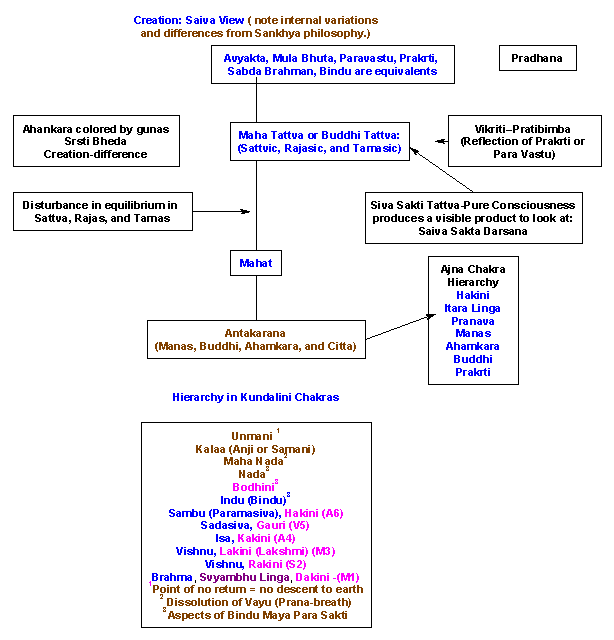
Mahat
Mahat
is the Great principle and results in buddhi, from which develops
ahankāra, I-ness or individuation. Mahat and buddhi are the cosmic and
individual counterparts of intellect. Sixteen entities such as five faculties
of action, manas (instinctive mind) five faculties of sense, and five tanmatras
namely sound, touch, color, taste, and smell arise from ahankāra (ego).
This pluripotential Prakrti (nature) results in gunas – Sattva, Rajas, and
Tamas. These three constituents of gunas are inseparable and form a complex –
Sattva-Rajas-Tamas complex, which is inert, if it is in equilibrium. Only one
of the three constituents is dominant in a person or entity. Sattva is
knowledge, intellect, light, and balanced emotion; Rajas is the motor behind
Sattva and Tamas; Tamas is darkness, passivity, or negativity. Without Rajas,
Sattva, and Tamas are inert; dominance of Rajas naturally means revved-up
emotions. These three gunas, complex or the strands condition the manifest
world, both animate and inanimate; the force behind this complex or strands is
excitatory Purusa, which agitates these strands or gunas and causes
disequilibrium and subsequently diversity and polymorphism. Bhagavatam
(3.10.14) states that God created the first product Mahat by causing
disturbance in the equilibrium of the gunas.
Ahankāra, the second product, is subject to Sattva, Rajas, and Tamas: The Sattvika ahankāra gives rise to the mind and the presiding deities of the senses; the Rajasic ahankāra gives rise to the sensory and motor organs; the Tamasika ahankāra gives rise to the subtle elements like sound, touch, color and vision, taste, and odor.
The sensory and motor organs are called Jnanedriyani and Karmendriyani. (Jnana +Indriyani = perception organs. Karma + Indriyani = action (motor) organs.) Organs of perception are eyes, ears, nose, tongue, and skin. Motor organs are larynx, hands, feet, anus and genitals and their functions are speech, grasp, locomotion, evacuation and reproduction. Citta, the command and control center or inner organ (antahkarana), presides over the vital functions of the universe of the body. These vital functions go by the generic name Prana which consists of five parts: Prana, Samana, Apana, Udana, and Vyana. Please refer to the commentary on verse, BG10.9 for more details on Vital breaths. Here breath does not exclusively mean physiological respiration. Implicit in the terms is the fact that all the organs to work optimally need breathing of air (prana) by the lungs.
The subtle elements proceed in their formation in a cascade fashion starting with sound, which gives rise to ether. The elements combine under the enzymatic action of Time, Maya, Jiva, and the glance of the Lord. Ether, treated with these enzymes, becomes touch, which transforms to air; the air and ether combine in the presence of enzymes to become color; from color evolves fire; fire and air combine to produce water, whose special quality is taste; water and fire combine to form earth, whose special quality is odor. Source: Bhagavatam 3.5.27-37.
The
elements starting with Ether going forward in their combinations and permutations
sequentially and progressively pick up qualities of the previous elements and
display their own special qualities. Bhagavatam 3.5.36
Table:
| Element(s) | Resulting Product | Cumulative & Special quality |
| Sound | Ether (all-pervasive, one quality) | Sound |
| Ether | Air (two qualities) | Sound and Touch |
| Air and Ether | Fire (three qualities) | Sound, Touch, and color/form |
| Air and Fire | Water (four qualities) | Sound, Touch, Color, and Taste |
| Water and Fire | Earth (five qualities) | Sound, Touch, Color, taste and odor. |
As I said earlier, the elements need four factors for transformation and they are Time, Maya, Jīva, and the glance of the Lord; time connotes change; Maya is illusion plus distraction; Jīva is the life force; the most critical deciding factor in the combinations, permutations, and transformations is the glance of the Lord. Maya is the cause of the universe, which, in its female form, derives its energy and support from the Lord. Avyakta (the Unmanifest) is the father of Maya.
According Saiva Siddhanta and its main proponent Tirumular, Sakti is the mother of Maya. Space, air, fire, water, and earth were born of Maya in succession. From Maya came the subtle elements Tanmatras, from which the gross elements were born.
Let
us take cloning as an example: The biologists have mastered the physical art of
cloning. The product is not as perfect as nature because the main factor –
glance of the Lord – is lacking.
In
the following diagram, the concept of Sūtra, not found in Sankhya system,
is a contribution of Bhagavata purana. Sūtra means thread or aphoristic
rule. Sutra is the functional counterpart of Mahat, the Cosmic Intelligence.
Both work together --Intelligence and function—to evolve Ahankara. Sutra is
subtler than Mahat.

Karmendriyas are motor functions: Speech, grasp, locomotion, evacuation, and generation, served by voice box, hands, feet, rectum and genitals. The five senses (Jnanendriyas) are vision, hearing, smelling, tasting, and touching, served by the eyes, the ears, the nose, the tongue, and the skin.
Sarasvati, Savitri and Gayatri preside over the gunas, Sattva,
Rajas and Tamas respectively.
Matter consists of four (individual and) cumulative stages 1: Matter (Anna) 2: Life (Prāna) 3: Mind (Manas) and 4: Intelligence (Jnāna). Bliss (Ānanda) is the spiritual ingredient. These are Kosas – sheaths: The four sheaths, layer on layer veil the Self. Self stands alone when the kosas fall; Self is King and likes his nakedness without all these sticky layers or Kosas. Self is self-supporting and Self is Bliss. Self is the light of Purusa's consciousness by which we become aware of the insentient Prakrti (nature) and its gunas (modes). The anandaMaya kosa or the Body of Bliss or Pure Consciousness or the Absolute is Self itself, and is a chronicler and a repository of karma of this and past lives. Self is the companion of jivatma – the individual self and the Greater Self in the spiritual heart are like the two birds on a tree. The Self by itself is bliss, but man needs realization to find the light that is bliss. Man has four cumulative features but does not reach his inherent potential that is bliss, illumined Consciousness, if he does not strive for it. Stage one is inanimate, and the cumulative state of all five elements is bliss. As you see, matter becomes finer from one stage to the next. Here is an illustration of evolution, the lower Prakrti goes through. When man strives for and gains perfection, he receives Ananda (Bliss); God according to the Vedas is Sat-Chit-Ananda– Satchidananda– Being, Consciousness, and Bliss.
Kosas and their origin
| Entity | Annamaya Kosa | Pranamaya Kosa | Manomaya Kosa | Vijnanamaya Kosa | Anandamaya Kosa |
| Sheaths | Food Sheath | Vital Air Sheath & Ether |
Mind Sheath | Knowledge Sheath | Bliss Sheath |
| Origin | Earth, Water and Fire. Lower three Chakras | Anahata and Visuddha Chakras | Ajna Chakra | Nada and Bindu Chakras | Sahasrara Chakra |
| Saiva View | Brahma shines in Food Sheath. | Vishnu shines in Breath Sheath. |
Rudra shines in the Mind Sheath. |
Mahesa shines in the sheath of Consciousness. | Sadasiva shines in the sheath of Bliss. |
| Saiva view is expressed by a real-life sage-poet by name Umapati Sivacharya (around 1300 A.D.) in Chidambaram, Tamil Nadu. | |||||
Bhrgu Muni practicing Raja Yoga (Kundalini yoga) discovered the sheaths or Kosas of the body. Annamaya Kosa takes its origin from Earth, Water, and Fire which are present in Muladhara, Svadisthana, and Manipura centers. Earth (minerals), water and Fire (heat) are the basic elements of our body. Pranamaya Kosa (Vital Air Sheath, five in number) and Ether take their origin from Anahata and Visuddha Chakras respectively. The mind or mental sheath originates from Ajna Chakra, which is the seat of Nada and Bindu, which give rise to Vijnanamaya Kosa. Primordial Prakrti in its undifferentiated form is Anadamaya Kosa.
According
to Joseph Campbell, bliss is never to say that you did not follow your bliss
and that you did not do what you wanted to do. He talks about the hub at the
center and the rim of the wheel. A person at the hub is serene and the one
riding on the rim gets the dizzying experience of duality of pain and pleasure,
love and hate. He adds that one should go where his body and soul take him. It
is not the wealth or the prestige (body-mind-ego complex) that he seeks or
recommends. You are the soul and not the body. Why does this soul wrap itself
with the body or these kosas? Swami Vivekananda says: “For the same reason that
I take a looking glass: to see myself. Thus in the body, the soul is reflected.”
Joseph Campbell puts it in another way (paraphrase): when one gains
transcendence (or the Brahman), one dies to his flesh and is born into his
spirit. The body is a vehicle.
Panchadasi puts forward the following theory with regards to Brahman, Jiva, and Prakrti. Prakrti is not a product of Brahman; it is not a palpable real entity separate from Brahman. It represents the Will (Iccha) of Brahman to create and this Will becomes (transforms into) the three gunas: Sattva, Rajas and Tamas which gel into material. When Prakrti is sattvic, it is called Maya; when it is dominated by Rajas and Tamas, it is called Avidya (nescience). Maya is the mirror that reflects Brahman; the reflected image of Brahman is called Isvara who controls Maya. It is like the lady who carries the mirror in her purse. The lady is Brahman, the mirror is maya and the lady's image in the mirror is Isvara. Sat Chit: Sat (Being) is Consciousness (Chit) and exercises its Will to create; therefore, it is Being, possessing and controlling maya, and becoming matter through the gunas. On the other hand, Brahman is the subject; Avidya is the water-mirror; and Jiva is the inverted reflection of Isvara in water. What does it mean? Isvara' head is at a high point and man's head in the water-mirror is at the low point. Isvara's consciousness is Pure Consciousness at the high point, while Jiva's consciousness is at the low point; there is a wide chasm between these two entities. Man, as said before, is governed by ignorance (avidya), meaning that he identifies himself with the body and not with the soul (self) which is organically connected and related to Isvara. This ignorance is both veiling and projecting (Avarana and Vikshepa). This ignorance veils Sat and Cit (Being and Consciousness) of Brahman and projects the phenomenal world by Vikshepa. Vikshepa: power of ignorance that causes the world seem real. This projection is mediated by Tanmatras: Principles of Sound, touch, vision and color, taste and smell, which are pervaded by qualities Sattva, Rajas and Tamas. The Sattva of Sound becomes the sense of hearing; that of touch, the sense of touch and so on. These in combination form an entity called Antakarana or inner organ which have four aspects: Manas, Buddhi, Ahankara and Chitta (citta). These were discussed above. The Rajas-dominated sound, touch, vision (color and form), taste, and smell become the respective motor organs.
| Sattva of Sound becomes hearing. | Sattva of touch becomes touch. | Sattva of vision or form becomes sight. | Sattva of taste becomes taste. | Sattva of smell becomes smell. |
| Antakarana: | ||||
| Rajas of Sound becomes larynx. | Rajas of touch becomes hand. | Rajas of vision or form becomes feet. | Rajas of taste becomes genitals. | Rajas of smell becomes rectum and anus. |
|
Quintuplication of elements (Panchikarana) |
||||
| Tamas of Sound becomes ether. | Tamas of touch becomes air. | Tamas of vision or form becomes fire. | Tamas of taste becomes water. | Tamas of smell becomes earth. |
Go to BG Chapter 13 The Knower, the Field, the Nature for more details contained in commentary under Verse 13.06 Table. Panchadasi says that these composite elements formed the Cosmic Egg (Brahma Anda) from which the universe came into being.
Jiva takes on the qualities of Sattva, Rajas and Tamas. Jiva's body is Avidya while Isvara's body is Maya. Subtle and gross bodies of Jiva come out of Avidya causal body. Lord's will (Ichha) is Maya Sarira (body) and the creator of the world. Here the term "body" does not mean a palpable body with head, trunk and limbs, in the same sense that a "body of knowledge" does not walk on feet. Isvara's Maya Body is creative (of the universe) while Jiva (man's individual soul) is the causal body, creative in its own limited sense because it gives rise to subtle and gross body--Suksma and Sthula Sarira). Jiva's causal body (Karana Sarira) is pervaded by Avidya (ignorance) of its true nature that it is part of Brahman; it is temporary amnesia (loss of memory or forgetfulness). Its amnesic state, Jiva is not contaminated with Vikshepa until it takes on the gross body with head, trunk and limbs. Jiva without Vikshepa is closer to Isvara (Supreme Consciousness and Supreme Knowlege) than the Sthula Sarira (gross body). Though it forgets its true nature, the causal body is closer to Isvara than the gross body; therefore, it has supreme knowledge within ignorance (Prajna within Praajna--knowledge within ignorance).
Let me mention about Tantric view, which is cognate with some aspects of Samkhya philosophy. Mahanirvana Tantra says the following as a dialogue between Sadasiva (Siva) and Devi (Sakti). Sadasiva eulogies Devi. You are Sive (Devi, the counterpart of Siva); you are Mula Prakriti; You created everything in this universe; You are Isvari, the controller; You are the the Great Mother Goddess, the origin of Brahma, Vishnu and Siva. You now the essence of all Tattvas (building blocks) of the entire universe, but no one know your nature. You are the gods and goddesses of the universe; you are Kali, Bhairavi, Mahalakshmi, Devi of speech and Annapurna. You are Sakti; you are subtle, gross, unmanifest, and manifest; you are formless and with form.
Saivaites say that the universe and beings are made of 36 Tattvas, which take their origin from Siva-Sakti.
Saktas (monistic worshippers of Devi, Mother Goddess) are firmly entrenched in their view which conflicts with Samkhya philosophy. Samkhya declares Prakrti as an unconscious element. Saktas declare that Devi has two aspects
2.13: As the soul
passes from childhood to youth to old age in a body, so also the soul takes
another body. This does not confuse a sage (brave and composed person).
Dēhina: Embodied
soul or jivātma. Dēhē: body. Kaumāra: childhood, age one to
five)
The
embodied atman passes from one body, be it animal or human being, to another
body, but the character of the owner of the body does not affect the atman or
the individual soul. The atman is free from death, decay or contamination. It
is like a diamond in the dirt and a pebble in the water. The character of body
that contains the atman does not affect its luster. Atman (soul) but not body
is permanent.
2.14: O son of Kunti
(Arjuna), as cold and heat, happiness and unhappiness are sensory perceptions,
appearing, disappearing and impermanent. Learn to endure them, O Bharata
(Arjuna).
When
the body, mind and ego interact, perceptions of dualities, such as pleasure and
pain, love and hate are dominant. These dualities cause vibrations on the
Body-Mind-Ego complex and are temporary during its existence. When the mind
separates from the body and the ego, and turns inward, composure, tranquillity,
transcendence, and certitude free from dualities get you close to your self and
therefore close to Brahman.
2.15: He, who suffers
no distress from this, O best of men, and stays even in sorrow and happiness,
is a sage and fit for nectar of eternity or liberation.
He, in whom dualities
cause no distress, O best of men, and who stays even in sorrow and happiness,
is a sage and fit for nectar of eternity or liberation.
2.16: In the
nonexistent (Asatah), there is no continuance (Bhāva), and in the existent
(Satah), there is no cessation (Abhāva). In the two, the seers saw the
truth and came to that conclusion.
In
the Unreal (Asatah) continuance is absent, and in the Real (Satah), there is
eternity (no end).
In
the Being (Sat), the Truth is existent and self itself. The self is real, the
body is unreal, and the self is embodied. The I-factor, heavily influenced by
avidya – ignorance – prevents us, from accepting the self as real and the body
as unreal. The self, being real, is eternal.
2.17: Know that which
pervades all, is indestructible and immutable by anyone.
The
self, emanating from Brahman (chip off the Old Block as it were), is
all-pervasive. Let me present to you the monistic theory of Atman or the
Absolute.
What
is that force that moves and animates the body? Body is not self-created. This
force must be a common denominator for all sentient beings. According to
Advaita philosophy even insentient objects have a force in them. This force
must be beyond the mind, body and matter, because it is still a mover or a
force or a bright light even after the mind and body are gone. Atman is that
all-pervasive force that remains after the body falls. It has to be
infinitesimal to be all-pervasive; it is what remains after you chop a fig seed
to its ultimate infinitesimal size. You cannot see it but you know it is there;
It has no shape and therefore no name; the ultimate infinitesimal, the one
without form or name, if it is conceivable, is within the fig seed. It is like
the salt in the water: You know it is there, but you do not see it. It is
all-pervasive like the all-pervasive salt in the saltwater. You have an Atman
and I have an Atman. How could that be possible if Atman is only One? Each one
of us is like a pot holding one’s individual space inside. When the pot breaks,
the space is still there. The Real (space) is Atman and the seeming (space) is
limit of the Real as in a pot. The space is unbound and bound at the same time:
The Real is unbound and the apparent has bounds. That is the difference between
the Real and the apparent man. The phenomenal world is an apparent product of
the Absolute by intermediation of time, space and causation. Since Atman has no
form and is beyond mind, it cannot be under the control of time, space and
causation.
Since
it is infinite and there can be only one infinite, infinite cannot have a
beginning or end, birth or death; and that infinite is Atman. Since the
infinite is only one and all-pervasive, Atman pervades the sentient and the
insentient, the whole universe. The phenomenal world and superimposition: This
phenomenal world rises and falls like the waves in the ocean. The wave has the
time, space and causation elements incorporated or expressed in them during the
wave. In addition, there are many waves; and therefore, there are many forms
and many names. Since the waves rise and fall into the ocean, the waves have a finite
existence. How can there be finite elements in the Infinite or the Absolute? As
the waves rise and fall (superimposition) on the ocean surface, transient
elements rise and fall on the Absolute. That is an illusion and
superimposition. Now it is there; and now it is not there, as the waves rise
and fall: It is Maya (illusion). The Time, Space, and causation elements are
translucent elements between the Upper Absolute and the lower universe. The
lower universe is a superimposition on the Absolute seen through time, space,
and causation. The allegory of a snake and a rope explains this
superimposition. In the dark, we see a snake in a rope; the rope is real and
the snake is a superimposition and unreal. When ignorance dissipates on closer
inspection, the real asserts itself. In the same manner, the phenomenal world
(the snake) superimposes on the absolute (the rope). Once ignorance dissipates,
realization sets in. That is how Maya manipulates the phenomenal world. The
snake depends on the rope, as the world depends on Brahman; if there is no
rope, there is no snake; if there is no Brahman, there is no phenomenal world.
The world is both real and unreal at the same time. The world is
Brahman-dependent, as the snake is rope-dependent. The world and the snake by
themselves (their intrinsic merit) are not real and non-existent; they are real
if considered in the context of primary essential Brahman and the primary
essential rope. Isvara has control over Maya whose effect is on the mind. Since
there is only one Absolute pervading the whole world, there is no second: The
Absolute or the Atman and the manifested universe are one giant organism. There
is no individuality: Individuality is apparent only because of the mind; if
there is no mind, there is no perception of individuality. If you look beyond
time and space, the Absolute is One who is real, immutable, all-pervasive; that
is Advaitism or Monism of Sankara. We are all part of that oneness. Vivekananda
says: “I am in everything, in everybody. I am in all lives and I am the
universe.”
How
could you say that Atman pervades everything in the universe, both sentient and
insentient? You cannot compare a tree or an animal to a man. Yes, you can.
Sentience is same in all. Only the extent of its manifestation varies.
Sentience manifests the most in man and the least in the insentient or the
inanimate and somewhere between from the plants to animals. Since there is only
a difference in the (expression) degree of sentience between animal and man,
how could one kill an animal for whatever purpose? That is the basis of Ahimsa
or noninjury.
2.18: The material
bodies are perishable, but the (embodied) souls are never destroyed and beyond
comprehension. Therefore, fight O Bharata (Arjuna).
The
bodies (encasing the imperishable, incomprehensible, and eternal individual
souls) are perishable. Therefore, O Arjuna, fight.
That,
which emanates from Self, pervades all living beings. They (self Vs self) are
separate but equal. Here the self is the individual self. It is existing,
unseen, unknown, and incomprehensible. During dreamless sleep, the body does
not exist as it were, but only the self is existing and awake, and shines as
the disembodied being, according to Ramana Maharishi.
2.19: Anyone who knows
this (atman or soul) as the killer, and thinks that this is killed, knows not
in his knowledge that this soul neither kills nor is killed.
He, who thinks he
knows this (atman or soul) as the killer, and thinks that this soul dies in the
hands of another soul, does not have the knowledge of the self. The soul
neither kills another soul nor dies in the hands of another soul.
As
there is Atman or Self, there is “not-Self” (anatman); according to Samkhya,
anything that is not Atman is anatman. To put it simply, not-Self is anything
other than atman except Brahman or Paramatman; anatman consists of body, sense organs, and their functions,
sense objects, mind, breath, ego, thoughts, emotions, and Maya – life itself.
Discussion of Maya appears later.
2.20: This (atman or
soul) is neither born, nor dead, nor having come to be, will it cease to be at
any time. This atman is unborn, eternal, timeless, everlasting, and primeval;
it is not killed when the body is slain.
Since
atman is the chip off the Old Block, which is “Self” (Atman, Paramatman,
Brahman, Superconsciousness or Purusa), it has the qualities, mentioned in
Verse 2.20. The atman is only a chip and not the whole and so it does not share
the highest qualities of the “Self.” The atman remains in the heart, not the
anatomical heart, but the spiritual heart, which exists on the right side of
the front of chest cavity. Man has two souls: Parmatman and jivātman.
Jivātman is the individual soul that falsely identifies itself with the
body; Paramatman is the universal immortal Self. This jivātman and
Paramatman are like the two companion birds on a tree. The jiva bird is eating
the sweet fruits, while Paramatman is watching and witnessing, and taking notes
without eating, contented, great, and free from sorrow. The jiva bird, once it
finishes eating the fruits on one tree, goes to the next tree. The tree here
represents the body and the bird represents the jivatma. Here eating means the
jiva identifies itself with the body, the body-mind-senses complex experiencing
pleasure and pain, and other life experiences. The transmigrating
jivātman, one among many, is susceptible to rebirth, while all-pervasive
Paramatman, free from Vasanas, Samskaras (impressions from past life), Karma
and transmigration, is One (Paramatman), but appears as many. Karma is the
cause of transmigration of the individual soul. Discussion of Karma will appear
elsewhere. Note: Read the detailed story
of the birds in the Supplement section:
See Supplement
< Go to Two Birds in One>
2.21: How can a human
being (Purusha), who knows that this (atman) is indestructible
(Avināsinam), eternal (nityam), immutable (Avyayan), and unborn (ajam), O
Partha (Arjuna), think that he could kill or cause anyone to kill?
Since
Purusa is uncreated, atman also is uncreated or unborn. That which is uncreated
or unborn cannot be slain. It is like saying, “You are not the body but the
jivātman and Parmatman, which can never be slain, when the body is slain.”
Here, Arjuna is fulfilling his duty as Ksatrya, by killing his enemies. Death
is justifiable in battlefield.
2.22: As a person (
Atman changes body as a person
changes garment. Each one of us has five sheaths, according to
Vivekachoodamani: The food sheath, the vital-air sheath, the mental sheath, the
intellectual sheath, and the bliss sheath. Another classification bundles these
sheaths differently. The physical body (Sthula or Annamaya Sarira) is food
sheath or layer. The astral or subtle body (Suksma Sarira) consists of many
sheaths namely vital air sheath (Prāna), mental, and
intellectual-instinctive sheaths–buddhi, ahankāra, manas, indriyāni,
and tanmātrāni. The causal body (Kārana Sarira) is the most
important and the innermost sheath consisting of the soul as light, which has a
record of all karmas of present and past lives and Bliss. When someone dies,
the physical body goes to the elements that nourished the physical body; the
vital air sheath dissipates, leaving the intellectual-instinctive and mental
sheath with the karmic sheath, the soul-light, and Bliss intact. Brhad-aranyaka
UP: 3.2.13: According to Yajnavalkya, on death, the speech of a dead person
goes into the fire, the breath into the air, the eyes into the sun, the mind
into the moon, the hearing into the space, the body into the earth, the self
into the ākāsam (ether), the hairs of the body into the bushes, the
hairs of the head into the trees, and the blood and the seed go into the
waters. The message is the body parts come home to their respective cosmic
counterparts. Karma, Dharma, and the functions of the respective organs
including that of the mind are the companions of the soul, when the kosas drop
and go to their gross or subtle source. Please read the commentary section of
verse 40 for details.
The
Lingasarira or Kāranasarira (causal body) takes with it not only the
soul-light and karma, but also the primary prāna, the senses, the manas,
avidya, a suitcase of experiences, purvajnāna, vidyā (knowledge), and
other vāsanās and samskaras. Purvajnāna is wisdom of past lives;
Vāsanā is fragrance from past karmas and impressions that cling to
the subtle body from birth to birth. At the time of creation, Lingasarira takes
its birth from Sattvika Mahat and is presided over by ksetrajana, which is
jiva-ksetrajna in beings and Supreme ksetrajna in the Lord, having control over
the respective ksetras. The Supreme Ksetrajna presides over all jiva-ksetrajnas
and the universe, while each jiva-ksetrajana presides over its respective body.
It is the light of life for we work, eat, sleep, and wake up again because of its
presence.
The
soul-light encased with the rest of the layers is ready for rebirth according
to the karmic compulsions. This karmic connection determines “the heredity,
ancestry, and environment”, the phrase used by Radhakrishnan.
The
soul is distinct from the body; they do not go together from one birth to the
next. The transmigration of the soul does not support Mendelian laws but
adheres to Karmic laws.
A
soul shall not come to reside in a son or grandson. --Bhagavatha Purana, 12.5.3.
The
soul’s origin is Brahman, while the body’s origin is matter. The laws for each
entity are different, but Isvara (Brahman) has control over both.
2.23: The weapons
cannot cut the self, the fire cannot burn it, the water cannot wet it, and the
wind cannot dry it.
Upanishads
looks at Atman in a perspective of exclusion: It is not this; it is not that
(neti, neti). The first Neti excludes Maya and the second Neti excludes the
products of Maya (Prakrti), matter and beings with names and forms; thus, what
stands alone after those exclusions is Atman. It is not susceptible to seizure and destruction. It is
irrevocably independent (unattached); no one can injure it; and it does not
tremble. Earth, water, light, ether, and air, the inanimate ingredients forming
the body need consciousness to animate it, which at universal level is Atman
(Paramātman or Supreme Soul) and at individual level is atman or
individual soul.
There
are many individual souls, many bodies, and many experiences; therefore, all
souls are immutable, irreducible, and atomic, and dependent on a controlling
authority: Brahman or God.
2.24: This (atman) is
unbreakable, fireproof, waterproof, besides without doubt drought-proof,
eternal, all-pervading, stable and immovable; it is everlasting
(sanātanah).
He is stable and immovable. There is stillness and movement. Just like the river that runs deep, there is stillness on the surface and movement deep in the river. It is like the earth, which moves, rotates and goes around the sun, yet there is no movement perceived by us.
2.25: This (atman) is
unmanifest (avyaktah), inconceivable (acintyah), and unchanging
(avikāryah). Knowing this, you should not grieve.
This
Superconsciousness or this Purusa is unmanifest and immutable, has no form and
no name, and is timeless: Time is in it. The bodies come and go, names come and
go, forms come and go, but atman or soul remains the same.
2.26: Even if you
think that this atman is continuously born, and continuously dies, O
mighty-armed (Mahābhāho), you should not grieve.
It is
not proper to grieve, even if you think the atman rides the perpetual cycle of
births and deaths.
Mahābhāho
refers to Arjuna here and means mighty-armed or long-armed one.
The
individual self (jivātman) is susceptible to rebirth in a body, be it an
animal or man. The jivātman goes through this cycle of birth and rebirth
based on ignorance and karma. Jivātman by itself has a life of its own; it
goes through bodies as in reincarnation or can achieve moksa and arrive at
Brahman.
2.27: For one who is
born, death is a certainty. For one who dies, birth is a certainty. It is not
proper that you grieve over something that is not a matter for prevention.
Cycle
of births and deaths is the drama and karma of life. The embodied souls are
like passengers on the bus and at the bus stops: some get on the bus, some get
off the bus, some go to the destination, but everyone has to get off the bus at
some time. Do we rejoice when they get on the bus and sink into depression when
they get off the bus? No. Karmic compulsions keep the cycle of births and
rebirths in motion. Wrongful death is not the subject of discussion here.
Garuda
Purana (1.113.48-52) states that karma brings killer and victim together. Man
receives what he is destined to receive. Karma takes him against his will to
places where he has to go. Flowers and fruits come into season at their
appointed time, so is the bane or boon of karma. Karma seeks and finds the doer
just like a calf finds its mother in the melee of a thousand cows. Your actions
follow you doggedly in this life and hereafter, for better or worse.
2.28: All living
beings are unmanifest before birth, manifest in the middle, and unmanifest
again after death. Therefore, O Bharata, where is the need for
(paridēvana) lamentation?
Until
the individual soul gets a body, there is no obvious or visual presence of a
soul in man or animal. So it is manifest in the middle and not so at the
beginning or the end.
2.29: Some see IT
(Atman) as astonishing, moreover some speak of IT as marvelous, and another
hears of IT as wonderful. Having heard of IT, no one yet knows what IT is.
Āscarya-vat:
Astonishing, marvelous, wonderful. Enam: IT (that, he, she.)
Brahman
as a subject is It or That and never He. Brahman is unknowable, inscrutable,
and unseen. Those who declare that they understand “IT” do not. However, those
who say they do not understand “IT,” understand “IT.” That is the riddle and
the paradox of its inscrutability. IT is the thought in your mind, the
voice in your speech, the movement of air in your breath, and the sight in you
eye. However, your mind knows IT not. Kena Upanishad states, “Your speech goes
not, and your eyes see not.” How could anybody say what IT is? Atman also is
beyond human reason, intelligence, and understanding. It is the knower and the
knowledge, but unknown (to us). No one knows what Atman is: The yogis with an
inkling are not talking much–mauna! Mauna or silence is its message. Since it
is beyond human understanding, it is not possible for a yogi, who experienced
Atman or Brahman, to explain IT to us. That is where the mauna comes in.
However,
Ramakrishna Paramahamsa had experienced Brahman many times and offered his
insight: Brahman performs magic shows, Brahman’s conjuring deludes the
audience, Brahman is Real, Brahman’s magic show is unreal, and Brahman’s world
is illusory.
He
elaborates further: One sees a shaft of light, one feels joy, one experiences
upsurge of immense current in one’s chest, and one sees another person (Brahman
or the Self) within him. This tells us the Greater Self and the individual self
reside in the spiritual heart in the right side of the chest in the form of
light.

Ramakrishna paramahamsa
Atman: Wonder beyond comprehension. Self-realization
is a hard and difficult path.
2.30: This atman,
residing in the bodies of all living beings, is eternal and cannot be slain.
Therefore, O Bharata, it is not proper that you grieve over (all) living beings.
Sarvāni
Bhūtani: All living beings. Socitum: to grieve.
Man
is self and “not-self.” The self is eternal and immortal, and the “not-self” is
the body, which is mortal. This mortal body is only a casing or a box or a container
for the self. What is more important, the container or the content? If the
content is more important and the casing is replaceable, why worry about the
casing or the body? The body or the casing is important to the extent that it
embodies the soul until death; that impermanence of the body is reason enough
not to lament over its departure. Arjuna, the warrior, has to worry less over
the death of the impermanent body and concentrate more on his dharma on the
battlefield and the permanence of the soul.
2.31: When you view
this from the perspective of your inherent dharma, in this case the duty
inherent to a Ksatriya, you should not tremble in fear. There is no greater
duty for a Ksatriya than a fight in battle.
A
duty-bound Ksatriya has to engage, kill and defeat his enemies. That is his
duty and his ticket to heaven. Anything other than that is humiliation for a
Ksatriya.
Dharma:
duty.
2.32: It happens on
its own accord the battle comes unsolicited to a happy Ksatriya in the form of
gateway to heaven, O Partha.
Happy
are the Ksatriyas, to whom war comes unsolicited in the form of a wide-open
gateway to heaven, O Partha (Arjuna).
Kurusetra war came to Arjuna, his brothers and
their allies unsolicited. There is no greater honor, duty or expectation than
for the Ksatriya to fight his battle to the end, win or lose, rise or fall,
live or die.
2.33: If you do not
prosecute this war according to your dharma, you will lose your inherent dharma
and fame, and incur sin.
A
Ksatriya's inherent, god-given duty is what his birth
BG: 2.42-43 for
details on karma.
2.34: Besides, people
will forever spread tales of your infamy. For a man enjoying tributes, infamy
is worse than death.
2.35: The great
Chariot-warriors, who held you in high esteem so far, would think low of you
and say that you backtracked from the battlefield out of fear.
2.36: Your enemies
will utter many unspeakable words and prevarication, while disparaging your
ability (Sāmarthyam). Is there any sorrow worse than that?
2.37: If you die you will go to heaven. If you conquer,
you will enjoy this world. Therefore, O Kaunteya, firmly resolved on war
(yuddhāya krta-niscayah), get up.
Kaunteya
means “son of Kunti.”
2.38: Holding
happiness and sorrow, profit and loss, victory and defeat alike, you will
prepare to fight for the sake of fighting. By doing this, you will incur no sin.
One's
emotions, considered outcomes in battle, or the resulting earthly gains or
losses should not deter a Ksatriya from doing his duty.
2.39: I revealed to
you this enlightened wisdom of Samkhya. Now hear thou the wisdom of yoga. With
your intuitive intelligence (buddhya), O Partha, you will be able free yourself
from the bondage of action (Karma).
This enlightened
wisdom of Samkhya comes from Me (the Lord). Now hear thou the wisdom of yoga.
With your intuitive intelligence, O Partha, you will be able free yourself from
the bondage of action (Karma).
Discussion
of Samkhya’s Purusa, and Prakrti, self and “not-self” occurs earlier. The
burden of proof that Purusa is indestructible and the external events in this
world have no effect on Purusa is under discussion here. How and when does
Arjuna come to realize this? The intellectual-instinctive-mental faculty is a
derivative of Prakrti; Buddhi or intuitive intelligence is part of this
faculty; but this Buddhi is not the ordinary or the creative intelligence seen
in arts and sciences.
Buddhi
helps you come to conclusions; manas flies on the wings of doubt; ahankara
burdens you with pride; citta helps you remember.
The
body is the chariot and the atman is riding on the chariot; Buddhi – intuitive
intelligence– is the chariot driver; the mind is the reins and the senses are
the horses. Buddhi, the chariot driver, controls the mind, ahankāra (ego),
and the senses. Control of the mind and senses is a precondition for
understanding self. Accomplished buddhi by its nature and training is
discriminating, restrained, calm, contented and forgiving, unless there are
some dominant vitiating factors such as senses. These characteristics weigh
heavily, when buddhi discriminates between purusa and Prakrti and consequently
liberation is attainable. In other words, the I-factor or I-ness or ego, the
mind, and Indriyas – sense organs – must come under the influence of
enlightened buddhi. When it happens, the ever-luminous light of self or atman
imparts its light and glow to buddhi. Now buddhi and atman are in unison,
leading to a union between these two principles. Discussion of Karma occurs
elsewhere.
2.40: In this path
(karma yoga path), loss and adverse effects are unknown. Even a meager pursuit
of this dharma saves (the practitioner) from the great fear (of birth and
death).
Karma,
performed without expecting fruits, is cumulative: the merit does not diminish
and never loses its value. Performing ordained duty of Ksatriya guarantees
against the fear of rebirth. The Great Fear here refers to the fear of rebirth;
the opposite of the Great Fear is The Great Freedom or Liberation or Moksa and
perpetual service to God in the other world without the fear of rebirth in this
world. Every little bit counts, when a man performs his righteous duty and
amasses merit, which takes him a little closer to his goal, namely liberation.
Let
me give you some information on the cumulative usefulness of endeavor in the
pursuit of Brahman and attainment of moksa after many births. Brahma Sutra
4.2.1: According to scriptures, the function of speech at death merges into the
mind; the mind merges into vital breath or life; life merges into the
individual soul; this soul-life entity merges into the functions of gross
elements (ether, air, fire, water, and earth): All these said entities make up
the subtle body with a load of karma. (The subtle body is
composed of the so-called "17": Buddhi1 inclusive of
Ahamkara, Manas2 (mind), the ten senses12 (Indriyas) and
the five Tanmatras.17 Mayavadins
have put the five Pranas in the place of Tanmatras. There may be other
variations.)
Explanation:
When
a person dies, the body dies and what remains are the functions of all organs,
the mind, and the prānas. These undying remnants, called soul-life entity
have a few destinations: It can go to Brahman permanently, if it does not have
a karmic load on it; or it can enjoy a certain period of respite in various
nontemporal worlds according to the weight, nature and quality of its karmic
load. The functions of all organs including the mind of this soul-life entity
of the dead remain intact in the subtle body’s memory (Vāsanās or
fragrance with samskara or impressions). According to its karmic load, subtle
body will find a home in a physical body with relevance to “ancestry, heredity,
and environment.”
Jung says: "our idea of heredity would be similar to the idea of Samskara, as well as our hypothesis of the collective unconscious."
The
benefits from meditation, contemplation, and religious study collect in the
repository of soul-life entity over many births until liberation: They do not
go to waste; the mind as a function remains intact over many births.
If you look around,
you will see people who excel in various fields of endeavor. It is not a stroke
of luck, but earned during this and previous lives; it is true of yogis,
scientists and every person on this earth.
2.41: (In this world),
O beloved joy of Kurus – Arjuna, only in the resolute, the intelligence is
focused, while in the irresolute, the intelligence is many-branched – unfocused
and endless.
O
beloved joy of the Kurus, (in the path of karma yoga) resolute intelligence
prevails. The irresolute intelligence is many-branched and unending. (2.41)
Bahu+sākhā:
many-branched. Distraction is the natural state of an untrained and irresolute
buddhi.
Buddhi
needs training and cultivation so it meets its expectation or goal; an
irresolute buddhi lets the mind go in many directions and keeps it unfocused:
There is no end to wandering of the mind. In such a case, the buddhi is not in
control of the mind and senses. If buddhi does not reflect the light of the
soul, it remains in avidya or ignorance (darkness). Resolute buddhi filters out
Rajas and Tamas (passion and ignorance) to project a sattvic character;
therefore, the resolute concentrates mainly on liberation. In the irresolute,
that focus on liberation (Moksa) is absent; he concentrates on rituals to earn
material benefits such as money, better job, better vahana (vehicle), a son, a
palatial house. The irresolute go for such secondary fruits and miss the
primary fruit of liberation, and that is why this unfocused intelligence is
many-branched.
2.42-43: The ignoramuses
immerse (themselves) in earthly pleasures, think of heaven as (their) supreme
goal, and argue there is nothing else (worth pursuing). They indulge in Vedic
sophism, play on words, and utter flowery speech, which recommend many kinds of
Vedic rites to gain opulence, which only results in karma and rebirth.
Veda-Vāda-ratāh: Vedic sophism (sophist); shallow sciolism
Veda: Vedas. Vāda: discuss, dispute. Ratāh:
(those who are) devoted or addicted to, Vedic ritualists.
2.44: Such speech
carries away their heart and mind; they are attached to wealth and enjoyment
and do not have the resolute intuitive intelligence focused on God.
With
their desire set on sense satisfaction and their eyes turned towards heaven,
they recommend various special ceremonies to gain enjoyments and opulence,
which result in “fruits” of actions and rebirth. Actions with good merits take
one to prosperity on earth and heaven after death but do not lead him to Moksa
or liberation. Once the term ends in heaven, he returns to earth and the cycle begins
again. Let me explain what action is according to Hindu sacred books. Karman is
action; originally, it meant performance of religious duty. Each action bears
fruit or fruits; action is neutral, good, or bad and so the fruit it bears is
neutral, good, or bad. Neutral action has no consequence, while good and bad
actions bear good and bad fruits respectively. This is Karmaphala
(action-fruit). The action-fruit gives rise to aftereffects (Uttaraphala) which
could be beneficial or harmful. Action that leads to bondage is karma-bandha.
The consequences, called fruits, can happen immediately, later in life, or in
the next birth.
Vedas
give descriptive and prescriptive details on the performance of rituals for
obtaining possessions, sense pleasures, and heaven. The rituals and actions
result in the fruits of karma, which is thought, word, and deed; deed
carries more weight than a thought, unit for unit. Karma is a cumulative and
continuous during one’s lifetime; thus, it reflects the past, the present, and
the real-time; karmas result in the cycle of birth and rebirths. Karmas
resolve in many ways: Some are in storage for resolution as fruits of actions
(consequences, good or bad) in the future births, some resolve in this life,
some undergo resolution in real-time, and some are in storage for the future as
seed karmas. Perfect karma is a zero-sum entity: When a person pares down his
karma to a zero-sum status by engaging in neutral or no acts, the unburdened
atman is ready to merge with Paramatman. Unresolved karma guarantees rebirth
and determines “the ancestry, heredity, and environment.” When bad incidents
happen to good people, bad karma is bearing fruits. When the actions of past
life or lives bear fruit in this life, the resulting consequence is unforeseen
and appears as if an invisible hand is dispensing either reward or punishment;
this power goes under the name, adrishta. Nobody escapes the pleasure, the
pain, and the ravages--the good, the bad, and the ugly--of karma, according to
Hindus.
There
are three basic karmas:
1.
Prārabda Karma (Actively sprouting seed karma)
2.
Āgami Karma (coming, approaching, impending, harvested seed Karma)
3.
Sanchita karma (Storehouse seed karma, the silos)
The
Sanchita or the storehouse seeds (karma) can be roasted, fried, burned
down, or depleted by Grace of God, if He chooses to do that, or by performing
Kundalini yoga under the expert guidance of a Guru or by knowledge of Brahman.
Prārabda karma is
not under our control, it is in resolution, it is in motion, it would not stop,
and it is like the potter's wheel, it spins even after the cessation of the
external force, and it stops once the momentum has spent itself. It is like the
discharged arrow from the bow; the archer has no control over it once the arrow
leaves the bow. Knowledge of Brahman cannot destroy Prārabda Karma. It is
both congenital (inherited from past lives) and acquired; there is no
prevention or cure for this; it is waiting for resolution. However, we do have
control over Āgami Karma, because our thoughts, words, and deeds make it;
and if the actions are Tamasic (black or krishna), “black seeds” accumulate for
sprouting later either in this life or in the next life. If the actions are
sattvic (white or shukla), “white seeds” accumulate for sprouting now or later.
If the actions are of mixed nature (white and black), the seeds are of both
colors (shukla-krishna). If the seeds (actions) are neither white nor black,
they result in sterile seeds (ashukla-akrishna). Rishis, by sterile karma-free
actions, kaivalya, and realization of the Self create the sterile seeds. Some
of the newly harvested Āgami karmic seeds sprout (bear fruits) in this
life, as it is the case with prārabda karma; some seeds that do not sprout
and bear fruits now, go into storage in Sanchita karmic silos. The stored seeds
of Sanchita karma are dormant (anarabhda) and the sprouting seeds of Prarabdha
karma are arabdha (sprouting). SEE Chapter 3 Verse 28 Comments on inflows into
the silos.
Author
expresses his views here on karma: Karma is thought, speech, and deed. A
perfect karma is null karma: a zero-sum entity. In this world, karma is the
only equalizer of all living beings; therefore, you wish you were holding an
empty bag of karma. The fried karmic seeds are healthier and tastier than
germinating seeds or nuts. The fact you are reading this means that your karma
is in the barrel for discharge, resolution, roasting, sprouting or
accumulation. Karma is something you do not wish on your friend or your enemy,
because it can boomerang on you (adrishta) when you least expect it in this
birth or future births: You will never know. Unit for unit thought is one
karmic unit, speech is ten karmic units, and deed is ten to the power of ten
karmic units. This karmic unit can be meritorious or demeritorious (positive or
negative, punyam or papam), or neutral or “sterile.” One's aim is zero karmic
units, because getting moksa is zero-sum game; only in karma, zero karmic units
is better than positive or negative units, because anything other than zero
karmic units guarantees birth, accumulation of Sanchita Karma and sprouting of
Prārabda karma. Isoelectric status or line is better than amplitudes
either way.
Sankaracharya states
that God provides the necessary ingredients for any possible path man chooses.
He provides the rain, the earth, the nutrients, the opportunities and seeds
(karma) and Himself as the constant companion of man; the karma (and dharma) of
men are like the seeds, which will germinate, sprout and grow into their
respective plants under identical soil conditions. God-pleasing thought, speech
and deed would kill or roast or destroy the karmic seeds. Rishis roast the
karmic seeds by the heat produced by Kaivalya.
Actions
in this phenomenal world are the fodder for karma. When life events go wrong,
one should not fall apart, but stay steady in the knowledge that karma is
resolving; your previous karma has put you in circumstances over which you have
no control (adrishta). According to karmic principles, you are self-natal
(self-born), self-controlling, self-sustaining, and self-releasing. You cannot
blame your parents for your birth; they are the womb, the egg, and the seed
(sperm) in physical terms; in karmic terms, your karma chooses the womb, the
egg, and the seed for your body. Everybody else and everything else have a
secondary role in your life; resolution and God-pleasing acts help one gain a
karma-free state: liberation or moksa
<BG
Chapter Three Karma Yoga. Go to verse 28>
2.45: The three modes
of material nature (Prakrti) are the subject matter of the Veda. Do not attach
yourself to these three gunas. O Arjuna, be free from dualities such as pain
and pleasure, steady in goodness (Sattva), free from thoughts of acquisition
and preservation, and fixed in atman (self).
Please
go to Verse 12, which explains three gunas (Sattva, Rajas, and Tamas). Here
Krishna Paramatama is prescriptive to Arjuna. The main thrust and message in
Bhagavad Gita is that one should love and devote oneself to
2.46: A Brahmana with Brahman
knowledge has as much use for knowledge from all Vedas, as he who has
a large body of water all around has use for so many small puddles of water.
A Brahmana is expert in Vedas and belongs to the Brahmin caste,
while Brahman is the Supreme Lord.
For a
billionaire, several thousand dollars are small change. In the same manner,
Brahman knowledge exceeds the essence of all Vedas: Know your Brahman, and know
Him well; there is nothing else and nothing more to know; do not waste time and
effort in ceremonial acts as prescribed in Karma-kanda. Gita challenges the
usefulness of ceremonies, rites, sacrifices, and austerities performed by the
Brahmanas and others for the sake of rewards in this life and after-life.
Upanishads expects us to emulate and give respect to a Brahmana who is
knowledgeable, respectful, just, and virtuous; but Gita puts the man in direct
contact with his God, getting rid of the intermediaries with
self-aggrandizement, haughtiness and their elaborate ceremonies.
Experiencing or receiving Brahman knowledge is Aparoksha and Alaukika Jnana, perceptible (spiritual) knowledge. Everything else is Paroksha and laukika knowledge, mere intellectual. Perception indicates spiritual and not intellectual knowledge (arts and sciences). Receiving Brahman knowledge is Sākshātkāra, evident or intuitive perception, realization, super-sensual experience, Experience-Whole.
Aproksha = Direct perception. Alaukika: Not worldly. Laukika = Worldly
Siva explains Brahman knowledge to Parvati: It is like a dreamless sleep which dissolves mind, speech and actions. It is one-pointedness, second to none, with tranquillity and peace; it is free from delusion and of the nature of a child (V59-60, Jnanasankalini Tantra).
Samkhya
recognized the miseries of human existence and came up with some solutions to
avoid or correct them. There are three miseries: adhyatmika,
endogenous; adhibhautika, exogenous; and adhidaivika, “theogenous,” divine
(or demonic) origin. Three recommended cures are empirical methods, ceremonies
and sacrifices, and Samkhya (discriminative knowledge). The first misery comes
from inside the sufferer; the second misery comes from external sources; the
third is god-sent and of unknown cause
2.47: You have a right
to action and never to its fruits. At no time should your motive be the fruit
of your actions. Never should there be any attachment to inaction either.
Disinterested
action, without any hidden motives or expectation of rewards in the form of
monetary gain, recognition, fame and name is the highest form of action and
dharma. For instance: In Gandhi and Mother Theresa, there was no expectation of
reward in their actions or services. Action for action's sake is superior
action; thus, attachment to the fruit action is action with no merit and for
sale. One commonly hears these expressions in the form of questions:
Why
should I do it?
What
is in it for me?
What
is it with you?
Inaction
means nonperformance of one's duty. Gandhi said the relationship between God and
man is like that of a master and a slave, and that of a puppeteer and a puppet.
The slaveowner decides on the reward to a slave; the puppet has no say in what
a puppeteer does.
2.48: O Dhananjaya
(Arjuna), give up attachment, and remain the same in success and failure. Be
steadfast in yoga and do your work. Equanimity (Samatvam) is yoga.
Dhananjaya:
winner of material wealth.
The
word “Yoga” means “yoke, join, or unite.” One needs two or more entities to
unite or yoke. Yoga's premise is to make atman to work in unison with
Paramatman for union of man and God or of atman and Paramatman. To attain this
Sat-Chit-Ananda (Being-Awareness-Bliss), one has to have certain yogic
qualities: putting the reins over senses and desires; focused concentration on
Parmatman; intuitive intelligence (buddhi);
“egolessness,” even temperament and inner composure (peace and poise)
under duress; staying even in pleasure and pain; and restrained and
contemplative mind. According to Ramanuja, one has to cultivate and develop
yoga with care; otherwise, one can lose it. Mind's waverings can make one lose
it. The Yogi is like a wind-sheltered “flickerless” flame in a lamp, stays calm
by subduing his indriyas (senses) and mind, and concentrates steadily on the
Self. As the floating lotus leaf does not get wet with the water, the yogi
floating in the ocean of samsāra (transmigration, mundane existence with
all its sorrows) does not succumb to agitations and oscillations of the world.
2.49: Action is
inferior to Buddhi yoga; therefore, O Dhananjaya, take refuge in buddhi. Those
who seek the fruits of their actions are pitiable.
Buddhi: intelligence.
2.50: He whose buddhi
is equable gives up both virtue and vice in this world. Therefore, remain in
commitment to yoga, for yoga is skill in action.
Since
yogi’s intelligence is in harmony with higher divine intelligence, he does only
good acts; anchoring well in yoga (refer
to verse 48 for yogi's qualities), he transcends good and evil, goes about
doing his prescribed duties day in and day out and gains union with God: That
yogi has skill in action.
To
dilate further on the yogi in making, the following is in order:
(1)
Abstinence from injury, lies,
sex, and greed
(2)
Morality, cleanliness of body
and mind, study of sacred books, silent interludes, meditation on God
(3)
Asanas or body postures (many
and varied). Lotus position is simple
(4)
Control over his senses and
prevention of senses meeting their objects.
(5)
Focus of the mind on the Brahman
(6)
Awareness of what he does in his
daily routine
(7)
Meditation on the Self
(8)
Samādhi: convergence and
unity of the contemplator and the Contemplated (Brahman).
(9)
Kaivalya: Total and absolute
independence, “neither white nor black” meaning complete resolution of Karma;
splendid isolation
Superconsciousness is
above human consciousness and have multiple layers: Kaivalya, Samādhi, and
Turiya.
Vivekananda
groups them under superconsciousness. He is one with God or Brahman or
Parmatman or Self or Superconsciousness.
Examples of true Yogis: Ramakrishna Paramahamsa, Ramana Maharishi, Jesus Christ...
2.51: The wise ones
with equable intuitive intelligence, give up fruits of their actions, gain
liberation from bondage of birth and death, and reach salutary (Anāmayam)
supreme bliss
Anāmayam:
free from sickness, salutary, healthy, wholesome
The
wise one knows that this earthly existence and enjoyment of fruits of action
result in the cycle of births and rebirths. Maitrayana says “what is the use of
enjoyment of pleasures, if he who feeds on them (pleasures) has in his destiny
to come back again and again. Realization releases the atman from the bondage
of birth and rebirth and thus the wise one gains Supreme Bliss or
Sat-Chit-Ananda (Being, Consciousness and Bliss).
2.52: When your
intuitive intelligence goes beyond the turbidity of delusion (moha-kalilam),
then, you become indifferent to all that is heard (srutasya) and all that is
yet to be heard (srotavyasya).
Moha:
delusion. Kalilam: full of, turbid, muddy, dirty. He, who has gained deep
insight into divine intelligence, has outgrown the knowledge revealed by the
shrutis (Vedas and Upanishads) and has no need for them. See Sabda-brahman and
Param-brahman, BG 6.44 Commentary
2.53: When your
buddhi, perplexed by the Vedas, remains unmoved and steadfast in contemplation
on God (Samādhi), then you will achieve self-realization (yoga).
With
many and diverse prescriptive rituals and recommendations, it is no wonder the
Vedas are bewildering to an aspiring mind. With buddhi (intuitive intelligence)
and devotion to God or
In Savikalpa Samādhi (imperfect), there is an awareness of Triad: the contemplator1 (object) and the Contemplated2, the Subject and the process3; in Nirvikalpa (perfect) Samādhi, the distinction disappears. The yogi becomes one with the One, the Brahman, who is One-without-a-second. The second Samādhi is deeper than the first; in the first, one gets to enjoy bliss or ecstasy knowing fully well there is a chasm between the yogi and the Brahman. The first phase can go into the second phase. In Savikalpa samādhi, the consciousness of the yogi is aware of its proximity to the Brahman, the self-awareness is still present, and the yogi experiences bliss and ecstasy. In Nirvikalpa Samādhi, the distinction between the yogi and the Brahman disappears, they become one (absorption of the yogi into Brahman takes place) and the yogi experiences bliss and ecstasy. Distracted mind, stray thoughts, “astringent, sharp (Kasaya) reminiscences,” (simply put an audiovisual tape running in the background of the mind), deep dreamless sleep, and Savikalpa samādhi are the obstacles to Nirvikalpa Samādhi. Why is Savikalpa Samādhi an obstacle? This is so because the yogi is an enjoyer and wants to keep on enjoying the juice (rasa) of bliss. Still the mind has not crossed the subtle line, boundary, space or chasm between nearness and a total assimilation or union or absorption or merging. The assimilation is similar to the wave falling into the water and disappearing. This cessation of action and motion in Nirvikalpa Samadhi is called Uparama. There are five modification of mind, Pramana, Viparyaya, Vikalpa, Nidra and Smrti. Pramana = Correct notion, correct knowledge, true conception, comprehension. Viparyaya = inverted notion, perverse idea, misapprehension. Vikalpa: conceptualization. Nidra = sleep. Smrti = memory.
People, who experience Samādhi, are not talking much, but the devotees of Ramakrishna Paramahamsa recorded and documented many of his experiences and sayings on Samādhi. What it means is that during Samādhi, a new state of consciousness outside the scope and range of usual human experience comes into existence. There are no satisfactory words to describe it.
Rasa and Vi-Rasa: Rasa is Bliss or Parama-Ananda-Rasa, Supreme Bliss Experience. Virasa = tasteless, bad flavor, having no taste for... Siva is both Rasa and Virasa. Rasa means both Superconscious Bliss and enjoyment of mundane pleasures. Virasa is detachment from mundane pleasures.
Later,
I will discuss gradations of devotion to God and the degrees of nearness of
Jivatma (the soul) to Brahman.
2.54: Arjuna said, O
Kesava (
Samādhi: meditation Arjuna is
asking
A man’s full life is
for 100 years. This (asrma) divides into four periods of 25 years each:
Brahmacharya (student), Grihasthya (householder),
Vanaprasthya (the ascetic or
hermit), and Sanyasya (renunciate, renouncer, or Sannyāsi). The fourth stage is the
last, and follows the earlier three stages of variable duration (which is often
the case) and is the crowning accomplishment in the life of a person. This
fourth stage, in an accomplished yogi, compares to Sahasrara Chakra of a
thousand petals in a rise of Kundalini energy from the base of the spine to the
crown. The caution is there are only a few yogis, who accomplished this, that
too for short duration. The previous stage namely, Ajna Chakra is more commonly
accomplished, that too only by a yogi. The true yogi and the renunciate has
given up all the duties of the student, the householder, and gone on a journey
to self-realization. He has no possessions, no family ties, and no dharmic demands,
and transcends all dualities. The third stage is a preparation for the last
stage. The yogi transcends
The following is applicable to Saktas, the followers of Sakti, the Mother Goddess.
He (the renouncer) is called Bhikshu (Beggar) or Avadhuta, one who has renounced all worldly attachments. There are two classes of Avadhutas: (1) Saivavadhutas, (2) Brahmavadhutas, the last one divided again into (2A) Apurna ( imperfect) and (2B) Purna ( Perfect or whole or Paramahamavadhuta). According to Tantric injunctions, one and 2A are allowed to have sexual relations with his own wife; 2B category Avadhuta should lead a chaste life, need not perform any rites, and should not come into contact with metal. He is Paramahamsa. It is said that a follower of Mother Goddess (Kaula) is Sakta at heart, Saiva in his external purport, and a Vaishnava in a gathering, chanting the glory of Hari.
A Brahmana only is allowed to go through all four stages of life; the Ksatriya, the first three; the Vaisya, the first two; and the Sudra, the second only.
2.55: Sri Bhagavan
said:
O son of Partha, When
a man completely sheds the desires of his mind, and finds satisfaction in the
self by the self, he is steady in wisdom.
Asrmas
(see above): Learning, earning, marriage, raising a family and accumulation of
wealth constitute the first two stages. Vanaprasthya is the next step, when the
aspiring yogi takes his vows. It means living in the forest; the man moves away
from his family and friends, leaving all responsibilities to his sons. He gives
up his lands, belongings, carnal desires, and sexual activities (loka, artha,
sthree, and vanchana); takes his wife with him; offers guidance to others; and
prepares himself for the next stage. Now he has satisfaction with himself and
is in peace and harmony with his self. Vanaprasthya is a preparatory stage for
Sanyāsa; the practitioner turns his energy, sram, inside to liberate the
self.
In
sanyāsa, he withdraws himself from all the worldly pleasures and sense
objects and focuses only on yoga.
2.56: He, in whose
mind sorrow does not cause perturbation, and who is not ardent in happiness and
who is free from passion, fear, and anger, is (called) a sage (muni) of
steadfast wisdom.
Freedom
from dualities, passion, fear, and anger is an indispensable condition of a
realized muni. Muni and mauna (silence) go together. Muni speaks rarely.
2.57: He, who shows detachment
from all desires, and who experiences neither joy at receiving good nor hatred
in receiving evil, has a steadfast wisdom.
Good
and evil happen. One should take them in stride. One should not have a love or
hate relationship with anything or anybody.
2.58: He, who retracts
his senses from sense objects as a tortoise, which withdraws all its limbs from
all directions, is steadfast in wisdom.
As
said earlier, a yogi does not spend his energy in anything other than yoga.
2.59: Once the objects of senses of man turn away
from (any contact with) the sense organs, the taste (rasah) remains, but it
leaves once the Supreme (Param) is in sight.
A proper understanding of the fleeting enjoyment of the senses and objects by the mind opens the door to the Eternal Bliss of Brahman. If mundane pleasures are measurable, Brahman-Bliss is immeasurable. When pleasure is experienced certain amount of calm and inner happiness result which is the reflection of Brahman-Bliss of the Self; it is not the Real Thing. Another universal bliss that we enjoy in this world is the Brahman-Bliss of deep sleep. The Yogi enjoys that bliss (Samadhi) in Turiya state, the fourth state of consciousness. The Jnani enjoys Bliss directly from the Self, the Source. Go to 14.27 for details on Bliss. BG Chapter 14 The Gunas. SatChitAnanda (Being, Consciousness, and Bliss) is the nature of Brahman (Svarupa) and not attributes of Brahman.
The Brahman-Bliss does not go parallel with mundane bliss of the senses; they actually go in opposite directions.
Once the objects of
senses of man do not come into contact the sense organs, the taste (rasah)
remains; however, it leaves, once he sees the Supreme (Param).
Man
should prevent contact between sense organs and sense objects. That itself is
not enough. Later, the mind should come under control of buddhi in the sense
that those desires do not even occur in one's thought; this occurs, once he
realizes the supreme. Body and mind should be focused and stay focused before
the seeker realizes the Supreme; once the Supreme fills the heart and mind,
all desires simply evaporate
2.60: O Kaunteya (son
of Kunti), since attachment has not died down, the turbulent senses of even a
man of sincere effort and intelligence forcibly carry away his mind.
Simply
put, the mind is no match against the raging hormones and the slavish senses.
We learned from the Puranas and the Great Epics that over ages many a sannyasi
came to ruin because of weakness and susceptibility to seduction by the
titillation of a seducer. Fighting the agitated and prurient senses is hard
even for a man of discriminate knowledge. If a sannyasi is susceptible to the
lure of sex and senses, it is a battle for ordinary people.
2.61: Having curbed all his senses, he should
meditate on (Supreme) Me; when his senses are under restraint, his wisdom is
steadfast.
He,
who meditates on the supreme, having curbed his senses, is a man of steadfast
intelligence (wisdom). Intelligence is not getting a postgraduate degree. The
real one is intuitive intelligence (Buddhi). According to Ramana Maharishi,
there are four internal and five external Indriyas or sense organs. One should
control all nine organs and break his ego. The four internal organs are mind,
intellect, will, and I-sense; and the five external organs are hearing,
smelling, seeing, taste, and touch.
2.62: A person while
thinking about the sense objects develops attachment to them. From attachment
develops desire (Kāmah). From desire develops anger.
2.63: From anger comes forth delusion (Sammohah);
from delusion comes loss of memory; from loss of memory comes loss of intuitive
(discriminative) intelligence; and from loss of intuitive intelligence, he
falls.
Sammohah: delusion, bewilderment Buddhi-nāsāt: loss of intuitive
intelligence
A succession of
cascading events from unrestrained senses results in destruction. Buddhi, as
said earlier is the intuitive (discriminative) intelligence. Bhagavan infers
that a person should keep the horses (senses) in harness; He wants us to keep
the senses under tight reins and under the control of the mind and buddhi.
2.64: He, who is free from likes and dislikes,
attachment or aversion, while keeping the senses and sense objects under
control of, and regulated by atman, gains calmness of mind (prasādam).
2.65: In that placid state of mind, the destruction
of all sorrows takes place. In that placid mind, certainly, soon the intuitive
intelligence (buddhi) becomes steady.
2.66: There is no intuitive intelligence for the
one, who has not controlled or curbed his mind and senses. For the uncontrolled
and the disconnected, there is no comprehension (Bhāvanā).
For the one with no
comprehension, there is no peace. For him, who has no peace, how could there be
happiness?
Bhāvanā:
Clear understanding or comprehension.
2.67: As the wind
sweeps away the ship in the water, the mind wandering among the senses succumbs
to one sense, which sweeps away the wisdom (holds the wisdom in its sway).
Bhagavan
gives a good example here. The senses are the wind, the mind is the water, and
the ship is the wisdom. The wind of the senses sweeps away the wisdom floating
on the waters of the mind
2.68: Therefore, O
mighty-armed (Arjuna), when his senses withdraw from the sense objects in all
ways, his intelligence is steadfast.
2.69: What is night for all beings is awakening for
the disciplined soul and what is awakening for all beings, is night for the
muni– the sage or seer.
What is night for all
beings is wakefulness for the self-controlled person. That (the senses) which
keeps all beings awake, is the night for the muni-the discriminating sage or
seer.
Man,
who seeks satiation of the senses, lives his life in the night of darkness and
ignorance; and is not awake to the reality of the soul or Truth. The ignorant
man “walks the nights.” What is awakening for a man of heightened senses, is
the night of the soul (no enlightenment) for the muni (sage, seer). Muni,
lacking worldly and sensual pursuits, and in the darkness (night of quietness)
of his mauna (silence), sees enlightenment of the soul
Pleasure
seekers are the “nightwalkers.” Muni, in his silence, is the night guard
keeping the senses out of his realm for the sake of realization of the Self.
2.70: As the waters
enter the ocean from all sides, it remains steady and unperturbed. So also, the
desires enter a person of steadiness, tranquillity, and peace (without causing
any perturbation). It is not so in (an epicure) a person who seeks desires.
Rivers
enter the ocean, but the ocean remains the same, unperturbed by the waters. In
the same sense, desires do not cause any ripple effect in a realized person;
but in an “epicure,” desires cause perturbation.
2.71: He, who is indifferent to his need, who gives
up all his wishes and pleasures, and who is free from ego and even a little
desire, gains peace.
The
first condition to gain Oneness with Brahman is abandoning the sense of “I” and
“mine.” You cannot have the I-factor or individuality to come between you and
Brahman; that I-factor projects as ego. Ego is an interloper between you and
God. You have to efface or shatter your ego before God. The halves of a broken
coconut, offered in temples and homes in worship of God, represent a broken ego
of the worshipper, who stands humble in front of the Lord.
The
Lord originates ego from His Prakrti (matter); the individual’s ego should
always be subservient to the Lord. When ego goes out of your heart and mind,
bliss comes in. In the ocean of samsāra (birth and rebirth), EGO is
driftwood and boat is the Bliss. Take the “Boat” and abandon the driftwood.
Say, “Ye go, to Ego.” Say NAY to “I”-ness.
2.72: This is the state of God-realization for him,
O Partha, and having achieved it, he does not suffer from delusion. Steadying
himself in the state of God-realization at (the hour of) death, he gains
Brahma-Nirvana (Absorption into Brahman, assimilation, union, Bliss).
God's
grace is huge, incomparable, and forgiving. He, by his grace, offers bliss, if
a person decides to allow God into his heart for the first time in his life at
(the hour of) death, and remains convincingly in a spiritual
state.
Sir John Woodroffe on Dharma, 1918.
◄►The
general Indian Religion or Bharata Dharma holds that the world is an Order or
Cosmos. It is not a Chaos of things and beings thrown haphazard together, in
which there is no binding relation or rule. The world-order is Dharma, which is
that by which the universe is upheld (Dharyate). Without Dharma it would fall
to pieces and dissolve into nothingness. But this is not possible, for though
there is Disorder (Adharma), it exists, and can exist only locally, for a time,
and in particular parts of the whole. Order however will and, from the nature
of things, must ultimately assert itself. And this is the meaning of the
saying that Righteousness or Dharma prevails. ◄►
End BG Chapter two: SAMKHYA YOGA– THE YOGA OF KNOWLEDGE