


THEORETICAL MODEL OF READING ABILITY
David Rumptz, 2003, Northern Marianas College
Abstract:
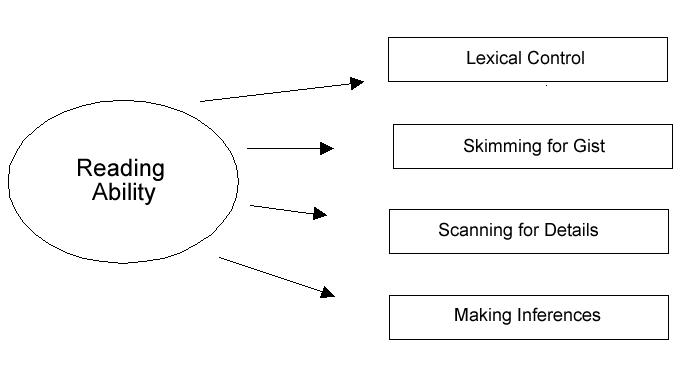
The review of literature exploring the operationalization of reading ability has led the inclusion, in my model, of four skills that are crucial for successful reading: (1) scanning for details; (2) skimming for gist; (3) making inferences; (4) ability to decode and interpret unknown lexical items. Because all of these skills interact to make a whole or global reading level, it only makes sense to weight each of the tasks equally when testing. This theoretical model of reading appears below as figure 1.
FIGURE 1: MODEL OF READING ABILITY
Reading is a complex process. It involves visual acuity in discerning printed letters, identifying these letters as the components of words, and interpreting the meaning of these words. It employs the readers’ psycholinguistic strategies (making inferences and predictions), and metacognitive strategies (selective attention, skimming, gist, previewing, sequencing, attending to details) to connect the visual information into existing schemata of knowledge. The reading process remains hard to explore using completely empirical methods because of its reliance on the metacognitive and psycholinguistic strategies. Because of this inherent ambiguity of the reading process, there have been no less than three theoretical models that have been developed to explain the process. These are the bottom-up, top-down, and interactive / psycholinguistic models.
The bottom-up model of reading ability is primarily concerned with the recognition of individual letters, phonemes and words. The “phonics” movement would best typify this view. This model believes that the reading process begins with individual recognition of letter and phonemic counterparts. This knowledge then leads to the recognition of individual words of the text presented to the reader. Meaning of the whole text is a process of building understanding of individual letters to the word level, then to the sentential level, and finally the text level. This is represented in our model as lexical control, for the model ignores any of the psycholinguistic and metacognitive strategies. The data are understood solely from this bottom-up process. The emphasis is on the printed text and what the reader receives from this, rather than the knowledge that the reader brings to this text (Lipson & Wixson, 1991).
The idea of the bottom-up model is that learners learn to read through their ability to sound out letters. Only when the learner has the decoding skills can the learner move on to the meaning of the words. Bloomfield (cited in Dubin & Bycina, 1991) defines first language reading as the manipulation of the phoneme-grapheme relationship. Olshtain (1991) claims that in early stages of ESL reading, the learner’s ability to map the phoneme-grapheme relationship is key in helping the learner to move to the larger units of text from the individual letters and words. Finally, Hawkins (1991) states that only through understanding of the phoneme-grapheme relationship can a learner be said to understand the meaning of text.
The bottom-down model does not give a full account of the process of reading, as it gives no account of a reader’s prior knowledge. The top-down model, on the other hand, places the emphasis on the reader’s active participation in the reconstruction of the meaning in the text. The top-down model looks at the reader’s knowledge base and his or her ability to make predictions using this base. The reader has the use of the printed text only to confirm and/or generate new hypotheses (Lipson & Wixson, 1991). In the view of Goodman (1967), a “good” reader is able to make predictions about the text given the occurrence of similar models of the genre. The reader then tests out hypotheses and adjusts theories when predictions are wrong. Smith (1978) argues that the efficient reader looks at the text through the lens of expectations from prior knowledge of the subject area. The reader then adjusts the lens based on outcomes of the reading, and in so doing, confirms or denies expectations. The top-down model of reading stresses the higher order skills inherent in reading. These higher order skills are primarily the use of predictions and inferences in the process of constructing meaning from past experiences, and the reconstruction of these predictions based on new information incongruent with past knowledge.
In the end, neither the top-down nor the bottom-up model of reading gives a complete picture in and of itself. In reality, it seems that the reading process is a conglomeration of the two models. After all, what reader would be able get to the higher level thinking skills involved in the top-down model without going through the learning stages of the bottom-up model. The integrative model suggests that a reader needs to have access to both the lower order thinking and decoding skills (as seen in the bottom-up model) and the higher order thinking skills (as seen in the top-down model). Rumelhart (1977) suggests that the processing of text is an interaction between the different forms of information available to the reader in the text and within the reader’s own higher order thinking skills, (i.e. inferences, and long term memory). Reading comprehension, in accordance with the interactive model, involves the use of the reader’s linguistic decoding processes to tap into his or her psycholinguistic strategies and schematic knowledge. The interactive model also allows for the selective annotation skills involved in reading. In these selective annotation skills, a reader might be attending to psycholinguistic strategies (for example, making inferences and predictions) while not needing to pay particular attention to the individual phoneme-grapheme relationship at the letter and/or word level.
There has been some research that has focused on the metacognitive strategies that influence reading ability. Phillips (cited in Hadley, 1993) argues for two types of reading - reading for information, and reading for enjoyment. He further states that when reading for information, the reader is identifying specific and detailed information, but when reading for enjoyment, the reader is trying to gain a global knowledge of the text and, therefore, employing skimming skills. Hughes (1983) views scanning and skimming skills as tools for identifying details and understanding the gist of text.
We would argue that the interactive model could account for the two previously mentioned metacognitive skills into a model of reading. The interactive model emphasizes both the identification skills, which are represented in the specific information acquisition skills in the bottom-down model, and the global interpretation skills, which come from the knowledge of the top-down model of making predictions and inferences. The identification skills of the bottom-up model are the same skills needed to scan for detailed information. The bottom-down interpretation skills are needed for skimming the text for gist and for making inferences. Since these skills are needed by our students to pass the ELA Regents exam, we will include them in our reading model. Scanning for details, skimming for main ideas or gist, and making inferences are, therefore, three of the most vital skills in determining reading ability.
The role of lexical ability is key to understanding reading ability. A reader could have all of the above skills, but be impeded in understanding a text if the vocabulary of the text was not of his or her schematic knowledge. Hughes (1989) includes lexical ability as an important constituent that influences the success of reading comprehension. The more lexical ability a reader has, the more he or she can understand text with lexically varied items, as interpretations of unknown lexical items can be made based on knowledge of similar and known lexical items. For this reason, we consider lexical ability as one of the important aspects of reading.
REFERENCES:
Boyle, O. & Peregoy, S. (1993) Reading writing and learning in ESL. New York: Longman.
Dubin , F. & Bycina, D. (1991). Academic reading and the ESL/EFL teacher. In M. Celce-Murcia (Ed.) Teaching English as a second or foreign language, 195-209. New York: Newbury House.
Faigley,L. & Witte, S. (1981). Coalescence, cohesion and writing quality, College Composition and Communication 32(1), 189-204.
Goodman, K. S. (1967). A psycholinguistic guessing game. Journal of Reading Specialist 6(1), 126-135.
Hadley-Omaggio, A. (1986). Teaching Language in context. Boston: Cambridge University Press.
Halliday, M.A.K. & Hasain, R. (1976). Cohesion in English. New York: Oxford University Press.
Hairston, M. (1982). The winds of change: Thomas Kuhn and the revolution in the teaching of writing. College Composition and Communication, 33(1), 76-88.
Hawkins, B. (1991). Teaching Children to read in a second language. In M. Celce-Murcia (Ed.) Teaching English as a second or foreign language (169-184). New York: Newbury House.
Horowitz,D.M. (1986a) Process, not product: less than meets the eye. TESOL Quarterly 20(1), 141-144.
Huges, A. (1989). Synthesis of research on teaching writing. Educational Leadership, 44 (8), 71-82.
Kirkland, M.R. & Sanders, M.A.P. (1991) Maximizing student preformance in summary writing: managing cognitive load. TESOL Quarterly 25(1), 105-121.
Lisson, M.Y. & Wixson, K.K. (1991). Assessment and instruction of reading disability: an interactive approach. New York: Harper Collins Publishers.
Olshtain, E. (1991). Functional task for mastering the mechanics of writing and going just beyond. In M.
Celce-Murcia (Ed.) Teaching English as a second or Foreign language, 235-244. New York: Newbury House.
Polio, C.G. (1997). Measures of linguistic accuracy in second language writing research. Language Learning 47(1), 101-143.
Raimes, A. (1991). Out of the woods, TESOL Quarterly 25(3), 407-430.
Rumelhart, D.E. (1977). Toward an interactive model of reading. In Dornic(Ed.) Attention performance , 573-603. New York: Academic Press.
Smith, F. (1978). Understanding Reading: A psycholinguistic analysis of reading and learning to read. New York: Holt, Rinehart and Winston.