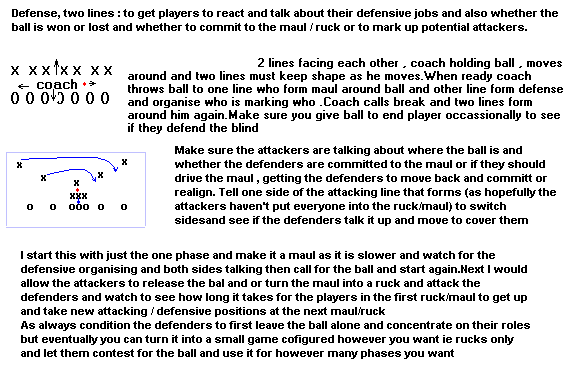
Designing drills....theory in practice and the on me, ball lost , ball lost plus bags and defense two lines drills.
Designing drills.... theory
Below is an extract from a discussion with Bob Woods on the rugby league message group that I thought would be useful for those of you trying to figure out new drills and how to break up your time to do them....
... I prefer to take a basic area of the game that needs work and break that down to it's individual components ... then work on each of those components for 5 minutes.
We have had trouble against teams with big forwards ... so tonight we worked for 5 minutes on curve and drop... I quickly explained how we show the player a channel down past our good shoulder and then turned a front on tackle into a side on tackle... one quick demo and then we were in to it. 10-15 sec of explanation.
I split the team into two groups and my assistant coach took over the other squad ... they were working in a 10 x 20 metre grid ... so I could watch both groups at once. Initially all I wanted was the curve and drop technique ... as the drill progressed I started to demand that the defender move forward ... here I had added a required element, but not one that I had explained at the start ...
I only gave them the basic information to start the drill off ... later in the drill I started to add the axing component ... we will continue this drill over many more sessions, and each session will add more elements ... so I haven't overloaded them with the whole skill at the start ... but they will build up to the full skill.
...again I take an area that I want to work on and turn it into a small game ... where they have to beat their mate at something ... I don't have to push them ... again allowing for the 5 minute concentration rule- 30 minutes would require 6 drills and these are probably different skill sets
....problems with players not wanting to do drills ... well that's why I have little competitive games ... I have to stop the players from doing the drills ... not try to force them to do them ... and when I take a player aside and say "Mate if you cut that angle harder and lower your body weight like this ... well I reckon you'll bust through his tackle ... ''cause he's weak on that shoulder".
Am I coaching that player ... not to the player I'm not ... I'm teaching him how to beat his mate ... and he'll more than likely have a go ... 'cause I'm not coaching ... and if he has a go and it works ... I've coached him into a skill.
I first try to give them a basic set of skills to apply to given situations ... then we bring those skills up to speed ... then put them under pressure ... then we put the players in a situation where they will need to apply those skills or strategies and see what they do ...
.. then we discuss why things worked and why they didn't ... the players should come up with the answer ... but the answer is the one that I had already given them ... what I am trying to do, is to see if they can recognize which skills to use in which situations .
.. if not, then it is back a couple of levels and start again ... they can do the skills ... but can't translate them from the training paddock to the field.
... basics, basics at speed ,basics at speed under pressure... For a lot of drills WALK through them ... perfect execution ... don't build up speed UNTIL there is perfect execution of the basics ... speed and then pressure are the last things added to the equation.
..... remain unconvinced in the benefits of traditional warm up and stretching ... these days I use game specific scenarios as warm ups ...I also don't use drills much these days. If in this area you were doing square drills etc ... I would change it to a 3 on 2 ... you've got the balls skills scenario and the guys are playing a game ... they won't even notice the time.
Stop after 5 minutes and talk about the options that they have chosen ... especially the good ones ... while you are talking, they are stretching ... 5 minutes of stretching and then back to 3 on 2, trying to implement the points that you raised in your previous talk ...
stop after 5 minutes and analyze the session ... look to praise certain people and their options ...players are stretching while you are talking ... there you have your 10 minutes of stretching that you want ... plus the players played a game for 10 minutes ... that they can relate to the field
Designing drills.... theory in practice and the on me, ball lost drill
.so working on this principle.... I prefer to take a basic area of the game that needs work and break that down to it's individual components ... then work on each of those components for 5 minutes..we designed the following drills as we were having problems with our communication and also with committing too many players to defensive rucks / mauls that were already lost i.e. no one was telling us what was going on with the ball and whether it was won or lost.
The first drill was the basic on me drill where all the 0's start above the paired up with a defender ballcarriers and work back to each pair
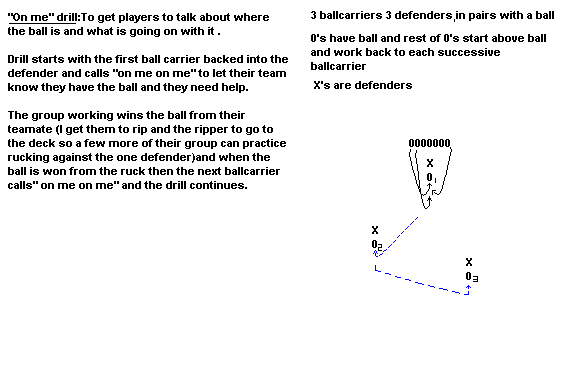
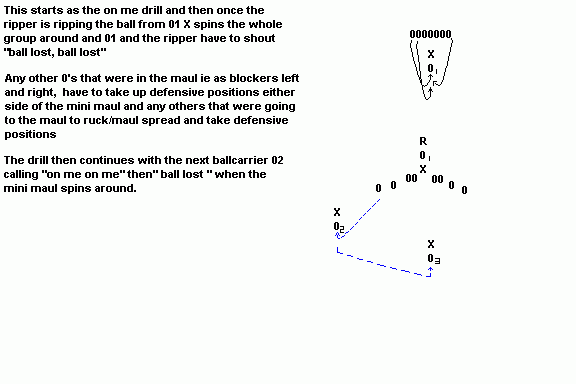
We did this because we were doing all the talking well but after we had spread and not committed to the ruck / maul that the ball was lost from , we found that when they ran at us we didn't come up and make the tackles
...so before the next ballcarrier says on me on me we had 1 to 4 attackers carrying contact bags come around the corner from a single file formation behind the maul/ruck and the edge defenders had to come up and hit the bags , after all the bags had been hit the next ball carrier shouted on me on me and the drill continues
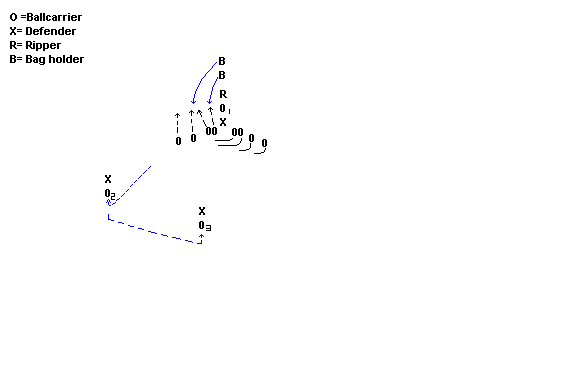
And as a final exercise we took all this work on talking and communicating with some contact and put it into the following drill in more of a game like situation.