| Contents |
| Home |
| About Us |
| Roster |
| Team Uniforms |
| Items 4 Sale |
| Gallery |
| Join RR |
| Forums |
| Local Links |
| Area Team Map |
| Tac Assault |
| External Links |
| eHobbyAsia |
| Redwolf |
| Airsoft GI |
| GA Outfitters |
| Zahal IDF |
| Israel Military |

| About the Ruff Ryders |
|
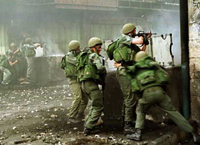
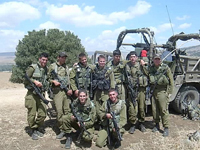
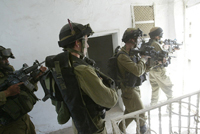
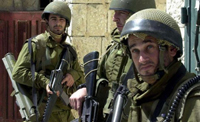
The Ruff Ryders, based in South Bend Indiana, are a team of airsoft hobbyists that belong to the Indiana Airsoft Association. The members choose to portray the Israeli Defense Forces of the State of Israel, a battle-hardened fighting force responsible for defending the State of Israel against the threats that surround her every day. This decision is based on a respect for the IDF as a fighting force as well as the fact that it gives us a unique uniform appearance when we take the field. This page will tell you a little more about the IDF and the founding of one of the most elite conventional military forces in the world.
The Guardian of Israel never slumbers nor sleeps. - Psalm 121:3 The presence of Jews in the land of Palestine had posed a dangerous situation since the turn of the century. Outnumbered by their Arab neighbors, the United Nations placed the land of Palestine under a British mandate in 1920. The British were never truly able to control the situation on the ground as the Arabs and Jews had both claimed the land as their ancestral homeland. Jews settled in Judea after they were freed from slavery in Egypt sometime between 1600 and 1200 BC. The Israelites launched a campaign against the Canaanites who settled in the land and, in 1050 BC, the land was established as a Jewish state under King Saul. Jewish presence had existed in this land, Judea, until the Romans expelled them from the land around 130 AD. It was at this time that the land was renamed Palestine (after the Philistines, the hated enemy of the Jews) in a Roman effort to wipe the existence of the Jews off of the map. The area would be ruled by many different powers, including those now identified as Palestinians, until the turn of the 20th century when Jews began to return. In 1920 the Jewish leaders organized a staged demonstration at the Western Wall in Jerusalem. This wall was the remains of the Second Temple of Herod, the holiest of Jewish sites. The Arabs that ruled Jerusalem had long denied the Jews the right to pray at the wall despite efforts of Jewish leaders. The demonstration ended in tragedy, however, when Arab demonstrators positioned themselves on the wall and attacked the Jewish congregation with bottle, rocks, and gunfire. This tragedy proved two things to the Jewish leadership in Palestine: They needed a reliable source of intelligence to warn them of future riots (this would later lead to the founding of Mossad, "The Institute" in Hebrew) and they needed a militia to defend the Jews in the region. This force would be known as Haganah ("The Defense" in Hebrew). The Haganah proved vital. They defended villages, protected farms, and even participated in some riot control alongside British forces. In 1936-39 10,000 Haganah soldiers and 40,000 reservists helped to quell the Arab revolt, giving the men vital combat training. This experience would pay off less than a decade later. Prior to World War II many European Jews fled the Nazi war machine and the death camps. After World War II holocaust survivors flooded Palestine determined to never again be subject to the threat of the gas chamber. European powers tried to stop the massive immigration and British ships even tried to ram crowded ferry vessels as they tried to come ashore. With the situation spiraling out of control the British and the United Nations announced that the mandate of Palestine would end and announced a partition plan that would give Jewish settlers and Arab Palestinians their own areas. The Palestinians rejected the plan, objecting to the idea of a Jewish homeland being carved out of their lands. In 1948 Israel's first Prime Minister, David Ben-Gurion, announced Israel's independence as a nation. 2 years of brutal war would follow. Israel managed to secure surplus weapons from the Czechs, and these would be pitted against a well-armed and massive Arab military. These arms would need to be multiplied with cunning tactics and determination, something the 25,000 men of the Haganah had in excess. In 1949 the war was over and Israel had repelled the Arab attack. Not only had they survived, Israel now controlled much of the former Palestine. The original partition plan had placed about 18% of Palestine under Jewish control. Israel now held about 80% of that land. The legend of the IDF was born. In 1953 the Egyptians had blockaded Israel�s trading port with the Red Sea. Finally, after Egypt closed the Suez Canal in 1956, Israel planned to invade the Sinai along with French and British forces. The invasion went very well and within a few weeks the Israelis had devastated the Egyptian forces on the Sinai. Politically, however, it was a disaster. The invasion, despite being sparked by a naval blockade of Israel, was seen as proof of Israel�s militarism. The United States had to pressure the British and French to cease the attacks and Egypt won the media war. A United Nations peacekeeping force would be positioned in the Peninsula. The Sinai would be given back only to be revisited a decade later. In May of 1967 Egypt kicked the United Nations peacekeeping force out of the Sinai. They then blockaded the straits of Tiran once again and began to mass over 100,000 men and 1000 tanks along the border. The call went out: Egypt wanted a united Arab attack on Israel. At 8:01am on June 5, 1967, at the exact minute that night shift personnel at Egyptian air bases left to punch out and the aircrews were in their mess halls, Israeli planes swept low over the sunrise on the horizon. Intelligence from Mossad had given the Israelis the ability to deliver a fatal blow to the Egyptian air force before a single plane could reach the skies. In response Jordanian forces invaded Israel from the East. Israeli forces swept across the Sinai Peninsula on June 6 & 7. Egyptian forces, in disarray and lacking cohesion in their upper echelons, withdrew at full speed across the desert. Israeli forces massacred the fleeing soldiers without ever truly engaging in any full-scale conflict. Israeli forces pushed into the West Bank to repel the Jordanians on June 6 & 7. Fighting raged into the Old City of Jerusalem. Originally Israeli leadership had decided not to set foot into Jerusalem for fear of damaging holy locations. When rumors of a U.N.-ordered ceasefire began to rumor, however, an epic land grab took place. IDF Paratroopers pushed into the Old City and, for the first time since the time of the Caesars, Jews controlled the site of the Holy Temple. On June 10 the war was over. After this epic victory, now known as the Six-Day War, Israel controlled the West Bank, Gaza, the Golan Heights, and all of the Sinai. Israel survived thanks to the men of the IDF. In October of 1973, however, the dividends paid by the victory in 1967 turned into debts. Convinced that Arab soldiers lacked the discipline, skill, and intelligence to fight effectively border defenses along the Suez Canal had grown lax. A few hundred infantrymen now held the border against more than 100,000 Egyptians. On Yom Kippur, the holiest day in the Jewish calendar, that border was attacked. In a daring crossing assault the main body of the Egyptian army came across the Suez Canal and crushed the defensive line. Many IDF soldiers, many mere reservists, held on for weeks with little ammunition, food, water, or hope. Egyptian forces tried to clear the many fortifications along the border but, after many assaults had ended in heavy casualties, they instead decided to bypass them and entrap the men within. Egyptian forces, moving under the cover of an impenetrable SAM umbrella, swept back across the Sinai and destroyed the Israeli forces they found along the way. Simultaneously the Syrians attacked up the Golan Heights a few hours away from Israeli population centers. Moshe Dayan, the Defense Minister, warned that the Third Temple was about to fall. Despite the horrible odds and dire appearance, the IDF held and managed to slowly turn the tide. Israel managed to draw Egyptian tanks into large open battles, something that the Israelis were exceptional in. Tank crews began to devise defensive maneuvers to defeat the anti-tank capabilities of the Egyptian forces. Paratroopers landed behind Egyptian lines and began knocking out SAM sites that held the invincible Israeli Air Force at bay. Israeli forces advanced along the Northern front and artillery shelled Damascus to send a message to the Syrians. By October 26th, against all odds, Israel had survived. In 20 days Israel suffered the same percentage of casualties as the United States had suffered during the entire nearly 20-year history of the Vietnam War. The IDF, however, had held. Since 1973 the role of the Israeli military has changed dramatically. They acted as peace keepers in Lebanon, helped to evacuate Jews from places like Sudan and Ethiopia, patrol the borders of Israel and the streets of occupied territories. Despite being tested at every turn and with the consequence of failure always being the extermination of Israel, the IDF has held. Today all Israeli citizens serve a mandatory term in the IDF making the IDF a force made up of civilians that wake within a war zone every morning with the death of their families and way of life on the line every night. Regardless of how you feel about the Israeli-Arab conflict it is impossible to deny the professionalism of the IDF and the commitment of the young men and women that make up this force. It is for this reason that we, the Ruff Ryders, portray them.
|