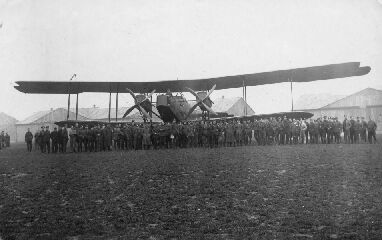
A Handley Page Bomber, in British military service!
SITE NAVIGATION
THE
HANDLEY PAGE BOMBER
HANDLEY
PAGE O/100
HANDLEY
PAGE O/400
OTHER
HANDLEY PAGE O/400 PHOTOS
HANDLEY
PAGE O/10 AND 0/11
HANDLEY
PAGE O/1500
HANDLEY
PAGE W.8
THE HANDLEY PAGE BOMBER
The Handley Page Bomber was a two-engine heavy bomber that was used by the United Kingdom, during World War I, and by the United States, after World War I. It was referred to as the "Bloodly Paralyser" and first used in combat by the Royal Naval Air Service, in November 1916, and was in service until the summer of 1923.
The first version of the Handley Page Bomber, the O/100 (Type H.P.11), first flew on December 17, 1916 and was, at the time, the largest aircraft to be built in the United Kingdom. The first Handley Page Bomber squadron was formed in August 1916 and was deployed to France around the beginning of November 1916. It first saw combat on the night of March 16-17, 1917, when it was used to attack a German railway station.
The second version of the Handley Page Bomber, the O/400 (Type H.P.12), was first deployed in early 1918 and had more powerful Rolls-Royce Eagle piston engines. They were supplied to Royal Air Force Squadrons Nos. 58, 97, 115, 207, 214, 215, and 216, and remained in service until late 1919, when they were replaced by the Vickers Vimy bomber. In this version of the Handley Page Bomber, the fuel tanks were moved from the engine nacelles to the fuselage and the propellers turned in the same direction, instead of opposite directions, as in the previous model. The aircraft saw combat in the middle-eastern theater during World War I, in 1918, and one, with serial number C9681, was flown by Captain Ross Smith, from No. 1 Squadron of the Australian Flying Corps, who would later, in 1919, make the first flight from England to Australia, in a Vickers Vimy, along with his brother, Keith Smith, and two mechanics.
A larger version of the aircraft, the O/1500 (Type H.P.15), unofficially known as the "Super Handley", first flew in May 1918 and entered Royal Air Force service in October 1918. Three of them were operational in November 1918, during World War I, with the No. 166 Squadron, at Bircham Newton, but bad weather prevented their use in combat,(1) though missions were also, reportedly, canceled due to engine problems, with some of the aircraft. After World War I, 57 of these strategic bombers were built for the Royal Air Force(2) and one, the Old Carthusian, with serial number J1936, was used for the first flight from England to India, via Rome, Malta, Cairo, and Baghdad. This flight, which was flown by Royal Air Force Major General A. C. S. MacLaren and Captain Robert Halley, started in December 1918 and ended, in India, in March 1919.(3) The aircraft continued on to Delhi, India, arriving there on January 16, 1919, and it was later used, on May 24, 1919, by Royal Air Force Captain Robert Halley, to drop four bombs on Amir Amanullah's palace in Kabul, Afghanistan, after Afghan forces invaded India, and part of the six-hour return flight was flown on three engines, as one of them had to be shut down, due to a leaking radiator.(4)
Another Handley Page O/1500, the Atlantic, with serial number F7140, was prepared for a non-stop transatlantic flight, in June 1919, from Harbour Grace, New Foundland, in Canada, with Royal Air Force Major Herbert George Brackley as the pilot, which would have won it the 10,000 Pound prize that was offered by Lord Northcliffe's Daily Mail, for such a flight, but the effort was abandoned, when British Captain John Alcock and his navigator, Lieutenant Arthur Brown, completed their own non-stop transatlantic flight, from Lester's Field, in St. Johns, New Foundland, Canada to Clifden, Ireland, in a Vickers Vimy bomber. Their 1,880-mile (2,896.82-kilometer) flight began on June 14th, at 4:13 p.m., and ended on June 15th, at 8:40 a.m., when they landed their airplane in a bog, after crossing the Irish coast at 8:25 a.m.
The Atlantic, however, was not ready for a transatlantic flight until June 18th, as its engines had overheated on a test flight, on June 8th, and its newly designed radiators did not arrive until June 14th.(5) Instead, the Atlantic took off for Mineola, New York, with Major Brackley, as its pilot, and Vice Admiral Mark Kerr, as its copilot, on July 7th, but two hours into its flight, its Rolls-Royce Eagle VIII engines overheated and it suffered a broken oil line and was forced to land at a race track in Parrsboro, Nova Scotia, in Canada, where it was damaged on landing.(6) It was not until October 9th that it made another attempt to reach Mineola, but on this flight it ran out of gas 96 miles short of its destination and it was not until October 13th that it was able to complete its flight.(7)
From October 17th to November 4th, the Atlantic made fourteen courtesy flights, from Mineola, and on November 14th, at 7:00 a.m., it was used by the American Railway Express Company used for an attempted cargo flight, flown by Major Brackley, from Mineola to Chicago, Illinois.(8) It carried 1,100 pounds of cargo, but was forced to abandon its flight in Ohio, after one of its engines overheated, due to a broken radiator water line.(9) It made an attempt to complete this flight, two days later, on November 16th, at 2:05 p.m., but a navigation error put it off course and its wing tips were torn off, by ground structures, while landing at a race track.(10) This is said to be the last flight of the Atlantic, as it was then dismantled for shipment back to the United Kingdom.(11)
After World War I, about ten of the Handley Page O/400 bombers were converted to twelve-seat airliners, which were designated the Handley Page O/10 or O/11, and Handley Page Transport used them on their London to Paris, France route. The design of the Handley Page Bomber was also used for the Handley Page W.8 (Type H.P.18) passenger airplane and its variants, though it was refined.
(1) Page 792, Paul Eden and Soph Moeng, The
Complete Encyclopedia of World Aircraft, Barnes & Noble, New York,
2002.
(2) Page 792, Eden and Moeng.
(3) Page
20, Alan Dowsett, Handley Page, Tempus Publishing Limited,
Gloucestershire, 1999.
(4) Page 20, Dowsett.
(5) Page
78, Edward Ludd, "Flight of the Atlantic", Air Classics,
Challenge Publications, Canoga Park, April 1985.
(6) Page 79, Ludd.
(7) Page 79, Ludd.
(8) Page 79, Ludd.
(9) Page 79, Ludd.
(10) Page 79, Ludd.
(11) Page 79, Ludd.
HANDLEY
PAGE
HANDLEY
PAGE AIRCRAFT PAGE 1
THE
BLOODLY PARALYSER