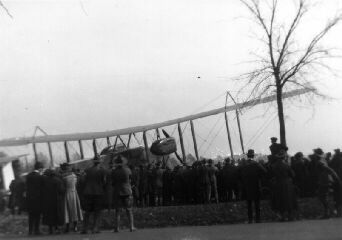
HANDLEY
PAGE BOMBER
HANDLEY PAGE O/100
CREW: 3 to 5.
ENGINES: Two 250-horsepower Rolls-Royce Eagle
VII Vee-12 piston engines.
MAXIMUM SPEED: 76 mph (122.31 kmh).
SERVICE CEILING: 8,500 feet (2,590.8 meters).
WINGSPAN: 100 feet (30.48 meters).
LENGTH: 62 feet 10 inches (19.1516 meters).
HEIGHT: 22 feet (6.7056 meters).
MAXIMUM LOAD: 6,000 pounds (2,239.44 kilograms).
The internal bomb bay could carry eight 250-pound (93.3099 kg) bombs or
sixteen 112-pound (41.8088 kg) bombs, and one 1,650-pound (615.846 kg)
bomb could also be carried, externally.
ARMAMENT: Two .303 inch Lewis machine guns
in the nose, one or two .303 inch Lewis machine gun in the dorsal position,
and one or two .303 inch Lewis machine gun in the ventral position.
PRODUCTION: 46
Handley Page O/100 (Type H.P.11) bombers were built. The prototype, number
1455, which had an enclosed cockpit, first flew on December 17, 1915 and
the first Handley Page O/100, number 1460, saw combat the night of March
16-17, 1917, when it bombed a German railway station near Metz.(1) The
Germans were able to capture a Handley Page O/100, number 1463, which was
flown by Lieutenant Vereker, on January 1, 1917, during World War I, when
it got lost and landed behind enemy lines, but they subsequently crashed
it, during a test flight.(2)
(1) Page 17, Alan Dowsett, Handley Page,
Tempus Publishing Limited, Gloucestershire, 1999.
(2) Page 17, Dowsett.
ROYAL
AIR FORCE MUSEUM HANDLEY PAGE O/100
1917
HP O/100S
HANDLEY PAGE O/400
CREW: 3 to 5.
ENGINES: Two 360-horsepower Rolls-Royce Eagle
VIII Vee-12 piston engines.
MAXIMUM SPEED: 97 mph (156.106 kmh)
SERVICE CEILING: 8,500 feet (2,590.8 meters)
WINGSPAN: 100 feet (30.48 meters)
LENGTH: 62 feet 10 inches (19.1516 meters)
HEIGHT: 22 feet (6.7056 meters)
MAXIMUM LOAD: 6,000 pounds (2,239.44 kilograms).
The internal bomb bay could carry eight 250-pound (93.3099 kg) bombs or
sixteen 112-pound (41.8088 kg) bombs, and one 1,650-pound (615.846 kg)
bomb could also be carried, externally.
ARMAMENT: Two .303 inch Lewis machine guns
in the nose, one or two .303 inch Lewis machine gun in the dorsal position,
and one or two .303 inch Lewis machine gun in the ventral position.
PRODUCTION: 663
Handley Page O/400 (Type H.P.12) bombers were built, including 107 that
were manufactured in the United States, with Liberty engines, by the Standard
Aircraft Corporation, of Elizabeth, New Jersey, who had a contract to build
1,500 of them, but this order was cancelled, when World War I ended.(1)
After World War I, the United States Air Service had 7 Handley Page O/400
bombers.
(1) Page 791, Paul Eden and Soph Moeng, The
Complete Encyclopedia of World Aircraft, Barnes & Noble, New York,
2002.
ROYAL
AIR FORCE MUSEUM HANDLEY PAGE O/400
HANDLEY
PAGE O/400
1917
HP O/400S
SCRATCHBUILDING
A 1-48 HANDLEY PAGE O/400
BRITISH
BOMBS
CAPTAIN
ROSS M. SMITH
SIR
ROSS SMITH