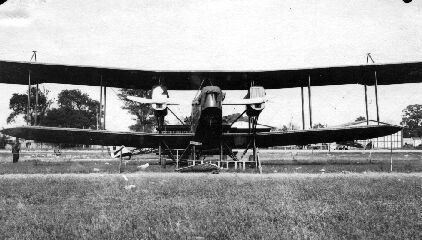
One of the Handley Page O/400 bombers, with Liberty engines, that were built, under contract, by Standard Aircraft Corporation. Seven of them served in the American air service.
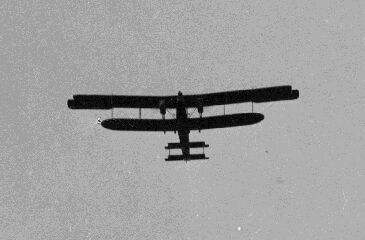
A Handley Page O/400 Bomber flying over New York City on April 10, 1919. This aircraft may have been based at the United States Signal Corps airfield in Mineola, New York, which later became Mitchell Field.
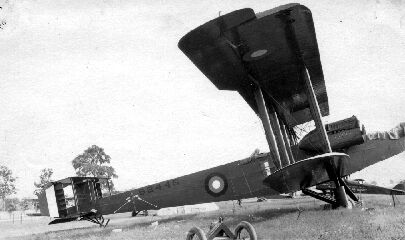
An American-built Handley Page O/400 bomber with American air service markings and serial number 62446.
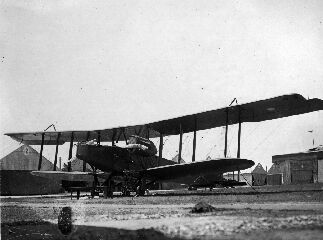
A Handley Page O/400 Bomber, in American military service, at Langley Field, in Hampton,Virginia.
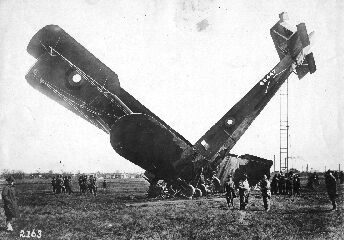
The Handley Page O/400 Bomber Langley, with serial number 62447, after a mishap. It was the first Handley Page Bomber built in the United States, by the Standard Aircraft Corporation, and first flew on July 6, 1918.(1)
(1) Page 86, Year, Flight, Year, Los Angeles, 1953.
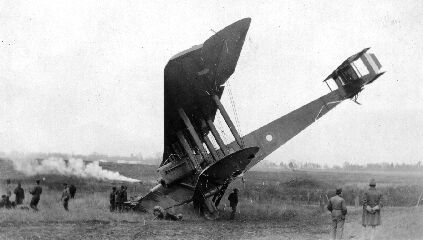
A Handley Page 0/400 Bomber, in American military service, with broken landing gear.
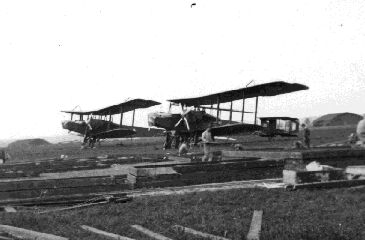
Groups of Handley Page Bombers, in British military service.
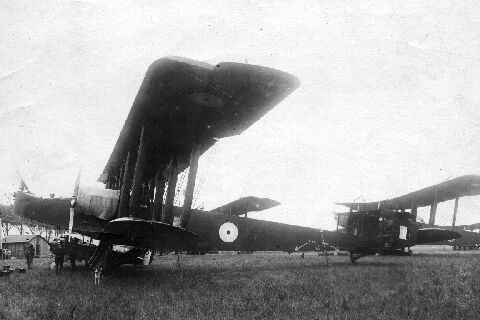
Groups of Handley Page Bombers, in British military service.
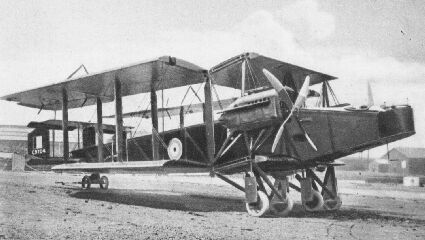
A Handley Page Bomber with its wings folded back and British air service markings.
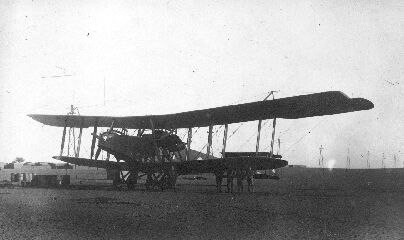
A photo of a Handley Page O/400 bomber, with serial number F302, which may have been taken in the Middle East. A Handley Page Bomber, withserial number C9681, was used in the middle-eastern theater during World War I, in July 1918, by the No. 1 Squadron of the Australian Flying Corps, and was flown by Captain Ross Smith. It was based in Palestine and was used for bombing, and transport, and Lawrence of Arabia, Colonel T. E. Lawarence, flew in it. Its pilot, Captain Smith, was awarded the Military Cross and the Distinguished Flying Cross, during World War I, and, at one point, flew Handley Page O/400 bomber C7900, with a crew that included two of his mechanics, Sergeant Jim Bennett and Sergeant Wally Shiers, on a survey flight from Cairo, Egypt to India. After World War I, in 1919, he and his brother Keith Smith, along with Bennett and Shiers, would make the first flight from England to Australia, in a Vickers Vimy, which was completed, in legs, in about 28 days, from November 12th to December 10th, and would win them a 10,000 Pound prize, for completing it within thirty days. He and his brother were knighted for this flight, and Bennett and Shiers were promoted to lieutenants. He and Bennett would later be killed, on April 13, 1922, in the crash of a Vickers seaplane.