ROGER W. KNIGHT, )
) No.
petitioner, )
) AMENDED PETITION FOR JUDICIAL
v. ) REVIEW OF AGENCY DECISION,
STATE OF
)
respondent. )
____________________________________)
COMES NOW ROGER W. KNIGHT, to petition for judicial review
of an agency decision under
chapter 34.05 RCW.
NAME AND MAILING
ADDRESS OF PETITIONER
Roger W. Knight
Redacted for this Website
NAME AND
MAILING ADDRESS OF PETITIONER’S ATTORNEY
Roger W. Knight, pro
se
c/o
ActionLaw.net
Redacted for this Website
NAME AND
MAILING ADDRESS OF AGENCY
Department of Social and Health
Services, Division of Child Support
500
AGENCY DECISIONS
AT ISSUE
Final
Order dated
PARTIES TO
ADJUDICATIVE PROCEEDINGS
Roger W. Knight and the Department of Social and Health Services,
Division of Child Support.
FACTS THAT DEMONSTRATE
PETITIONER IS ENTITLED TO JUDICIAL REVIEW
The
Statement of the Case is as follows:
On
On
On
On
While
Mr. Knight may request a reconsideration of the
Final Order by the
Administrative Law Judge, he may appeal the
Final Order to
this Court without
requesting such administrative reconsideration,
RCW 34.05.534(2) and
RCW
34.05.470(5). This petition is filed and
served less than 30 days after the re-mailing of the
Final Order and is
therefore timely under
WAC 388-02-0645 and
RCW 34.05.542(3).
This
Court has jurisdiction under
Article IV Section 6 of the
Washington Constitution. This Court has venue under
chapter 4.12 RCW
and under
RCW 34.05.514(1).
ARGUMENT
FOR RELIEF
A. Introduction
RCW
34.05.570(3) provides that a court in reviewing agency orders in adjudicative
proceedings shall grant relief if it determines:
(a) The order, or the statute or rule
on which the order is based, is in violation of constitutional provisions on
its face or as applied.
(b) The order is outside the
statutory authority or jurisdiction of the agency conferred by any provision of
law;
(c) The agency has engaged in unlawful
procedure or decision-making process, or has failed to follow a prescribed
procedure;
(d) The agency has erroneously
interpreted or applied the law;
The
petitioner is under an order to pay child support entered in In re Marriage of Knight,
King County
Superior Court No. 90-3-04471-1. The
decree was entered on
On
Mr.
Knight cannot enter into any repayment agreement as contemplated by
RCW 74.20A.320(5) without committing fraud. If he does, he “shall
by color or aid of any false or fraudulent representation, pretense, token or
writing induce any creditor to participate in the benefits of such assignments”
which is defined as a gross misdemeanor by
RCW 9.45.100. If he knows he cannot pay a sum each month
sufficient to cover the repayment agreement, and he induces the creditor to
participate in the benefit of such assignment, he would be making a false or
fraudulent representation.
Mr.
Knight is barred from obtaining any reduction in the arrearage by
RCW
26.09.170(1). The Administrative Law
Judge ignored this fact when finding:
Mr.
Knight could avoid its impact by paying support, seek modification and enter
into an agreement to pay arrears support.
The
Administrative Law Judge does not identify any facts, and none were submitted
into the record by either party, to support the proposition that Mr. Knight
possesses $66,229.69 with which to pay the support arrearage, or can obtain
such funds, or where he can obtain income sufficient to pay this arrearage plus
the current support, as established by the pre-existing support order, of
$851.76 per month.
Where findings of fact cannot be
supported by substantial evidence, or is against the weight of evidence, such
findings of fact cannot stand on appeal.
Substantial
evidence is that which is sufficient to persuade a fair minded person of the
truth or correctness of the challenged finding.
The WorkFirst Act does not embrace a Legislative declaration of
retroactive application to pre-existing support orders under the
Smith and
Cruz test
State v. Cruz, (1999) 139
The presumption against retroactive application of a
statute “is an essential thread in the mantle of protection that the law affords
the individual citizen. That presumption
‘is deeply rooted in our jurisprudence, and embodies a legal doctrine centuries
older than our Republic.’”
Lynce v. Mathis, 519
Reaffirmed
and quoted by
State v. Smith, (2001)
144
(2) Sections 201 through 203, 301 through 305, 701
through 706, and 901 through 904 shall
take effect
Cruz at 139
Smith at 144
In 2000, the Legislature responded
to our decision in
Cruz by enacting
RCW 9.94A.345.
Laws of 2000, ch.
26, §2. This statute states: “Any
sentence imposed under this chapter shall be determined in accordance with the
law in effect when the current offense was committed.”
RCW
9.94A.345. On its face, this
language does not implicate
Cruz. However, the Legislature also included the
following statement in the statutory note:
“RCW
9.94A.345 is intended to cure any ambiguity that might have led to the
Washington supreme court’s decision in
State
v. Cruz, Cause No. 67147-8 (October 7, 1999). A decision as to whether a prior conviction
shall be included in an individual’s offender score should be determined by the
law in effect on the day the current offense was committed.
RCW 9.94A.345 is also intended to clarify the
applicability of statutes creating new sentencing alternatives or modifying the
availability of existing alternatives.
RCW 9.94A.345
Intent
-- 2000 c 26. The State asks us to find in
this language a clear legislative intent that the 1997 amendment applies
retroactively. We cannot. Although this statement indicates a
legislative discontent with our holding in
Cruz,
there is nothing demonstrating an intent for the
retroactive application of the 1997 amendment.
Smith at 144
The
SRA contains no language showing
the Legislature intended the 1997 amendment to apply retroactively. Legislative intent for retroactivity must be
clearly found within the statute’s language.
Landgraf, 511
“Criminal
history means the list of a defendant’s prior convictions and juvenile
adjudications, whether in this state, in federal court, or elsewhere. The history shall include, where known, for
each conviction (a) whether the defendant has been placed on probation and the
length of terms thereof; and (b) whether the defendant has been incarcerated
and the length of incarceration.
RCW
9.94A.030(12).
This language fails to establish a legislative intent that the 1997
amendment applies retroactively.
Applying the
Smith and
Cruz tests to the WorkFirst Act
provisions relevant to this case,
RCW 74.20A.320 et seq., leads to the
conclusion that the WorkFirst Act does not apply
retroactively to noncustodial parents who were and
are still more than 180 days out of compliance with support orders entered
before
RCW 74.20A.320 et seq. are not “curative” or “remedial”. These far sweeping provisions provide, for
the first time in the history of the State of
Because the WorkFirst
Act provisions in question are clearly not “curative” or “remedial”, and
definitely affect substantive rights, then there must be a clear statement of
legislative intent for retroactive application within the statute’s language,
or the agencies lack the statutory authority to suspend or revoke Mr. Knight’s
licenses, or to prohibit renewal, or to prohibit him from obtaining any other
license for the first time.
The Administrative Law Judge’s
findings,
Final Order page 4 that the court will not apply a remedial statute
retroactively if it affects a substantive or vested right, citing
Miebach v. Colasurdo,
(1984) 102 Wash. 2d. 170, 181, 685 P. 2d. 1074, is
contradicted by its findings that suspension or revocation of a driver’s
license is not penal or criminal in nature and therefore suspension does not
unjustly or unreasonably impair the petitioner’s driving privilege. A driver’s license is recognized as a substantive
or vested right in
Bell v. Burson, (1971) 402
Once licenses
are issued, as in petitioner's case, their continued possession may become
essential in the pursuit of a livelihood. Suspension of issued licenses thus
involves state action that adjudicates important interests of the licensees. In
such cases the licenses are not to be taken away without that procedural due
process required by the
Fourteenth Amendment.
The
Supreme Court of the
The legislative intent of
RCW
74.20A.320 et seq. is set forth in Laws 1997 chapter 58 §801:
It is the intent of the legislature
to provide a strong incentive for persons owing child support to make timely payments, and to cooperate with the
department of social and
health services to establish an appropriate schedule for the payment of any
arrears. To further ensure that child
support obligations are met, sections 801 through 890 of this act establish a
program by which certain licenses may be suspended or not renewed if a person
is one hundred eighty days or more in arrears on child support payments.
In the implementation and management
of this program, it is the legislature’s intent that the objective of the
department of social and health services be to obtain
payment in full of arrears, or where that is not possible, to enter into
agreements with delinquent obligors to make timely support payments towards the
arrears. The legislature intends that if
the obligor refuses to cooperate in establishing a fair and reasonable payment
schedule for arrears or refuses to make timely support payments, the
department
shall proceed with certification to a licensing entity or the
department of
licensing that the person is not in compliance with a child support order.
There
is no clear statement here of intent of retroactive application of this statute
to pre-existing support orders and to pre-existing support arrearages. While the statutory and legislative language
does not specifically exclude pre 1997 support orders and arrearages, it does
not meet the
Smith and
Cruz test for specific legislative
intent for retroactivity to include such orders and arrearages.
C. By
Prohibiting Consideration of Inability to Comply With Support Orders,
RCW
74.20A.320 Deprives
And
Invidiously Discriminates in Violation of the Right to Equal Protection
License
Suspension for Child Support Not Rationally Related to Activities
Licensed,
Offending
Fourteenth Amendment and
Article I Sections 3 and 12 of the
Bell
v. Burson, supra, at 402 U.S. 536, found
that Georgia’s statutory scheme excluded any consideration of whether an
uninsured motorist involved in an accident is likely to be found liable for the
accident in the administrative hearing before the suspension of the
license. This was found to offend the
Fourteenth Amendment Due Process Clause because under
If a parent is unable to comply with
a support order, a permanent suspension of his license will not improve his
ability to comply. If the parent has no
recent traffic offenses or accidents on his record whatsoever, the suspension does not serve the public interest in the safety of
the roads and highways.
Schware v. Board of Bar Examiners,
(1957) 353
A state can require high standards for qualification,
such as good moral character or proficiency in its law, before it admits an
applicant to the bar, but any qualification must be have a rational connection
with the applicant’s fitness or capacity to practice law.
. . .
Obviously an applicant could not be excluded merely
because he was a Republican or a Negro or a member of a particular church.
City of
But even where the character
of an applicant is subject to evaluation by the licensing officer, the matters
taken into account must be relevant to the activity licensed.
and thereby invalidated a city ordinance concerning the
licensing of motion picture theaters.
Compliance or noncompliance with a
child support order is irrelevant to whether the parent can safely operate a
motor vehicle, the activity licensed in Mr. Knight’s case. And it is irrelevant to whether he can safely
remove a kidney stone, pilot an aircraft, prescribe drugs, administer drugs,
prepare and sell prescription drugs, drill a water well, sign off on an
engineering drawing, hunt Roosevelt elk, carry a concealed weapon, build a
house, or any of the numerous other activities for which this state requires a
license.
D. In Case of Parents
Unable to Comply With Support Orders WorkFirst Act is
a
Bill of Attainder
and as Applied to Pre-Existing Support Orders, it is an
Ex Post Facto Law,
Offending
Article I Section 10 clause 1 of the United States
Constitution
and
Article I Section 23 of the
By
providing for the automatic and permanent suspension of all licenses of noncustodial parents unable to comply with their support
orders, given that
RCW 26.09.170(1) prohibits any modification or vacation of a
support order and forgiveness of any arrearage, no matter what the
circumstances,
RCW 74.20A.320 imposes punishment by legislative fiat. It is thus a bill of attainder prohibited by
Article I Section 10 clause 1 of the United States Constitution and prohibited
by
Article I Section 23 of the
Washington Constitution.
RCW
74.20A.320(3) prohibits consideration of inability to
comply with a support order. If the
parent has not complied with the support order, the licenses must be suspended,
permanently if the parent is never able to comply. For a pre-existing support order where the
debt was accrued prior to the passage of the statute, the imposition of such a
sanction by irrebuttable legislative presumption is a
bill of attainder. The subsequent
legislation is a legislative, not a judicial, modification of the pre-existing
support order.
A
bill of attainder or an ex post facto law imposes punishment upon a group of
persons by legislative action and without judicial trial. While bills of attainder are not restricted
to criminal punishments, ex post facto laws add a quantum of punishment to
previously committed crimes or define as criminal previous acts that were not
criminal at the time committed.[1]
Cummings v.
Justice Black’s concurring opinion in
Aptheker v. Secretary of State, (1964) 378
The
Supreme Court of Washington
split 5-4 in
State v. Schmidt, (2001) 143
The majority of the
Court found that
merely adding long firearms to a list of firearms already prohibited to the
class was not a punishment for prior crimes,
Schmidt at 143
the ‘marginal effect of adding long guns to the otherwise
exhaustive list of restricted weapons does not amount to punishment for ex post
facto purposes.’
However,
RCW 74.20A.320 does not have any such “marginal effect” upon parents who
previously did not comply with support orders.
RCW 74.20A.320 applies to all licenses by directing the state’s agencies
to suspend licenses upon a certification by the respondent agency that the
parent is out of compliance with a support order. Previously no such threat existed in any
support order or was contemplated in any statute. There is no list of license restrictions to
which the
RCW 74.20A.320 makes a “marginal” addition. It is thus an ex post facto law to the extent
noncompliance with a support order may be considered a crime. It is a bill of attainder whether or not
nonpayment of child support is considered a crime.
Some
useful guideposts of whether a sanction imposed by subsequent legislation is
punitive are set forth in
Kennedy v.
Mendoza-Martinez, (1963) 372
(1) "[w]hether the
sanction involves an affirmative disability or restraint"; (2)
"whether it has historically been regarded as a punishment"; (3)
"whether it comes into play only on a finding of scienter
"; (4) "whether its operation will promote the traditional aims of
punishment-retribution and deterrence"; (5) "whether the behavior to
which it applies is already a crime"; (6) "whether an alternative
purpose to which it may rationally be connected is assignable for it"; and
(7) "whether it appears excessive in relation to the alternative purpose
assigned." It is important to note, however, that "these factors must
be considered in relation to the statute on its face,"
Suspension of licenses, whether to
operate an automobile or other activities, involve an affirmative disability or
restraint. Such has historically been
regarded as punishments for such crimes as drunk driving for driver’s licenses,
abortion for medical licenses, and any felony for licenses to practice law. Under
RCW 74.20A.320 it comes into play on a
finding of noncompliance with a support order, a scienter. Suspending licenses serve the traditional
aims of punishment, retribution and deterrence.
People are less likely to drive while impaired if they believe their
licenses to drive will be suspended, and those who drive while impaired are
subject to the retribution of license suspension and other penalties. The behavior to which
RCW 74.20A.320 applies
license suspension, noncompliance with a support order, has been and is
considered a crime in many jurisdictions, including federal under
18 U.S.C.
§228. Because
RCW 74.20A.320(3)
prohibits consideration of ability to comply with the support order, no
non-punitive purpose can be rationally assignable to the sanction of license
suspension.
By
contrast,
Smith v. Doe, (
Freedom
from bills of attainder and ex post facto laws are fundamental rights. In
Federalist Paper 44, quoted in
Brown, 381 U.S. 444 n. 18, James Madison
wrote:
Bills
of attainder, ex post facto laws, and
laws impairing the obligations of contracts, are contrary to the first
principles of the social compact and to every principle of sound legislation.
In
Federalist Paper 78, listed in
Brown, n. 17, Alexander Hamilton wrote:
By a
limited Constitution, I understood one which contains certain specified
exceptions to legislative authority; such for instance, as that it shall pass
no bills of attainder, no ex post facto
laws and the like. Limitations of this
kind can be preserved in practice no other way than through the medium of
courts of justice, whose duty it must be to declare all acts contrary to the
manifest tenor of the Constitution void.
Without this, all the reservations of rights or privileges would amount
to nothing.
In
Federalist Paper 84,
The creation of crimes after the commission of the
fact, or, in other words, the subjecting of men to punishment for things which,
when they were done, were breaches of no law, and the practice of arbitrary
imprisonments, have been, in all ages, the favorite and formidable instruments
of tyranny.
While
E. WorkFirst Act is Void as a Multi-Subject Bill
Prohibited by
Article II Section 19
Of
the
In re Boot, (1996) 130
Then
Amalgamated
Transit Union Local 587 v. State of Washington, (2000) 142
However, there is no
rational unity between the subjects of I-695.
. . . I-695 also has two purposes: to specifically set license tab fees
at $30 and to provide a continuing method of approving all future tax
increases. Further, neither subject is
necessary to implement the other. I-695
violates the single-subject requirement of
art. II, § 19 because both its title
and the body of the act include two subjects: repeal of the MVET and a voter
approval requirement for taxes.
Affirmed in
City
of
This
test for rational unity was further modified by
Washington Association of Neighborhood Stores v. State of Washington,
(
In order to survive, however, rational unity must exist among all matters included within the measure and the general topic expressed in the title. Kiga, 144 Wn.2d at 826. Rational unity requires included subjects to be reasonably connected to one another and the ballot title.
Amalgamated Transit
We conclude rational unity exists between the sections of the initiative because the tobacco taxes directly relate to the programs they fund, and the programs relate to the title. As the ballot title explains, the subject of I-773 is imposing additional tobacco taxes for low-income health programs and other programs. Every provision of the initiative relates to those functions. The provisions raising taxes relate because they provide the revenue to support the new and existing programs. Each section of I-773 presents a single and rationally unified proposal for improving the health of our state's low-income citizens without imposing a net loss of tax revenue on other preexisting programs. The provisions are interrelated and germane to the general subject matter of I-773 and are, therefore, rationally unified and constitutional.
The
dissent, written by
Justice Richard Sanders, while
not commenting directly upon the analysis as to the Single Subject Requirement,
nevertheless criticizes the finding that the Two Year Appropriations Clause,
Article VIII Section 4 was not violated.
The majority determined that the Initiative’s language that Legislature
“shall” appropriate funds for health care, is actually
a suggestion, not a mandate. If it is a
suggestion, then the tobacco tax imposed by the Initiative arguably does not
“directly” relate to the programs funded, at least beyond two years when the
Legislature may choose to spend the tobacco tax revenue in such manner.
An alternative argument is that Neighborhood Stores effectively reversed Amalgamated Transit and Kiga and restored the Eyman Intiatives. Since this argument is not likely to be accepted, then Amalgamated Transit must survive by a finding that repeal of the Motor Vehicle Excise Tax and replacing it with a flat $30 fee does not directly relate to the requirement for a vote for every state and local tax increase, as contained in Initiative 695. Where “neither subject is necessary to implement each other” is found, then the test for rational unity must require that each allegedly diverse provision of a bill or initiative “directly relate” to each other such diverse provision.
The VRA and the OACSA were not analyzed under this test in the previous decisions. When this test is applied to the WorkFirst Act, the WorkFirst Act embraces more than one subject. The provisions reforming the terms and conditions for public assistance grants are not necessary to implement nor are directly related to license suspension for noncompliance with child support orders and neither is necessary to implement nor are directly related to programs promoting teenage abstinence and pregnancy prevention. As both title and content of the WorkFirst Act thus embrace more than one subject, it is void in its entirety.
Bennett v. State of Washington, (Div. II, June 3, 2003) ____ Wash. App. ____ does not adequately explain why there is rational unity in the WorkFirst Act and no rational unity in Initiative 695 as found by Amalgamated Transit. Both the repeal of the Motor Vehicle Excise Tax and the requirement for voter approval are apparently within the subject of tax limitation, which is listed in the Initiative title. Bennett found that license suspension for child support and the other provisions of the WorkFirst Act (teen parents, limitations on public assistance, illegitimacy prevention and abstinence promotion, accountability of DSHS) are within the subject of personal responsibility. How accountability of DSHS is within the subject of personal responsibility is not explained in Bennett. There is no analysis of the WorkFirst Act by the Bennett Court on the necessity of implementation test that was apparently established by Amalgamated Transit and Kiga, or the direct relationship test as clarified by Neighborhood Stores. In fact, Neighborhood Stores is not cited by Bennett.
G. License
Suspension to Coerce Repayment Agreement is Coercion of or Attempt to
Coerce
Employment Declared Null and Void by Antipeonage Act
Any
effort by legal process, including license suspension, to coerce employment in
liquidation of a debt or obligation, whether such employment is available or
not, is declared null and void by
42 U.S.C. §1994 and is the crime defined by
18 U.S.C. §1581. If the intent is to
coerce Mr. Knight into entering into a repayment agreement as contemplated by
RCW 74.20A.320(5), where compliance, if possible, requires employment, the
proceedings below and the statutes and common law usages upon which the
proceedings below are based, are declared null and void by
42 U.S.C. §1994.
42
U.S.C. §1994 reads:
The
holding of any person to service or labor under the system known as peonage is
abolished and forever prohibited in any Territory or State of the United
States; and all acts, laws, resolutions, orders, regulations, or usages of any
Territory or State, which have heretofore established, maintained, or enforced,
or by virtue of which any attempt shall hereafter be made to establish,
maintain, or enforce, directly or indirectly, the voluntary or involuntary
service or labor of any persons as peons, in liquidation of any debt or
obligation, or otherwise, are declared null and void.
This language is adapted
from the original statute at 14 Stat 546, which refers specifically to the
system then existing in
“Our task is to give
effect to the will of Congress, and where its will has been expressed in
reasonably plain terms, that language must ordinarily be regarded as
conclusive.”
quoting
Griffin
v. Oceanic Contractors, Inc., (1982) 458
Under the system known as peonage in
42 U.S.C. §1994 and the Antipeonage Act as originally passed, 14 Stat 546, include
the phrase: “debt or obligation, or otherwise”.
If Congress had intended an exception for child support or alimony, or
to limit the application to debts arising from contract, it could have easily
written in such language. Limitations to
contractual debts are written explicitly in the imprisonment for debt
provisions of some state constitutions. State v. Lenz, (Ct. App.
1999) 230
If the language of
42 U.S.C. §1994
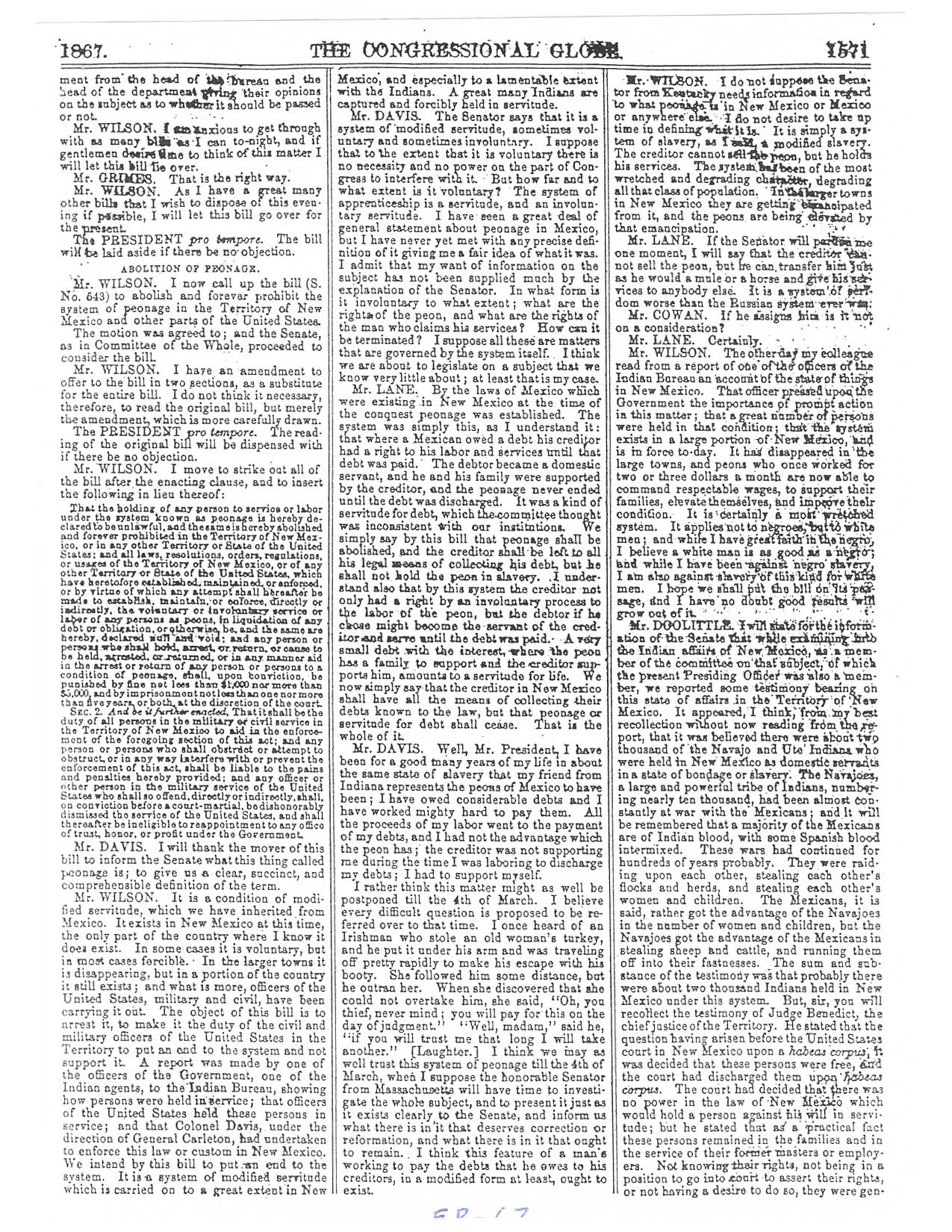
does not express the will of Congress in reasonably plain terms, then Senator
Lane’s comments recorded in the
Congressional
Globe, 39th Cong. 2d. Sess. at p. 1571, about the
effects of
The deliberate decision by Congress
to not exclude alimony and child support from the Antipeonage
Act, as originally passed in 1867, 14 Stat 546, and since as codified as
42 U.S.C. §1994, should be respected by the courts.
RCW 74.20A.320(5)
provides that the DSHS may stay suspension of the license if the parent agrees
to a repayment schedule acceptable to the DSHS.
This is a clear statutory authorization for the agency to coerce,
through a legal sanction not justified by any other consideration, and not
related in any way to the activities licensed, including operating motor
vehicles, the employment necessary to comply with a support order. That the noncustodial
parent may choose his employer does not escape the prohibition.
When thus at labor, the
convict is working under a contract which he has made with his surety. He is to work until the amount which the
surety has paid for him -- the sum of the fine and the costs -- is paid. The surety has paid the state and the service
is rendered to reimburse him. That is
the real substance of the transaction.
The terms of that contract are agreed upon by the contracting parties,
as the result of their own negotiations.
The statute of the state does not prescribe them. It leaves the making of the contract to the
parties concerned, and this fact is not changed because of the requirement that
the judge shall approve the contract.
Thus, it is not fatal to a claim of
peonage that the peon may choose his employer or even his profession. The surety as contemplated in
Reynolds could easily be a manufacturing
concern, a restaurant, or an engineering firm, if interested in hiring someone
with appropriate skills who happens to be in trouble with the law.
RCW 74.20A.320(9)
provides that the DSHS may send a release of the license suspension when the
parent is in compliance with the support order.
This is precisely the type of
statutory scheme declared null and void by
42 U.S.C. §1994.
PETITIONER’S REQUEST TO FILE OVERLONG
TRIAL BRIEF
The Case Schedule Order provides that the Petitioner’s
Trial Brief is due on or before
REQUEST FOR
RELIEF
Petitioner
prays for an order reversing or vacating the
Final Order and requiring
restoration of his license to operate a motor vehicle without any reissue fee,
and if such order is entered after June 30, 2003, that he be allowed to renew
his license on the same basis if he had been allowed to renew prior to the expiration
date of June 30, 2003.
Respectfully submitted,
____________________________________
Roger
W. Knight, pro se
Petitioner
[1]
18 U.S.C. §228 defines failure to pay child support
for a child residing in a different state to be a crime. If applied to an unmodified child support
order that predates its passage in 1993, it too is a bill of attainder and an
ex post facto law, where the parent is unable to pay the pre-existing debt. The 1998 amendment to this statute, P.L.
105-187, 112 Stat 618, is called the Deadbeat Parents Punishment Act. When applied to support orders predating
1998, it is clearly a bill of attainder and an ex post facto law in that
Congress intended it to be punitive.