|
Yangon (Rangoon) |
 |
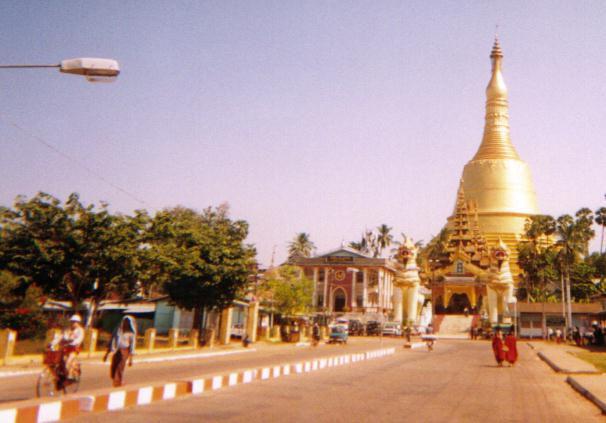
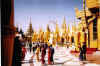
Shwedagon Paya
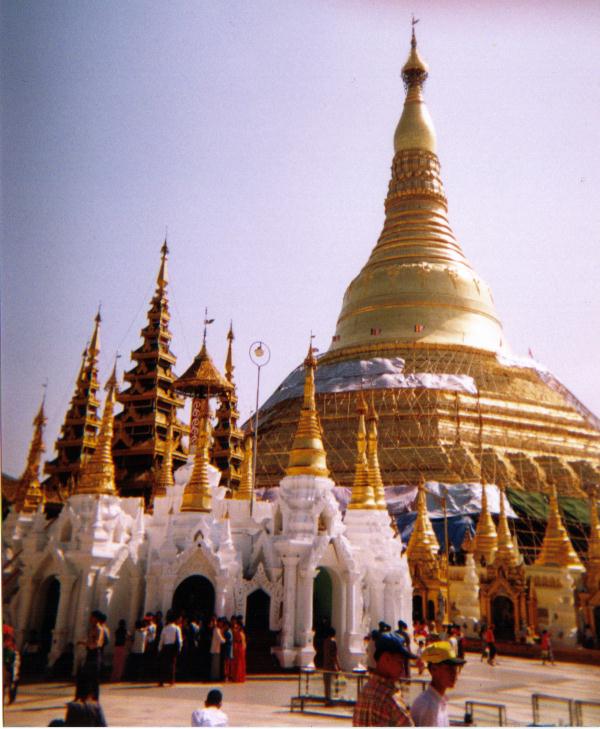
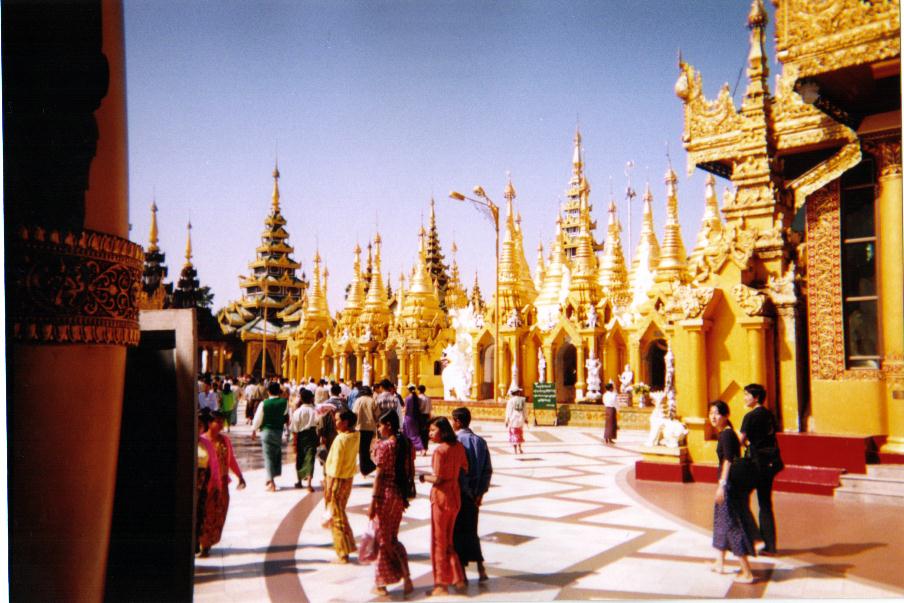
Kipling called it 'a golden mystery...a beautiful winking wonder'. As the setting sun casts its last rays on the soft orange dome of the great Shwedagon Paya you can feel the magic in the air. In the heat of the day the stupa glitters bright gold. It can be quiet and contemplative; colourful and raucous. The 'Golden Dagon' is the essence of Myanmar and a place that never fails to enchant.
For Burmese Buddhists, Shwedagon is the most sacred of all Buddhist sites in the country, one which all Burmese hope to visit at least once in their lifetime.
The great golden dome rises 98m above its base. According to legends this stupa - of the solid zedi type - is 2500 years old but archaeologists are nearly unanimous in suggesting the original stupa was built by the Mon sometime between the 6th and 10th centuries. In common with many other ancient zedis in earthquake-prone Myanmar, it has been rebuilt many times and its current form dates back only to 1769.
The central zedi is regilded every year; by 1985 it had
reportedly accumulated 53 metric tonnes of gold leaf. |
 |
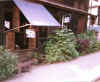 |
Telecommunication
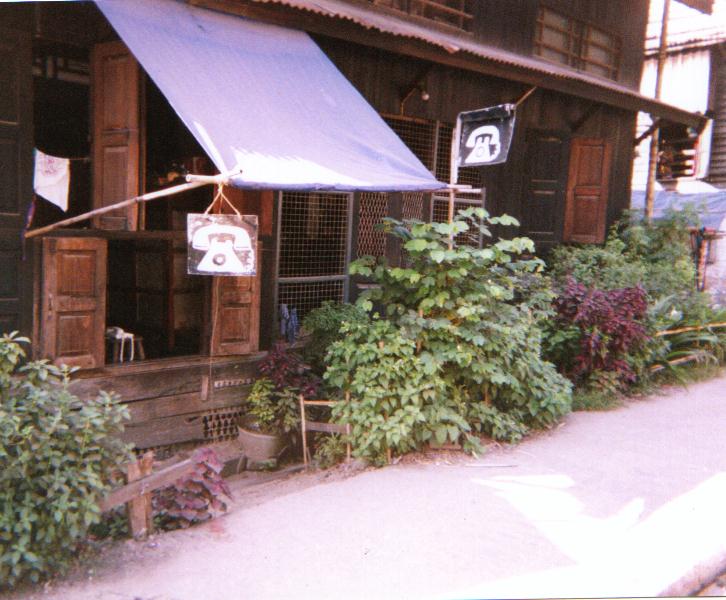
A common sight in Yangon and Mandalay, private pay phones which cost
about 20 kyat (or US$0.06). Small towns still maintain a manual
switchboard.
|
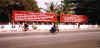 |
State Propaganda - "The People's
Desire"
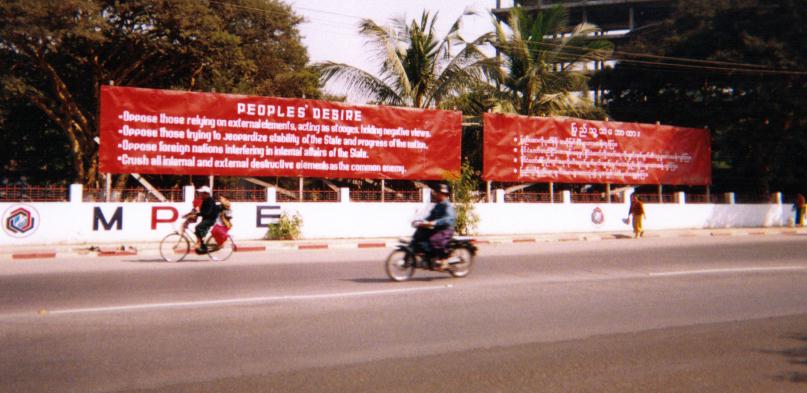
The ruling military junta, the State Law and Order Restoration Council
(SLORC), not only dominate television, radio and print with propaganda but
also the streets... ...this poster reads:
 | "Oppose those relying on external elements, acting as stooges,
holding negative views, |
| Oppose those trying to jeopardize stability of the state and
progress of the nation, |
| Oppose foreign nations interfering in internal affairs of the state, |
| Crush all internal and external destructive elements as the common
enemy." |
|
|
Bago (Pegu) |
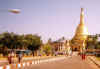 |
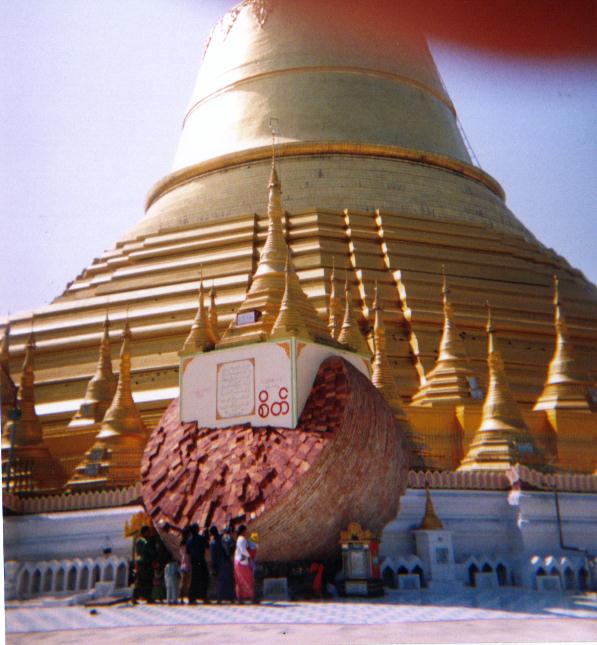
Shwemawdaw Paya
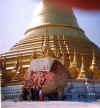
The Shwemawdaw is said to be over 1000 years old and was originally
built by the Mon to a height of 23m to enshrine two hairs of the
Buddha. Current reaching the height of 114 metres after many
renovations and reconstructions due to massive earthquakes in 1912, 1917
and 1930. The picture to the left is shows a portions of the hti
that toppled from the stupa in 1917. |
 |
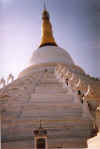 |
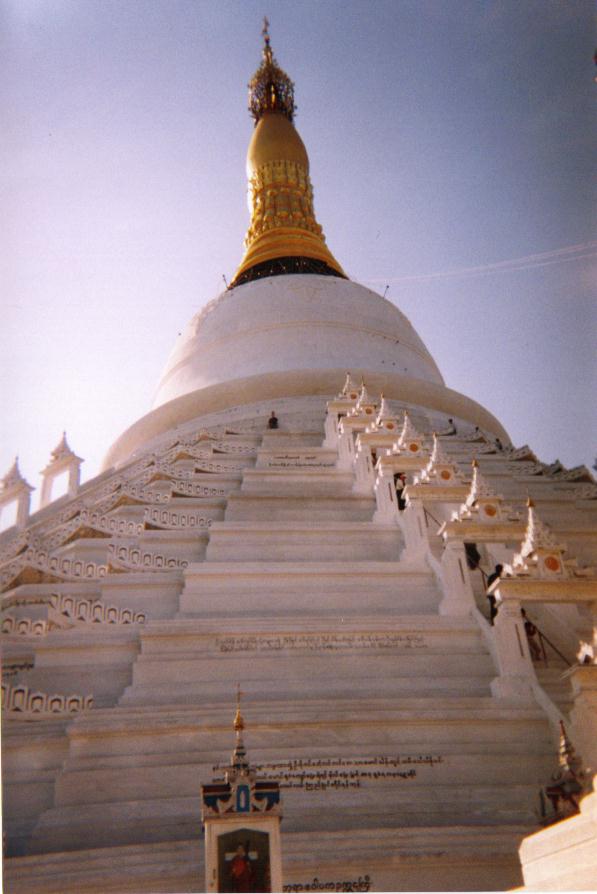
Mahazedi Paya
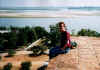
The Mahazedi (or 'Great Stupa') was contructed in 1560 by King
Bayinnaung but destroyed in 1757 during the sack of Bago. The
current construction was completed in 1982, but more notable is the
awesome view from the top of the stupa (that's me in the centre of the
photograph). Piercing the surrounding jungle canopy at random
intervals are hundreds golden stupas.
|
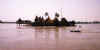 |
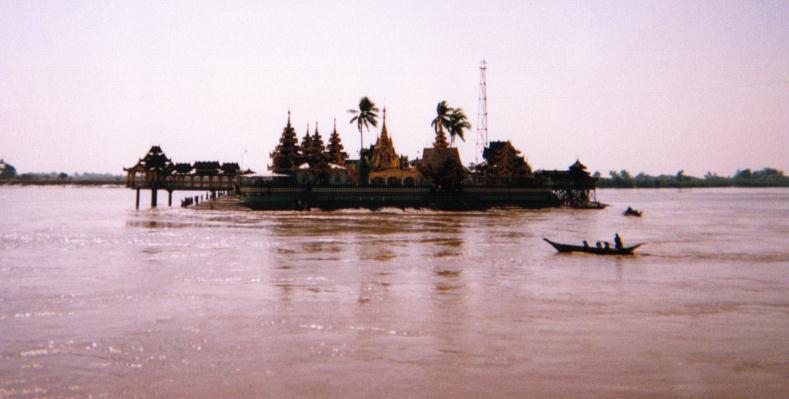
Name and location unknown ("I
forgot").
This place was bizarre, a large temple complex residing in the middle
of a chocolate coloured river. Whilst people waited for water taxis
(left hand side of the island) the surrounding water boiled with catfish
fighting for meagre offerings.
|
|
Mandalay |
 |
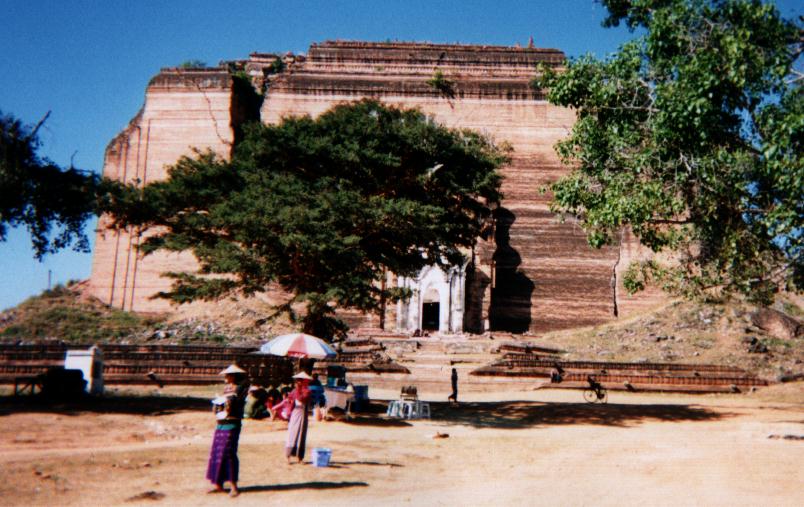
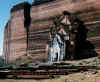
Mingun Paya
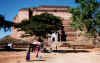
The Mingun village is located about 11km up river from Mandalay on the
opposite side of the Ayeyarwady river and is only accessible by
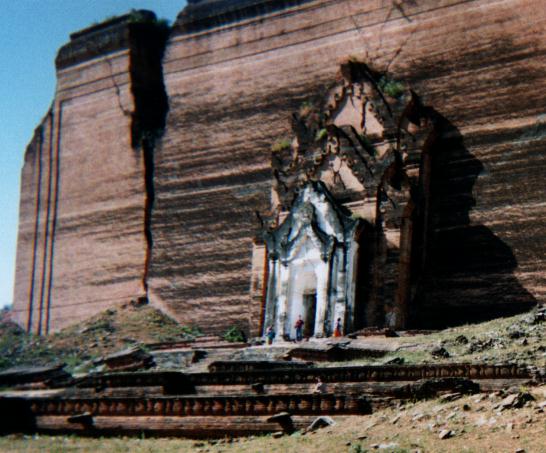
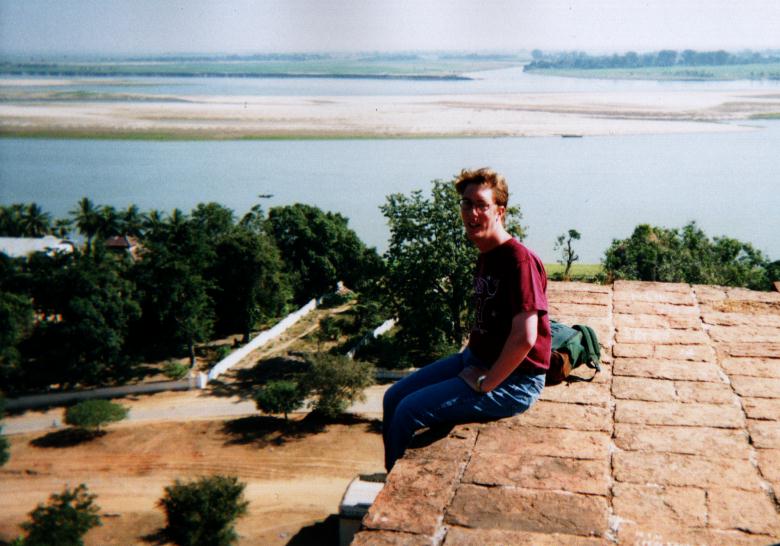
boat. The ruins of Mingun Paya would have to rate as one of the
highlights of my holiday... ...even in its present state it is one
huge structure.
Twenty thousand slaves laboured to build the massive stupa beginning in
1790. Work halted in 1819 when King Bodawpaya died, leaving a brick
base that stands about a third of its intended height.
Although partially destroyed during an earthquake in 1838 is currently
stands 50m high with a base measuring 72x72m. If completed it would
have stood 150m high.
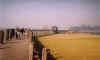
In 1808 King Bodawpaya had a gigantic bell cast to go with his gigantic
zedi. Weight in at 90 tonnes it is claimed to be the largest
uncracked bell in the world.
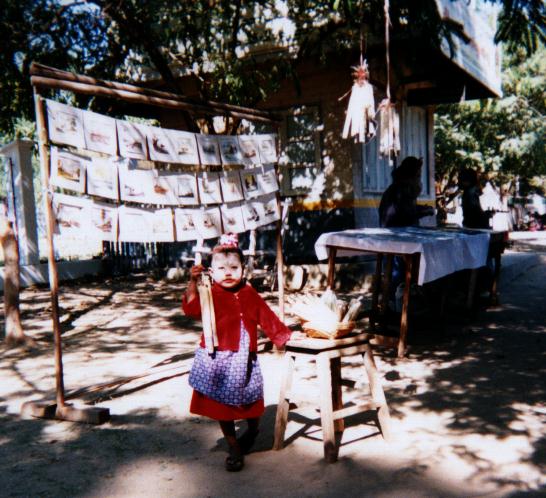
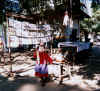
Pictured last is a young girl hawking Burmese cigars (cheroots).
With the exception of young women, practical all Myanmar people are
chewing betel nut or smoking cigars. Older women tending to prefer
the huge cigars as advertised in the photo. |
 |
 |
 |
 |
u_beins_bridge
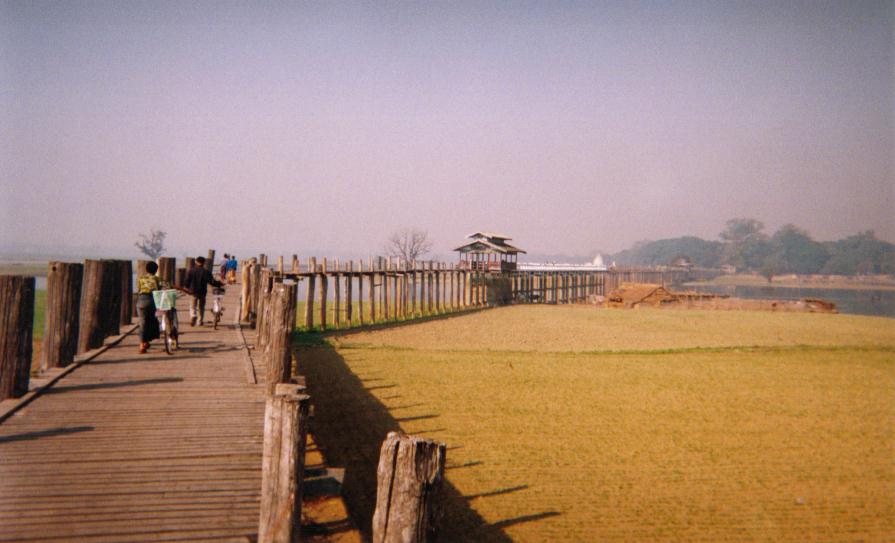
South of Pahtodawgyi, the shallow Taungthaman Lake is crossed by a long
and rickety teak bridge. During the dry season the bridge crosses
dry land. U Bein was the 'mayor' at the time of the shift from Ava,
and he wisely salvaged material from the deserted Ava Palace to build this
1.2 km long footbridge. It has stood the test of time for two
centuries and remains the longest teak span in the world.
|
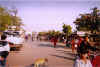 |
Street Scene
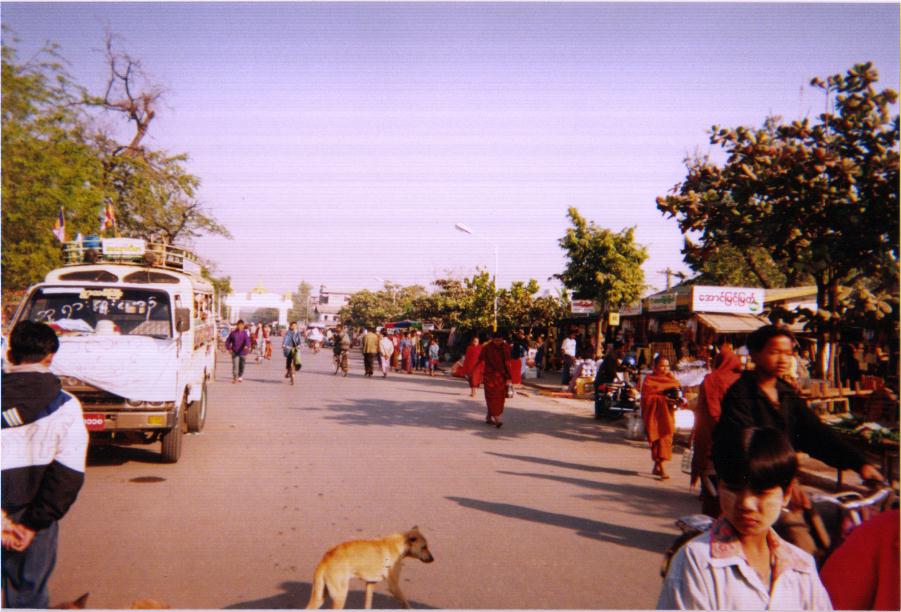
A typical Myanmar street scene. On the left hand side of the
photograph is a parked public bus, normally second hand Toyota Hilux utes
from China. During particular claustrophobic journey in the back on
these vehicles I counted 35 other passengers.
To the right of the photograph are some novice monks seeking food (or
money) for the morning meal. |
 |
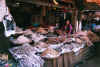
Beggars
Beggars in Myanmar were surprisingly common. Although generally
regarded as lazy most Myanmar people give without hesitation. An
interesting quirk to the begging industry in Myanmar were people posing as
Monks and Nuns.
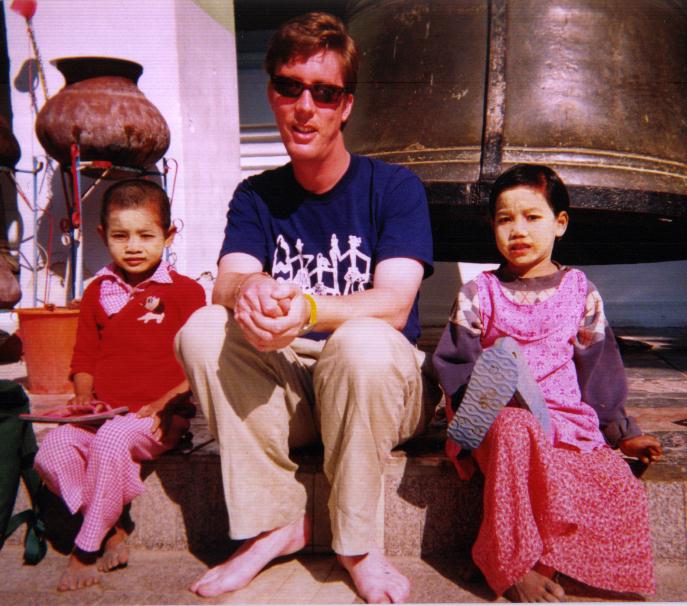
These children were seeking donors at an attraction in Mandalay.
Like these children most women and young men in Myanmar smear powdered
teak wood (or preferably bark) cream on their faces for skin protection
and nutrition. |
| Pyin U Lwin (Maymyo) |
 |
During the British annexation of
Myanmar, Pyin U Lwin was renamed Maymyo after a British Colonel May, and
among many people it is still referred by its colonial name. Pyin U
Lwin was long a British hill station where, during the hot season, the
servants of the Raj went to escape the heat and dust of the plains.
As a legacy of the influx of South Asians during the British colonial
era, Pyin U Lwin township has a large Nepali and Indian ethnic
group. Pyin U Lwin has a large sweater-knitting industry, another
large but unpublicised occupation is smuggling goods between Myanmar and
China along the Burma Road to the north-east.
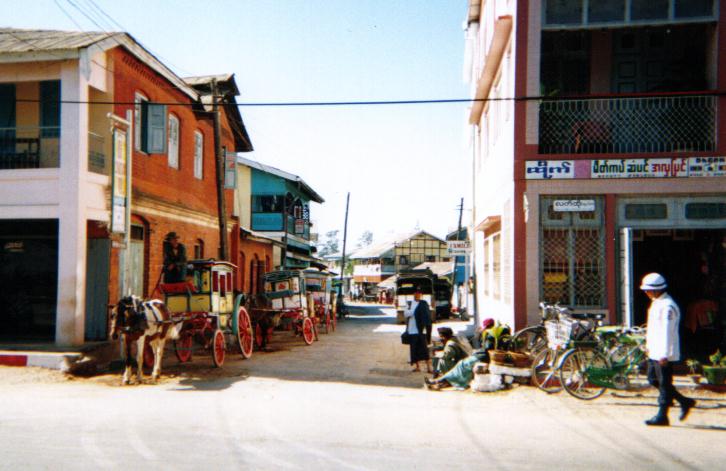
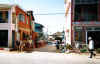
An unusual quirk of this township are the miniature carriages pulled by
ponies (as pictured). To take a ride in one of these pony carts is
like a time-warp to the American Wild West. |
 |
|
Inle Lake |
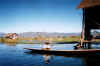 |
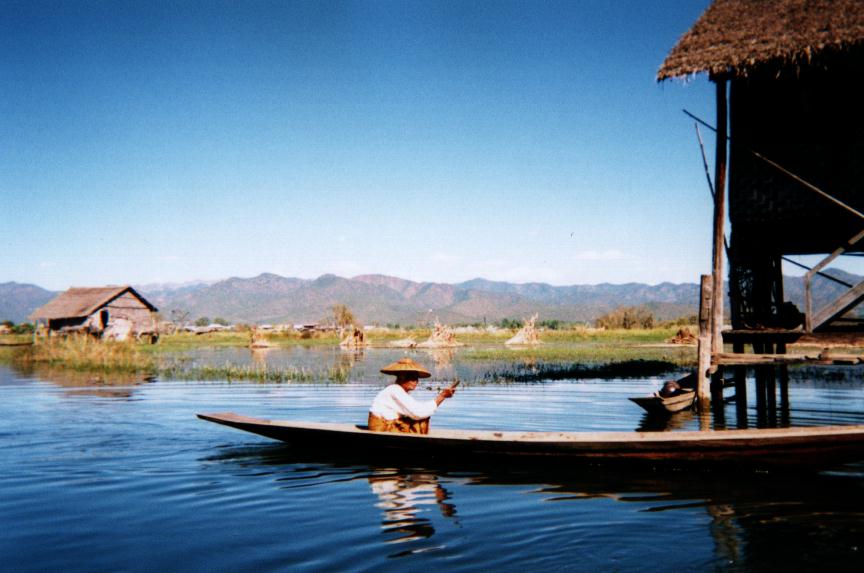
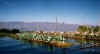
Inle Lake is 22 km long, 11 km wide, 1328
metres above sea level and outrageously picturesque - it has dead calm
waters dotted with patches of floating vegetation and busy fishing
canoes. High hills rim the lake on both sides; the lakeshore and
lake islands bear 17 villages on stilts, mostly inhabited by the Intha
people.
The hard-working Intha are famous for propelling their flat-bottomed
boats by standing at the stern on one leg and wrapping the other leg
around the oar. This strange leg-rowing technique offers relief to
the arms - which are also used for rowing - during the long paddles from
one end of the lake to another.
|
 |
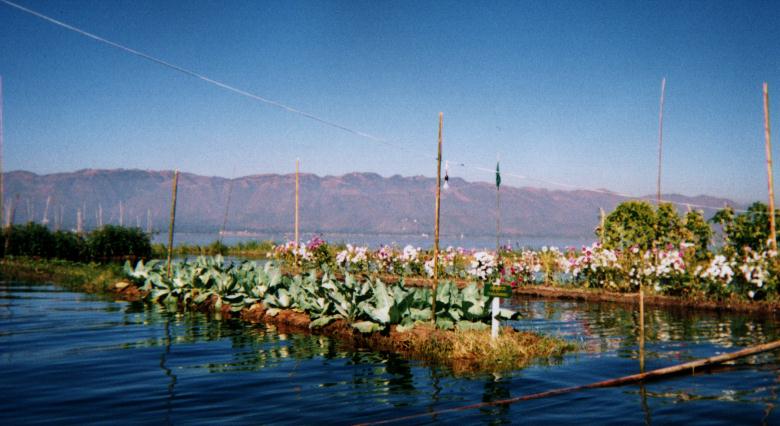
The industrious villages inhabiting the lake
region support themselves by growing a wide variety of flowers, vegetables
and fruit all year round. Many of these crops are cultivated on
floating islands, where marsh, soil and water hyacinth have combined to
form incredibly fertile solid masses which are staked to the lake bottom
with bamboo poles. |
 |
Nga Phe Kyaung
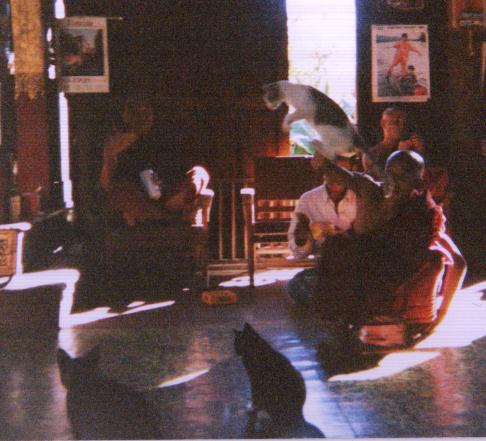
This monastery located on Inle Lake has an impressive collection of
Buddhist images but the monastery is famed for its jumping cats!
Picture is one of the star cats in action jumping through a loop held by
one of the monks. |
 |
Phaung Daw U Kyaung
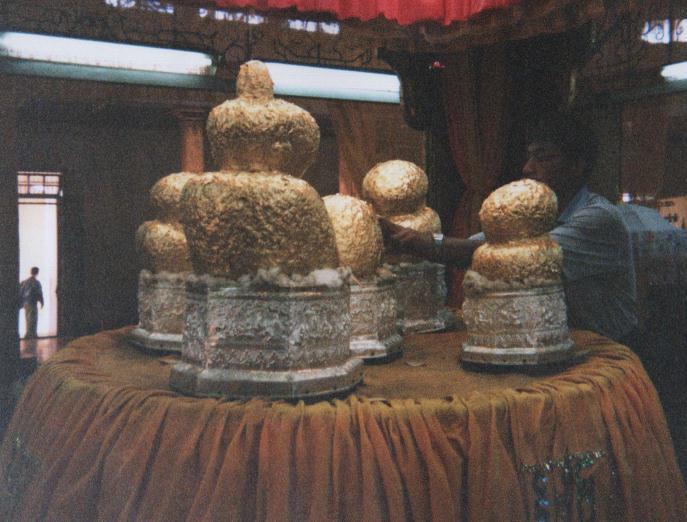
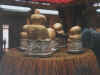
One of holiest sites in the Shan State, it is the home of five
gold-leaf-covered statues, of which three are said to be Buddha images,
while the remaining two are reportedly Arahats or historical disciples or
Buddha. The gold leaf on the figures has figures has become so thick
that it is hard to tell what the figures represent.
The statues were reportedly fashioned during the rein of King
Alaungsithu (1112-1167AD). The gold lumps are so holy that pilgrims
rub red strips of cloth against them, then tie the cloth strips to their
bikes, cars and trucks to create protective spiritual force-fields around
themselves and their vehicles.
|
|
Fateful Journey... |
 |
Two thirds along the fifteen hour bus journey
from Inle Lake to Nyaung U (near Bagan) the bus broke down in the middle
of nowhere. It was early afternoon when the bus driver and conductor
left the bus to fetch a replacement part from the next township. The
driver never returned!
Most passengers were already fast asleep sacrificing their bodies to
the mosquitoes when I abandoned the bus on the back of a truck to Kyauk
Padaung. The hotel manager in the Kyauk Padaung had to seek special
dispensation to allow me to stay (<US$1/night) as none of the hotels in
the township had a license for foreigners.
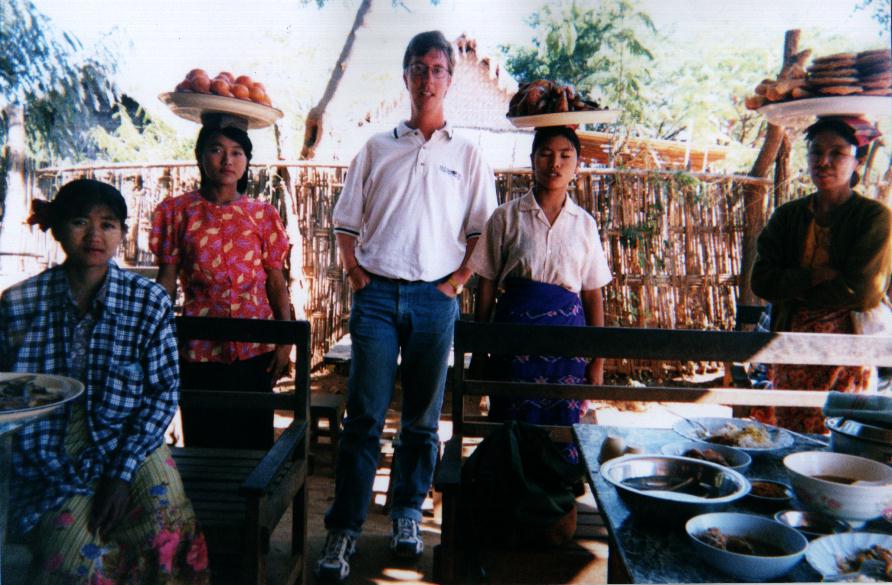
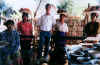
At any stop during a long bus journey (either intentional or not)
people swarm around and inside the bus offering many types of eatable (hygiene
optional) treats. At the lunch stop pictured to the left, women are
offering oranges, roast chicken pieces, fried prawn fritters, cured goat
meat (or other bits?) and crackers. |
|
Mount Popa |
 |
One advantage of the forces detour to Kyauk
Padaung (see above) was the close facinity to Mount Popa which would
otherwise be a full day trip from Bagan.
Whilst the temple complex is nothing extraordinary the sight of it atop
a huge vertical column of rock is amazing. The bizarre natural
formation, which is more impressive from a distance, is considered the
abode of Myanmars most powerful nats and as such is the most
important nat worship centre. At the base of the rocky
outcrop there is a display of mannequin-like figures representing the 37 nats.
|
| Bagan (Pagan) |
|
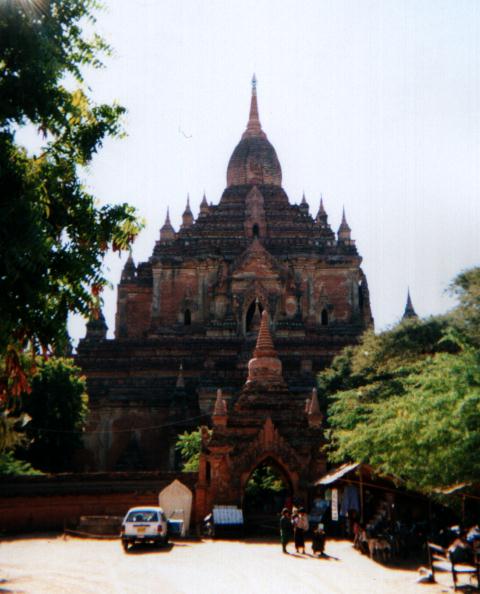
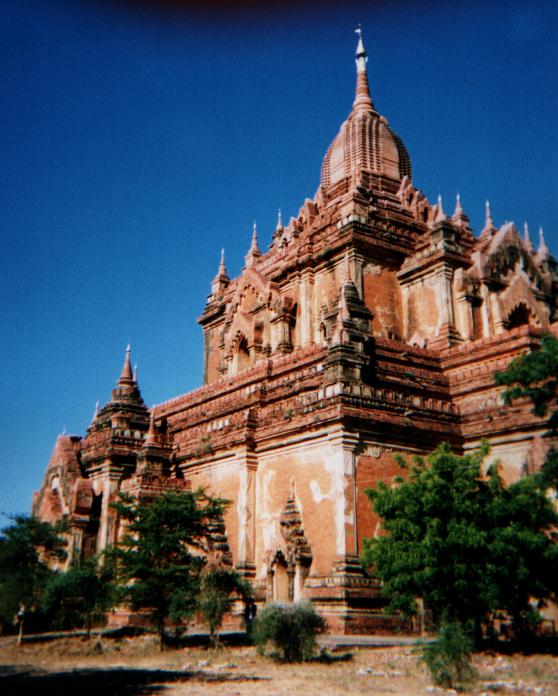
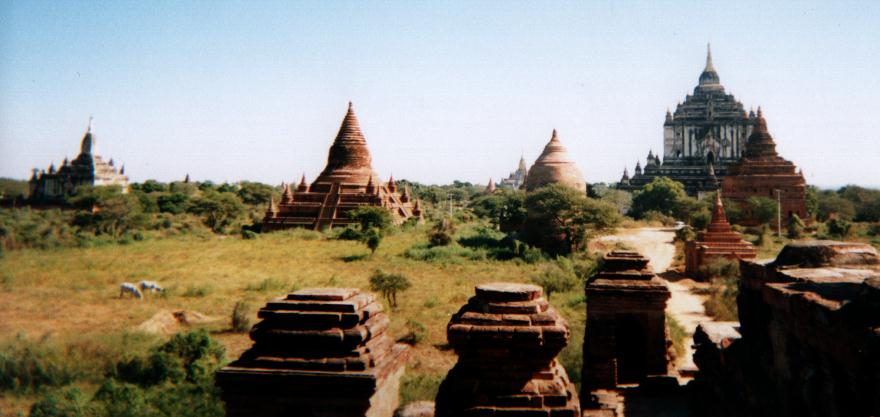
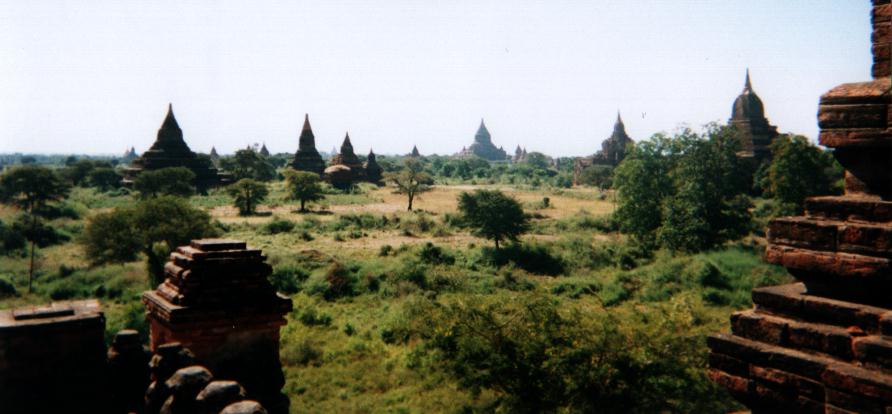
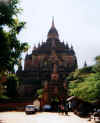
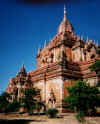
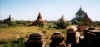
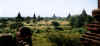
Bagan is the most amazing sight in Myanmar, if
no South East Asia. Across 40 sq km of country, stretching back from
the Ayeyarwady, stand literally thousands of stupas and temples. In
every direction you look you will see ruins of all sizes - huge and
glorious temples like the Ananda soar towards the sky, small, graceful zedis
stand alone in fields. Some come with all manner of historical
tales, while others are identified only in a number.
The extraordinary religious fervour that resulted in this unique
collection of buildings lasted two and a half centuries. Although
humans habitation at Bagan dates back almost to the beginning of the
Christian era, Bagan only entered its golden period with the conquest of
Thation in 1057 AD. Just over 200 years later, Bagan declined and in
1287 was overrun by the Mongols of Kublai Khan. But what fantastic
effort went into those two and a half centuries - it is as if all the
mediaeval cathedrals of Europe had been built in one small area, and then
deserted, barely touched over the centuries.
Bagan's prime began with the Burman King Anawrahta's ascent to the
throne in 1044. At the time, Myanmar was in a period of transition
from Hindu and Mahayana Buddhist beliefs to the Theravada Buddhist beliefs
that have since been characteristic of Myanmar. Manuha, the Mon king
of Thaton, sent a monk to convert Anawrahta; latter met with such success
that Anawrahta asked Manuha to give him a number of sacred texts and
important relics. Manuha uncertain of the depths of Anawrahta's
beliefs, refused the request. Anawrahta's reply to this snub was
straightforward - he marched his army south, conquered Thaton and carted
back to Bagan everything worth carrying, including 32 sets of the Tripitaka
(the classic Buddhist scriptures), the city's monks and scholars and, for
good measure, King Manuha himself. All in all some 30,000 Mon
prisoners of war were brought to Bagan from Thaton.
Marco Polo described the city state of Bagan in hi famous 1298
chronicle:
"The towers are built of fine stone; and then one of them has
been covered with gold a good finger in thickness, so that the tower looks
as if it were all of solid gold; and the other is covered with silver in
like manner so that it seems to be all of solid silver... ...The
King caused these towers to be erected to commemorate his magnificence and
for the good of his soul; and really they do form one of the finest sights
in the world, so exquisitely finished are they, so splendid and
costly. And when they are lighted up by the sun they shine most
brilliantly and are visible from a vast distance."
|
 |
 |
 |
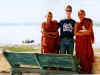 |
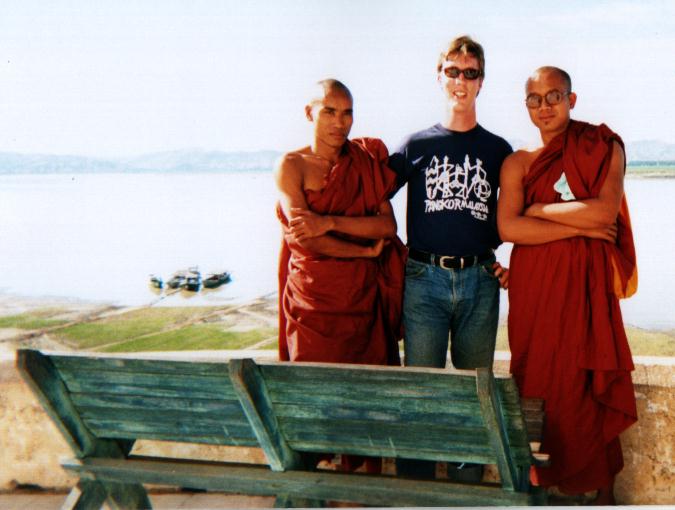
This picture was taken at the Bupaya stupa
situated on the banks of the Ayeyarwady and is reputed to be the oldest in
Bagam (~850AD) and in my opinion the ugliest. The two gentlemen are
monks from Mandalay who's English was worst than my Burmese.
Socially, every Burmese male is expected to take up temporary monastic
residence twice in his life: once as a samanera or novice monk
between the ages of 5 and 15 and again as a fully ordained monk or pongyi
sometime after age 20. Almost all men or boys under 20 years of age
participate in the shinpyu or novitiation ceremony - quite a common
event since a family earns great merit when one of its sons takes robe and
bowl. A samanera adheres to 10 precepts or vows, which include the
usual prohibitions against stealing, lying, killing, intoxication and
sexual involvement, along with ones forbidding: eating after noon;
listening to music or dancing; wearing jewellery, garlands or perfume;
sleeping on high beds; and accepting money for personal use. A
novice usually lasts a week or two - nine days is an auspicious number.
Later in life a male should spend three months as a pongyi at a
monastery during the Buddhist Lent (Waso) which begins in July and
coincides with the rainy season. For many men the post-rice harvest,
hot-season hiatus between January and April is a more convenient
time. Some men spend as little as three to nine days to accrue merit
as monks. Others may enter the monkhood yet a third time, since
three is considered an especially lucky number.
|
|
Mruak U (Myphaung) |
 |
Once a centre for one of Myanmar's most
powerful kingdoms, Mrauk U straddles the banks of Aungdat Chaung, a
tributary of the Kaladan River, 72 km from the coast.
The Rakhine King Minzawmun founded Mrauk U in 1433 and in the next
century it became a free port that traded with the Middle East, Asia,
Holland, Portugal and Spain; elephant were one of the main commodities
supplied from the Rakhine region. A Dutchman who visited Mrauk U in
the 16th century described it as one of the richest cities in Asia, and
compared it with Amsterdam and London in size and prosperity.
The Mrauk U dynasty, which lasted 352 years, was much feared by the
peoples of the Indian subcontinent and central Myanmar. Mrauk U
kings even hired Japanese samurai as bodyguards against
assassination. At Mrauk U's peak King Minbin (1531-53) created a
naval fleet of 10,000 war boats that dominated the Bay of Bengal and Gulf
of Martaban.
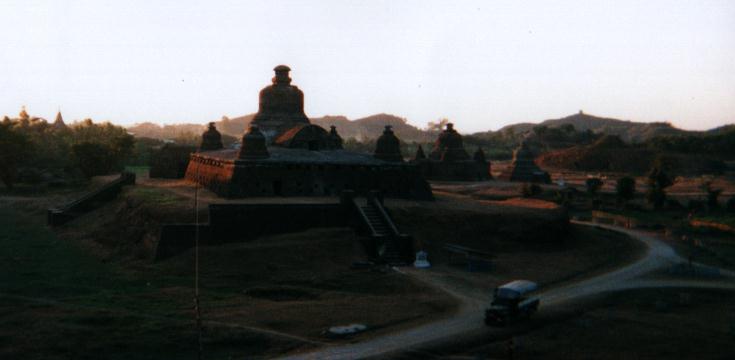
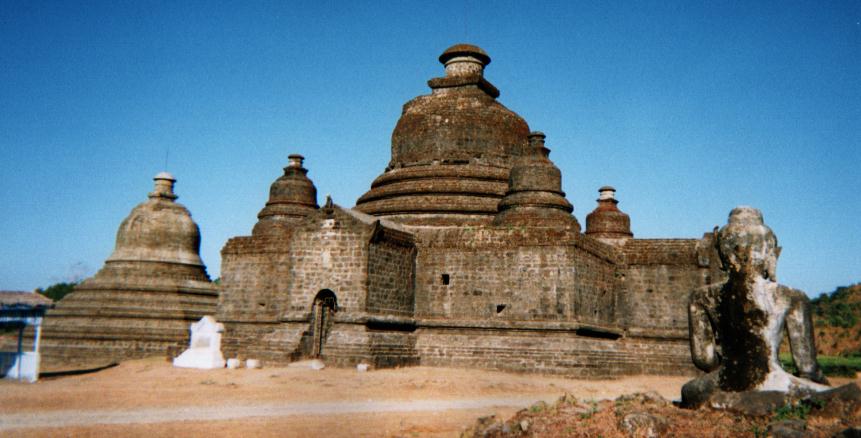
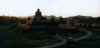
Pictured to the left is the impressive Dukkanthein at sunset.
Dukkanthein, said to have been constructed by order of King Minphalaung in
1571, loosely translates to 'ordination hall that spiritually reinforces
the town'. The cloisters are lined with 146 Buddha niches along with
sandstone reliefs depicting 64 different types of hairstyles for the wives
of Mrauk U nobility.
|
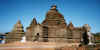 |
Laymyetnha
|
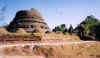 |
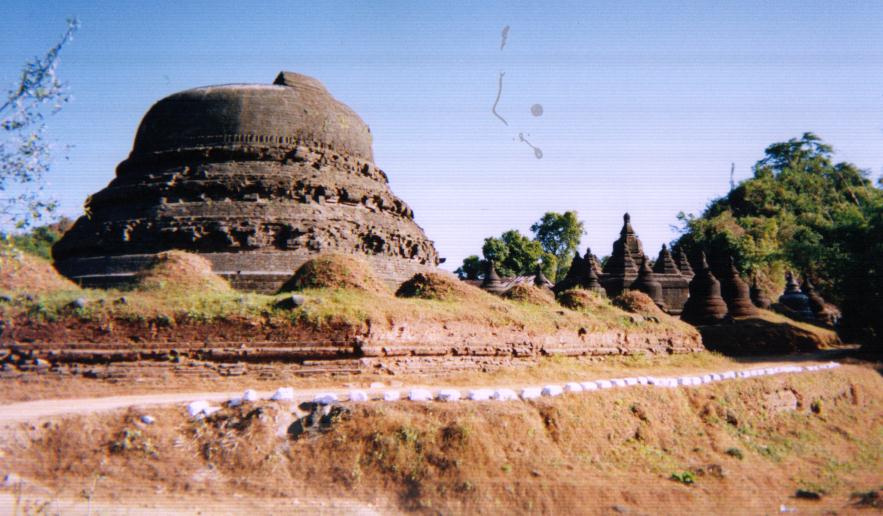
Yadanapon Paya & Andaw Paya
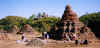
Yadanapon Paya (left) is the largest stupa in the area but was heavily
damaged during WW II bombing.
Andaw Paya (right) was originally constructed by King Minhlaraza in
1521. King Minrazagi then rebuilt Andaw in 1596 to enshrine a piece
of the tooth relic supposedly brought from Sri Lanka by King Minbin in the
early 16th century. |
 |
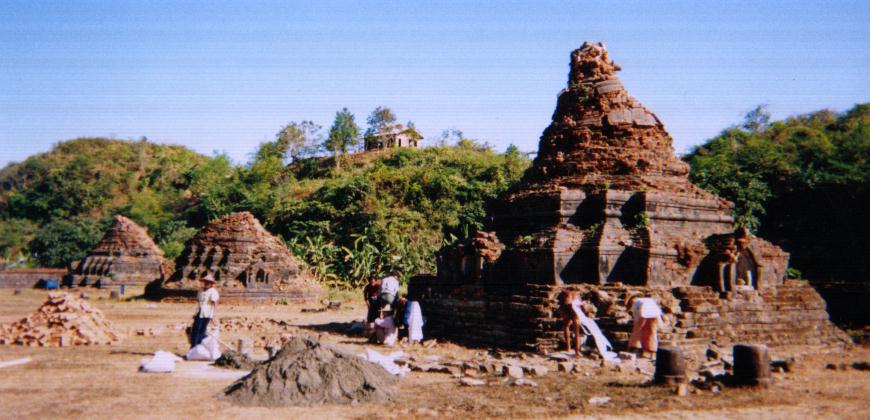
Stupa Reconstruction
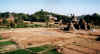
Many of the restoration and reconstruction projects in Myanmar
(primarily Bagan and Mrauk U) are funded by UNESCO. There is some suspicion
that the military pockets most (if not all) of the entrance fees requested
from foreign tourist to enter Myanmar's archaeological sites. |
 |
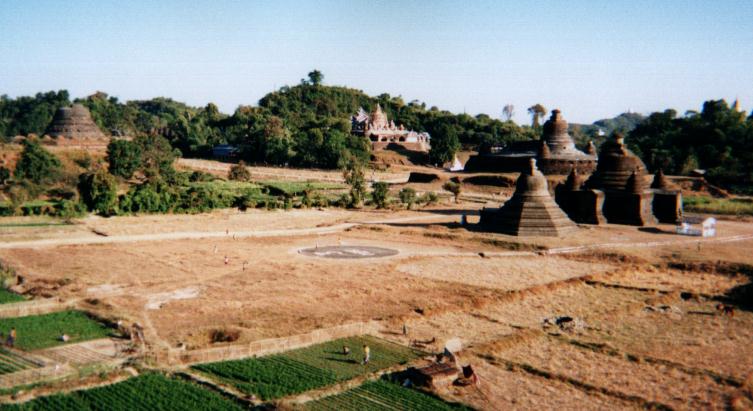
Shittaung, Laymyetnha & Dukkanthein
View from the top of the crumbled ruins of Parahia. At the
top-centre of the photograph is most complex and well-preserved of the
surviving Mrauk U temples, Shittaung. And on the right hand side are
the temples of Laymyetnha and Dukkanthein.
Shittaung was built in 1535 by King Minbin, the most powerful of the
Rakhine kings. The name means 'Shine of the 80,000 images', a
reference to the number of holy images found inside. A maze-like
floor plan - which vaguely resembles a square-cornered pinwheel - suggests
the shrine was originally used for Tantric-like initiation rituals.
Though much smaller in size, Shittaung shares many architectural
similarities with Indonesia's Borobudur.
|
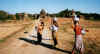 |
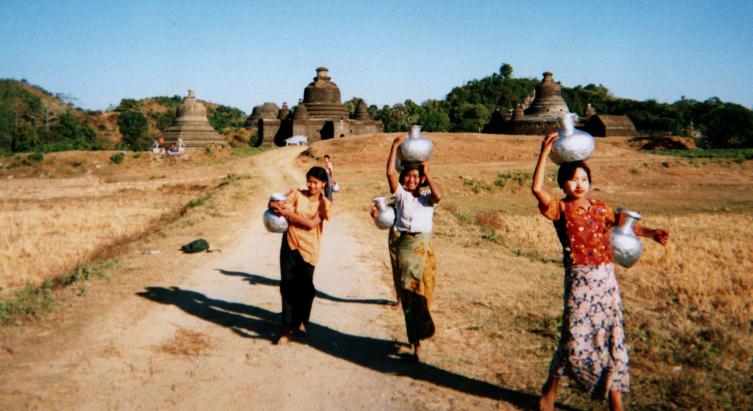
Water Carriers
Young women returning home after fetching water from a well located
near the old temples. Unlike the rest of Myanmar that use clay pots
or rectangular oil tins, Mrauk U residents prefer to use aluminium pots
imported from India.
|
 |
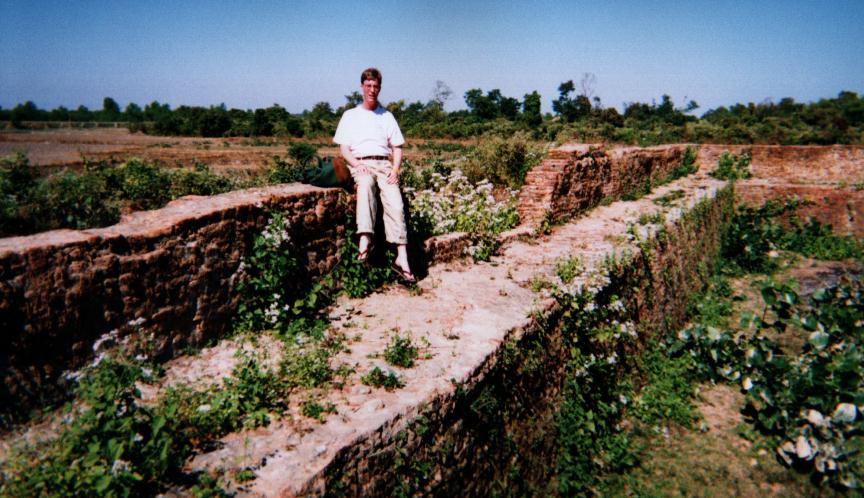
Wethali
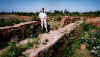
Just under 10 km north of Mrauk U are the remains of the Wethali
kingdom. According to Rakhine chronicles, Wethali was founded in 327
AD by King Mahataing Chandra, Archaeologists believe that this kingdom
lasted until the 8th century. The only remains of the ancient city
are parts of the city wall and moat and the pictured structure which used
to be the palace prayer hall.
|
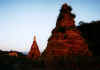 |
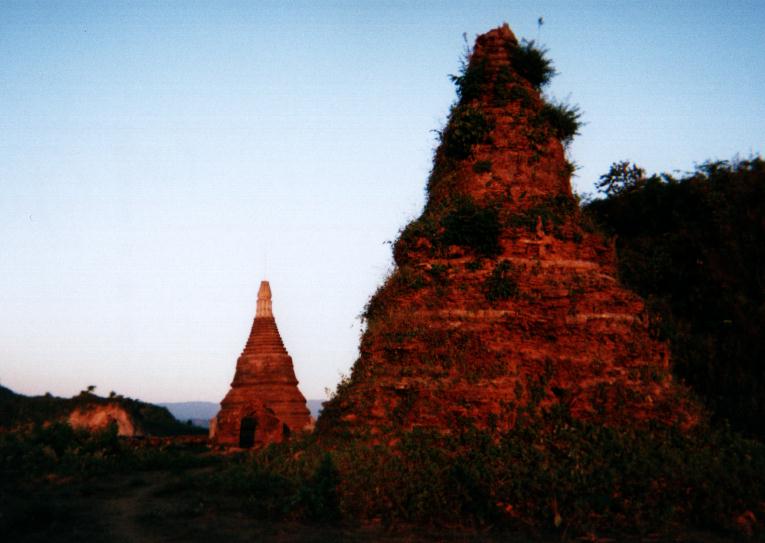
From the hilltop on the edge of Mrauk U
township two stupa are bathed in the light of sunset. |