
What to do when your head is/has...
| incorrect --> The flatness of the head is emphasized because the hair is flat and too low on top. |
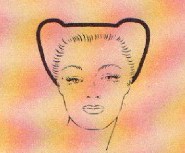 |
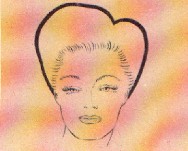 |
<-- correct The top hair arrangement is high, and causes the flatness of the head to be noticeable. |
| incorrect --> The high forehead is exposed, and the high hair arrangement accentuates it. The up-do causes the upper half of the face to look longer. |
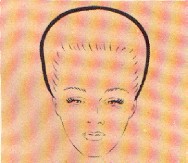 |
 |
<-- correct Flatness and bangs shorten the face length, and conceal the high forehead. Fullness at the sides gives good proportion to the face. |
| incorrect --> The hair arrangement is too flat on top and calls attention to the low forehead. |
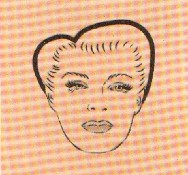 |
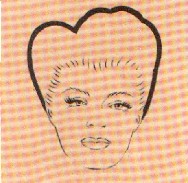 |
<-- correct The hair has a high outline that causes the upper half of the face to appear normal. (Bangs are also good for low foreheads IF they have height.) |
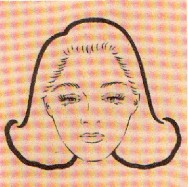
| incorrect --> Because the hair converges to a point on top, attention is attracted to the narrow temples. The hair is too wide at the bottom. |
 |
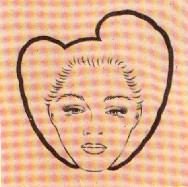 |
<-- correct Width in the temple area and moderate height on top causes the temples to appear wider. |
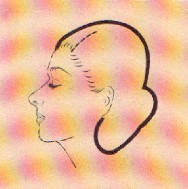
| incorrect --> The top of the hair continues the line of the nose, and therefore emphasizes its length. The hair arrangement on the neck also repeats the line of the nose. The up-diagonal part is bad because it takes the same direction as the nose. |
 |
 |
<-- correct The top hair is well to the front and has a soft outline. This draws the eye away from the nose, and gives better proportion to the upper half of the face. The hair on the neck and over the ears is full and casual. |
| incorrect --> Since the center part divides the face into two equal parts, attention is attracted to any feature that is off balance. Notice the dotted line in this sketch. If the part were here, the crooked nose would be emphasizes because the part would take the same direction as the nose. |
 |
 |
<-- correct The side part and irregular outline draws the eye away from the crooked nose. Surveys indicate that nine out of ten women have crooked noses. |
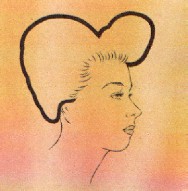
| incorrect --> The outline of the hair is too wide at the top, and because it narrows down, the eye is directed to the receding chin. |
 |
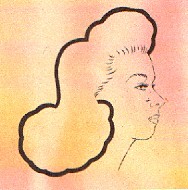 |
<-- correct The top hair is full and irregular in shape. The soft hair arrangement on the neck and over the ears gives good proportion to the lower half of the face, and draws the eye away from the receding chin. (These incorrect and correct outlines also apply to a PROTRUDING JAW.) |
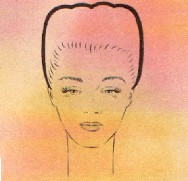
| incorrect --> The hairdress has an all up line. The outline of the hair at the sides is almost straight up and down. These vertical lines take the same direction as the neck line, and make the neck appear longer and thinner than it really is. |
 |
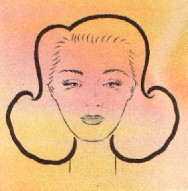 |
<-- correct This style fills out the face and causes the long neck to be less noticeable. |
| incorrect --> The top hair continues the line of the receding forehead, thus emphasizing the bad feature. |
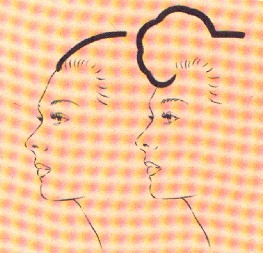 |
<-- correct The soft bangs conceal the upper half of the forehead and make it appear normal. |
| Center parts are becoming to about ten percent of the American women, so avoid center parts if your features are not regular. Properly shaped and tapered hair is more flattering than hair which is all the same length. Loose, fluffy curls are more becoming than small, tight curls. Wide, soft waves are more artistic and flattering than narrow, ridgy waves. Up-lines in a hairdress make one appear buoyant, and seem to erase facial lines. Scars and deep wrinkles on the forehead can be hidden by bangs. If there are wens or bumps on the head, decide on a part that does not show them and arrange the hair in rolls or bangs to cover them. If there are scars or birth marks behind the ears, plan fullness so the defect will be concealed. Small faces are best complimented by a style that is soft, wispy, and in proportion to the size of the head. Excessively large or small hairdresses should be avoided. Women with large faces should wear wide waves and full rolls. Fussy details are out. The problem of a short neck is best solved by wearing the hair high with the ears partly showing. This gives the illusion of a longer neck. A swirled back with diagonal waves is suitable. Sloping shoulders are best counteracted by a style that is low and full on the neck. Avoid hairdresses that have all-up lines. Broad shoulders are emphasized when the lines ofa hairdress are horizontal. Short women can add inches to their height by wearing high hairdresses.
|