CELESTIAL PORTRAITS
Astronomy Articles
Astronomy Articles
Astronomy Articles: Rotational Smearing
ARTICLE1: ROTATIONAL SMEARING
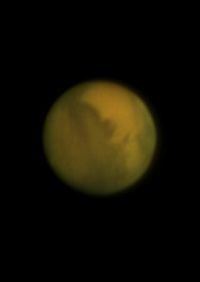
ROTATIONAL SMEARING
[ROTATIONAL SMEARING] Very often, AVI video sequence files are used to capture planetary images in the initial stage before using stacking software like Registax to stack the individual sub-frames of the AVI sequence. However, in order to maximize the amount of detail and features seen on the planetary surface, there is a limit to how long the AVI sequence should be, before planet rotationary smearing begins.
Once smearing occurs, details will be "blurred" and the end result will be an image that is not as sharp as one where the optimum smearing limit duration is not overlooked. Depending on the planet's rotation, we have varying limits for different planets, and each planet itself might have differentail rotational periods (for example Jupiter). In this case, we will assume the equatorial rotational speed of that planet instead. The following calculations will all be based on assuming the use of Phillips' Toucam Pro II camera which is widely used in the amateur astronomy imaging community.
ROTATIONAL SMEARING CALCULATION
[ROTATIONAL SMEARING CALCULATION EXAMPLE - MARS]
Let us take Mars as our first example.
Assuming the Toucam Pro II web-camera is used in imaging (640x480 capture resolution,
3.87mm x 2.82mm chip dimension) and we are using an 8-inch SCT (2032 f.l.) with 5X Televue
Powermate barlow:
Resolution (arc-seonds) / pixel =
pixel size in microns of capture device / effective focal length (mm) of imaging instrument * 206
Mars has an angular diameter as 20 arc seconds (assumption). It will therefore cover 20/0.12165 pixels on the Toucam imaging chip. This works out to 164.4 pixels. We take 164 pixels (take the lower rounded off limit) instead.
Next, we need to consider the linear rotation of Mars (km per minute) of its surface. Mars has a linear diameter of 6794km. Therefore it's circumference is
The length of a typical day on Mars is 24.6597 hours. Therefore, the rotation per minute at the central meridian of Mars is
As such, we are able to know now that each pixel spans a definite amount in km on Mars. For 164 pixels, each pixel at the central meridian spans
Finally, we are able to calculate the smearing rate (in minutes) per pixel.
(41.43km/pixel) / (14.42km/min) = 2.873 minutes/pixel
Therefore, it takes approximately 3 minutes for rotation to smear across one pixel at the central meridian where the effect is the worst. You can certainly use your own criteria as to how much smear is acceptable.
= 6/(2032*5)*206
= 0.12165" / pixel
6794 Km diameter x 3.14159 = 21344km
21344km / (24.6597 x 60 minutes) = 14.42km/min
6794km diameter / 164 = 41.43km
FURTHER ROTATIONAL SMEARING EXAMPLES 1
[ROTATIONAL SMEARING CALCULATION EXAMPLE - JUPITER]
Let us now take Jupiter as a working example.
Again, we assume the same setup for the camera and imaging instrument as above, plus the same barlow:
Resolution (arc-seonds) / pixel = 0.12165" / pixel
However, Jupiter has a larger angular diameter of 40 arc seconds (assumption). It will therefore cover 40/0.12165 pixels on the Toucam imaging chip. This works out to 328.8 pixels. We take 328 pixels (take the lower rounded off limit) instead.
Next, we need to consider the equatorial linear rotation of Jupiter (km per minute) of its surface. The Jovian giant has a equatorial linear diameter of 142984km. Therefore it's circumference is
142984km diameter x 3.14159 = 449197km
The length of a typical day on Jupiter is 9.9250 hours (based on System III 1965.0 sideral rotational period coordinates). Therefore, the rotation per minute at the central meridian of Jupiter is
449197km / (9.9250 x 60 minutes) = 754.3km/min
As such, we are able to know now that each pixel spans a definite amount in km on Jupiter. For 328 pixels, each pixel at the central meridian spans
142984km diameter / 328 = 435.9km
Finally, we are able to calculate the smearing rate (in minutes) per pixel.
(435.9km/pixel) / (754.3km/min) = 0.578 minutes/pixel
Therefore, it takes approximately 0.6 minutes (or 35 seconds) for rotation to smear across one pixel at the central meridian where the effect is the worst.
FURTHER ROTATIONAL SMEARING EXAMPLES 2
[ROTATIONAL SMEARING CALCULATION EXAMPLE - SATURN]
We shall consider Saturn next.
Let us use the same imaging setup configuration again like above.
Resolution (arc-seonds) / pixel = 0.12165" / pixel
Saturn has an average angular diameter of 18.9 arc seconds (assumption). This is equivalent to 155 pixels. The ringed planet has a equatorial linear diameter of 119300km. Therefore it's circumference is 119300km diameter x 3.14159 = 374792km
Saturn's equatorial rotational period is 10.2331 hours. Hence, the rotation per minute at the central meridian of Saturn is
374792km / (10.2331 x 60 minutes) = 610.4km/min
As such, we are able to know now that each pixel spans a definite amount in km on Saturn. For 155 pixels, each pixel at the central meridian spans
119300km diameter / 155 = 769.7km
Finally, we are able to calculate the smearing rate (in minutes) per pixel.
(769.7km/pixel) / (610.4km/min) = 1.26 minutes/pixel
Therefore, it takes approximately 1.3 minutes (or roughly 80 seconds) for rotation to smear across one pixel at the central meridian where the effect is the worst.
[Note] Please note that the above calculations will just evaluate the smear rate only and says nothing about other conditions. Whether you can use a 5X barlow with an 8-inch SCT for example will really depends on your local conditons, for example whether the seeing is good enough for imaging at that effective focal length, or perhaps a lower applification barlow should be used instead. Also, collimation is extremely important when it comes to successful planetary imaging. This is especially so when SCTs are used. The way the SCT focuses (by motion of the primary mirror), collimation can be effected so make sure your scope is spot-on collimation-wise regularly even during an imaging session. Good luck!