
|
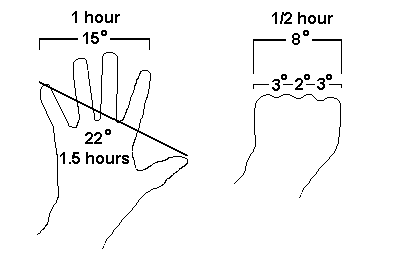
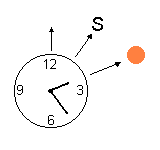
Finding Direction with a Watch Direction can easily be determined if you know the time. If you point at the sun at high noon, standard time, that direction is true south (north in the southern hemisphere). Magnetic compass headings can vary widely depending on where in the country you are, so sun-bearings are actually more accurate. By calculating how many minutes it is before, or after, noon, you can quite accurately determine directions at other times of the day. Method 1 - Doing the math Given: The earth is 360 degrees around. There are 24 hours in a day. Therefore: One hour represents 15 degrees of arc. One degree equals 4 minutes. Example 1 - At 11:00 a.m., it will be 60 minutes until noon, or 15 degrees of sun travel. Examine the diagrams below to see how to measure degrees using your hands on an out stretched arm. You see that the distance between your spread fingers is 15 degrees. Align your fingers so that one of them is on the sun with the others to the right side of it. (the sun is always moving left to right as you face it in the northern hemisphere). The far opposite finger is laying over true south, or where the sun will be at noon.. Example 2 - At 2:00 p.m., it has been 120 minutes since noon. That is 30 degrees (120 minutes / 4 minutes per degree). Place the spread fingers of both hands together and align them on the left side of the sun. True south is under the far opposite finger on the left. This system works best between the hours of 9:00 a.m. and 3:00 p.m. Method 2 - Using watch hands Hold the watch horizontally and point the hour hand at the sun. Bisect the angle between the hour hand and the 12:00 mark to get true south. If your watch is set to Daylight Savings Time, use the "1" instead of "12". If you have a digital watch, draw the watch face on a piece of paper or scratch it in the ground. See drawing below. Errors - Two things can affect how accurate your sun bearing is. The first thing is your relative position to the timeline. The Twin Cities is about in the middle of the Central Time Zone. At noon, the sun still has another 1/2 hour of travel before it is over head. For someone near the western edge of the timeline, sun-bearings will be nearly an hour off. Timelines are 15 degrees wide so that represents the maximum potential error in your heading. If you don't know your relative position to the timeline, add 30 minutes (7 or 8 degrees) to your sun-bearing. That cuts the maximum error in half. For the Twin Cities area of Minnesota, that puts you close to the mark. The second thing affecting your heading is the season or time of year. This has to do with adjusting mean (average) time with solar time. From April through September this error is 5 minutes or less, or only about 1 degree. That is much less error than a typical compass reading has. In the winter months this error can become as much as a 3 degrees, still too insignificant to worry about for basic navigation. |
|
Shelters & Water Survival Food Wild animals Weapons Directions Time Using the stars Walking out Setting up camp |



|
Using a watch to find south |