Age Of Empires
The Elephanta cave art works are fascinating and come from a time when the place was called GharaPuri (Note: Pur or Puri was a Dravir city). They were sculpted probably in the 6th century or were excavated in the 6th century. It is a place of tourism and pilgrimage. Nobody knows who built this gem of art and achitecture. These art are mostly of Shiva, the Hindu God. The art work here depicts the different aspects of Shiva. The artwork is strictly religious and rigid and belongs to the Archaic form. Another of the greatest centres of Art was the Chandelas. These Chandela emperors created some of the most breath taking rock cut temple complexes ever. There were originally 85 temples in the complex but only 22 have survived. Gods and goddesses, warriors, celestial dancers and animals, and couples in erotic poses are the theme of the art work of these temples. The Hindu philosophy of Y(j)oga and Bhog (physical pleasure) seem to be depicted in the fabulous art. The art work from the Khajuraho is of the classical form. In the east the Pal art (often mispronounced Pala) of Bengal (Pals also ruled Bihar and at one time all the way to Afganistan) was at its height. This art form influenced the art of Tibet, Nepal and the Tsang art of China. The Lobpuri art of Thailand (10th-13th century) was a mix of Pal, Khmer and local styles. In the far south under the Cholas great Hindu artwork continued to be produced.
Over all this was the climax of the age of empires though this age would spill into the first part of the Age Of Darkness. The Art form of this era is mostly classical. Archaic form survives but becomes more intricate. There is a ressurgence of Archaic form towards the end of this period. The baroque form also peeks in often.
Author: NOVO
E-mail: [email protected] 27th July 2000

The Ajanta caves was India's best kept secret until 1819, when it was discovered by the British. Before that it was only known to the Bhil tribe who are native to the land. The Ajanta cave-paintings start in the second centrury BC and contunue until the Gupta era some 600 years later.
Post-Gupta
5th Century -10th Century AD

Ajanta (Ancient Shiva site), near Bombay, India
Probably 6th century
Religious. Symmetry maintained and rigid.

Ajanta (Ancient Shiva site), near Bombay, India
Probably 6th century
Ornate headgear. Not fluid but not rigid.

Ajanta (Ancient Shiva site), near Bombay, India
Probably 6th century
Buddhist Art
Graceful and idealized.

Nepal
7th Century AD
Vishnu laying on his serpent on the cosmic waters. The statue is rigid.

South India
7th Century
In an idealized hunting pose, a partially preserved goddess.

Mahabalipuram, South India
Pallava Art
7th Century (Earliest in the 1st Century BC)
This is a realistic image of an elephant with babies. There is use of shapes.

Mahabalipuram, South India
Pallava Art
Material: Stone
7th Century (Earliest in the 1st Century BC)
Massive structure with detailed carving. Definitely Baroque.

South India
7th Century
Rock Cut Temple
This complex style is distinct to South Indian Temples.

Himachal Pradesh, Northern Indian Himalayan regions
Brass
8th or 9th century
Symmetrical with lots of shapes as guide like for the Buddha head.

Bengal, Eastern India
9th century
Pal Art
Bronze
The Goddess is depicted gracefully with gentle curves flowing up. Intricate patterns are carved into the piece.

Bihar, Eastern India
Pal Art
Material: Basalt
9th century
Very rigid sculpture.

Uttar Pradesh, North India
9th Century AD
Material: Sandstone
Beautiful use of curves to depict this idealized beautiful girl who is unaffected by the monkey above her.

Lumbini, India-Nepal Border
9th Century AD
Buddhist Art
This art work from the birthplace of Buddha is graceful and idealized. Lumbini is one of the 8 most sacred Buddhist sites.

Bengal or Bihar
Pal Art
9th Century
Seated in the Lotus Ashon, Buddha is in meditation in the rigid sculpture.

South India
Chola Period
9-10th Century
Material: Bronze
This is another dancing Shiva. Shiva is the main deity of Hindus. Here he is dancing. He dances the universe into creation, sustains it with his rythm and dances it to destruction. He dispells ignorance (the dwarf at his feet) and brings forth knowledge. The carving shows waves moving throughout. One nice one is the curve moving from his left leg to his lower left hand. Note also his upper left hand points to his right leg and his two arms are parallel.

Central or Western India
Material: Pink sandstone
9 th-10th century
Graceful image of a girl depicted. s-curves go up the torso of the statue.

Bengal or Bihar, Eastern India
Pal Art
Material: Black Basalt
10th century
Regal position. Rigid.

Western India
Material: Pink Sandstone
10th Century AD
Idealized
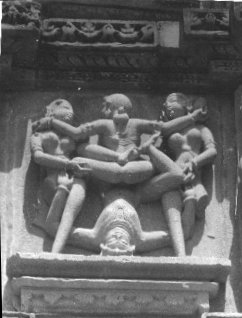
Khajuraho Temple
South India
Possibly 9-10th Century
The erotic sculpture show the Hindu is not just obsessed with spirituality but also sex and other physical desires. Kama is one of the four goals in life. It is the physical pleasure which includes sex as a most important aspect.
The sculpture is definitely idealized and so of the classical form.

10th Century AD
Material: Rock
This is another beautiful carving from Khajuraho. The S-curve is also neatly used here to give an air of grace and eroticism.

Karnataka, India
10th Century AD
Jain Art
This statue of Mahaveera is a religious symbol. It is symmetrical and rigid.

(Temple Complex)
10th Century AD
Madhya Pradesh, India
Rock
This is an erotic piece which shows beautiful use of curves. S curves lead up the female figures and point to the male head and the three heads lie in a nice semicircle.
Both religious and secular.

Material: Stone
10th Century AD
Rigid

Rajasthan, Northwest India
10th Century
This is also Ambika Devi. The piece is idealized yet there is tumultous action going on with curves moving in and out. The pillars on either side are marked at regular intervals and the Devi's body follows them, like the elbow or knee or hand.
Tamil Nadu, South India
Chola Period
10th Century
Material: Copper alloy
Restful use of curves and intricated details carved.

South Indian (Tamil Nadu)
Chola Period
10th century AD
Material: Granite with traces of gesso and red pigment
Three headed Brahma seated. The statue like many others is not very well preserved. But details can still be seen. It departs from being rigid with fluidity of curves.

Bengal, East India
Pal Art
10th Century AD
Material: Grey Slate
The main statue of the Sun God is static but there is a lot of activity going on around it that might make it baroque.

Eastern India
Pal Art
Material: Basalt
10th century
This is a remarkable representation of the Moon God, Chandra. (Note: The name, Sandra means moon too) The piece is complicated with various shapes and curves coming together like baroque form but it is also idealized.
|Feedback|
|India|
|Ancient|
|Majlish|Kashmir|NOVO1|NOVO2|NOVO3|
|HOME|
