Age Of Empires
The other art type that was prevalent in the ancient times was art on fabric. Bengals, Kalingas (Orissa) probably two of the descendant groups of the Indus carried on a tradition of fabric painting that started in the Indus. This is one of the several art forms that seem to have continued from the Indus. Even before the 7th century BC Bengal was a centre of fabric production. They produced silk, cotton and other fabrics, like jute. On these they created beautiful images. The carpet probably has its origins in Bengal which still produces 80% of the world's jute. Later Banaras and Madhya Pradesh become centres of fabric production as well. Bengal fabric production reached a climax around the 18th century. They produced the Muslin. This was forcibly shut down by the British.
The art form of this period is archaic as the Age Of Civilization but a definite classical form can be seen emerging among the various art forms.
Author: NOVO
E-mail: [email protected] 27th July 2000
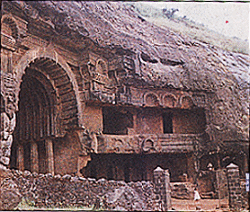

2nd Century Baja Cave Temple (Left)
Inside the Cave are corroded and hardly visible art work. (Right: sample)
Pre-Gupta
1500 BC -350 AD

Silk Embroidery
Symmetric but not rigid.
Existed before the 7th century BC and continues today. This is a reproduction.

Mauryan Empire, (Ancient Indian Empire)
3rd Century BC
This is now the national symbol of India. The art shows great detail but stylization and rigidity.

North India
3rd Century BC
Symmetrical and stylized.

3rd Century BC
Mauryan Art
Somewhat realistic but still stylized.

Rajgir, North East India
3rd Century BC
Symmetrical and idealized.

Mauryan Empire
3rd Century BC
This carving shows great detail and is based on s-curves going up her torso and across her arms. There is fluidity in the piece, yet retains certain idealization.

Unknown Timeframe
Possibly Mauryan Empire
3rd Century BC
This is a complex piece depicting a war scene. There is a lot of action and the curves are convoluted, yet there seems to be not much realism. Two things to note: The head gear is horned like that of Pashu-Poti from the Indus valley and the figure that looks like a horse at first glance is not a horse but possibly a tiger. Is this a pre-historic battle before the 3rd century BC?

Mauryan Empire
Uttar Pradesh, North India
Material: Black Terra-cotta
Stylized and rigid.

Ellora (Ancient Shiva site later used by Buddhists and Jains, where 36 temples were curved out of rock downwards from the top), India
Unknown time frame but BC.
The use of the circle is obvious with the extreme portions of the sculpture touching the circumference. S-curves come together to form the beautiful form of Shiva. This is also idealized.

Ellora
Unknown time frame but BC. This is a static symmetric statue carved out of the rock wall in a rocktemple. It is rigid and thus of Archaic form. Note the three heads.

Karla, North India
(Near Baja)
Buddhist Art
2nd Century BC
Religious and not very fluid.

Pitalkhora, North India
2nd Century BC
Idealized and rigid.

Badsa, North India
2nd Century BC
This exquisite sculpture shows a man (woman?) on a horse. The sculpture is realistic yet idealized.

Ajanta (Ancient Shiva site), near Bombay, India
2nd Century BC
This ancient painting shows use of different shapes that curve.

Ajanta (Ancient Shiva site), near Bombay, India
2nd Century BC
This ancient painting shows use of different shapes and curves. The curves are tumultous.

100 BC
Kushan Empire, N W India
This figure with its great detailed design is from the Kushan empire. Though it is not extremely rigid, it is still static and so an archaic form.

Bharhut, Central India
2nd Century BC
Material: Sandstone
Religious, idealized. Not rigid.

Bharhut, Central India
2nd Century BC
Material: Sandstone
Religious, idealized. Not rigid.
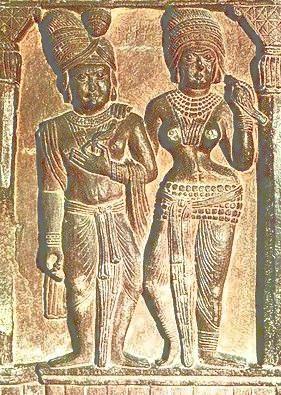
Bharhut, Central India
2nd Century BC
Material: Sandstone
Secular, idealized. Not rigid

Location: Bihar (NE India)
Material: Gray terra-cotta
100 AD
Semi-divine proto-type of Snake Goddess. Rigid and generalized with some details.

Gandhara
(Old name of Afganistan)
2nd Century AD
This statue has great detail in the clothes but is very rigid and static.
|Feedback|
|India|
|Ancient|
|Majlish|Kashmir|NOVO1|NOVO2|NOVO3|
|HOME|
