Age Of Civilization
Rock Painting and Indus Period

The art of this period falls mostly into the Archaic form. Archaic form is a simplified and genreralized representation of something or person. This was the most prevalent form in almost all ancient cultures. Towards the end, the form gets slightly more fluid but retains the stylized form and thus remains Archaic. A lot of the art of the Indus are found on seals. In the civilization, seals were used most probably for trade purposes. This seals bear the earliest artwork of India. They are of the Archaic form.
Note the script with each image. They have not been deciphered yet. There are other kinds of art examples such as exquisite ornaments of a variety of materials and design. There is also pottery art with distinctive paintings and other curious items of whose significance is unknown, like the cones. Unfortunately if there were any works of painting in the ancient period, they have not survived. It is however, known that the ancient Indians were very much into colour. The buildings in their cities were decorated with multicoloured tiles and the fabric was dyed. Women used bright lipstick. But not much visible trace of paintings survive from the Age Of Civilization.
The Indus civilization is marked by massive quantities of art pieces of teracotta and other materials. This period falls from pre-history and to 1800 BC with the coming of the first foreigners, the Aryans. Note these are not Aryans of Hitler's definition but the real Aryans (Arya, Arjo) by race. They were tall, with larger noses and pale-skinned, with dark hair and spoke Sanskrit. They came to India from central Asia via Iran.
Author: NOVO
E-mail: [email protected] 27th July 2000

Ancient Boat
With boats like these, the Indus (Meluhha) people became the first seafarers.

Naturalistic on Cave walls
10,000 BC +
Stylized
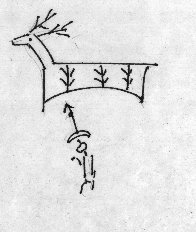
Naturalistic on Cave walls
10,000 BC +
Stylized
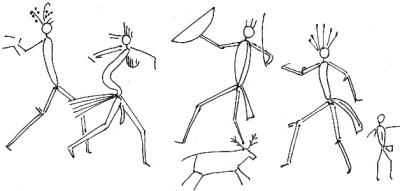
Naturalistic on Cave walls
10,000 BC +
Stylized

Showing many hands and legs, a precursor to later Indian deities.
Naturalistic on Cave walls
10,000 BC +

Was this a depiction of a crocodile or the mythical ocean bred steeds that are said to have been used by the Bengals fighting the Aryans? Note this is not a hunt, the people are unarmed and there are children present.
Naturalistic on Cave walls
10,000 BC +

Naturalistic on Cave walls
10,000 BC +

Location: Mohenjodaro
Material: gray brown unfired steatite.
2500 BC
Some details shown but rigid.

Location: Mohenjodaro
Material: white fired glazed steatite
2500 BC
Some details shown but rigid.

Location: Mohenjodaro
Material:
2500 BC
Stylization
A panel found at Mohenjodaro, depicting a sailing craft. Vessels were of many types. Their construction is vividly described in the Yukti Kalpa Taru an ancient Indian text on Ship-building. -- Sudheer

Location: Mohenjodaro
Material: tan steatite
2500 BC
Very generalized yogi (proto-Shiva?) with three heads. Definitely rigid and stylized.

(Lord of beasts)
Very generalized and rigid. There are some curves though. (Proto-Shiva)

Location: Mohenjodaro
Material: white, low fired steatite
2500 BC
A very detailed bust. It is unknown if this was an actual person. Note the bust is dubbed Priest King, but it is not known if there was a king there or even a priest.

Location: Mohenjodaro
Material: terra cotta
2500 BC
Very simple and generalized female.

Material: terra cotta
2500 BC
Very simple and generalized bull.

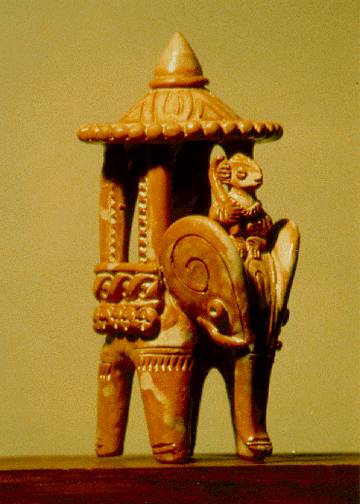
Material: yellow-brown glazed faience
2500 BC
This figure poses an exception. The figure is not so rigid but is simplified. There is attempt to capture the ammusement in the monkeys' faces.

Location: Harappa
Material: metal
2500 BC
This figure breaks from rigidity and captures the dance but stylized.
|Feedback|
|India|
|Ancient|
|Majlish|Kashmir|NOVO1|NOVO2|NOVO3|
|HOME|
