Bangladesh India
In The Name Of The People
Written in June, 2000 NOVO, Last updatedAugust 3rd 2000 |
|||
Ancient History: (NOTE: Bangla, Banga, Bengal will be used interchangably as will Bengali, Bangalee and at times Bangla)
Religion:
Bangla was originally a Hindu nation but later she became Buddhist soon after the advent of Buddhism (Note the Malla were Hindu through out their reign in Southwestern Bangla as were Sens later). The ancient people of Bangla worshipped Shiva, Devi and Visnu and believed in the concepts of karma and transmigration of the soul, and practiced Yoga before the influence of Vedic Hinduism. In the Rig Ved, the Aryans actually despise Shiva and worship of Shiv-Lingam. In Rig Ved (vii) Ch 21-5 it is clearly seen as a sin: "Let those whose deity is the Phallus (Shiv-Lingam) not penetrate our Sanctuary" Gradually later Veds accept Shiv. By the time of Yajur Ved, Shiv is the main deity.
These concepts were later adopted by the North Indians and spread to South India. Bengals also spread the Shiva religion all over East Asia as they spread into Indonesia, Burma, Thailand, Cambodia, Laos and Vietnam with Vijay Singh and the B(v)arman kings.
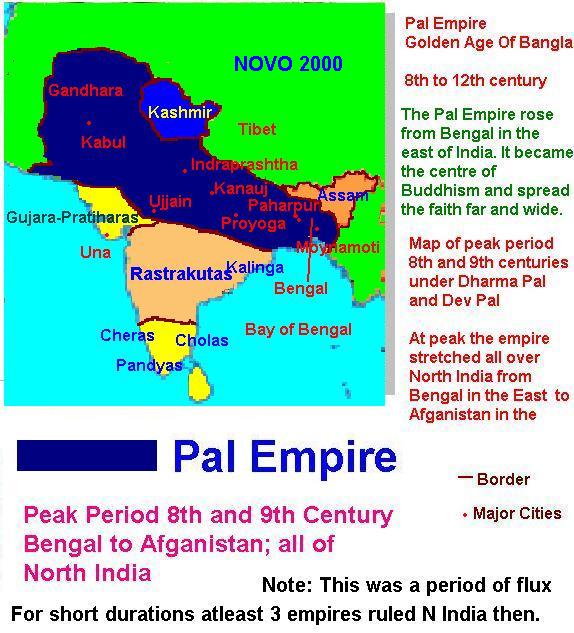
They also had own unique culture, where the men painted their nails and for marriage turmeric was used and men wore Dhootis and created beautiful grafitti art with paint on floors. These also passed into the North Indians' culture when the Bengals were absorbed and aryanized. The Vedic or Aryan Hindu elements of caste and others enter Bengal by 5 AD but does not take root because at that time Buddhism had made inroads. It is not known when Bangla became Buddhist but it is known that Buddha himself had come to Bangla (Pundra-Bardhan or Nagar in northern Bangladesh, Samatat which is presently Chittagong in South East Bangladesh, Noakhali in Bangladesh and Kamasbama which is now Murshidabad in West Bengal) to preach his teachings. How much he had converted is not known but it is known that Bangla was definitely a Buddhist nation as early as the third century AD. The Nagarijunikonda inscription (2nd or 3rd Century AD) refers to Vanga (Bengal) as an important center of Buddhism. Even a line of Buddhist kings ruled in East Bengal towards the close of seventh century AD The Buddhist scholars of Bengal in the seventh century AD largely contributed to the development of the Nalanda monastery in Magadha. It became the greatest centre of learning in the world. During the Pal reign Bangla became even more Buddhist. Travellers came to Bangla and saw hundreds of monastries and centres of Buddhism. Bangla, remarkably, retained its Buddhist culture long after the rest of India was lost to Brahmanic Hindu rule. According to Dr. Dinesh Chandra Sen, Bangla was for centuries in open revolt against Hindu orthodoxy. It was a land of religious freedom even after there was a strong resurgence in Hindu religion sponsored by the state in the rest of India. Of course, various local cults emerged such as the Vajrayana, Shajayana, Kalachakrayana, Tantrayana, Nathism, the Bauls, and others. Some ancient Buddhist sites remain in different parts of Bangla as in Comilla (Bangladesh) and Rajshahi (Bangladesh). The great library of Nalanda was at its height when it was under Pal (Bengal) rule and the Buddhist teachers were Bengal. However, at the end of the first millennium C.E. Bangla was once again Hindu under the Sens. This may have been an unpopular conversion of religion and so when Islam came to Bangla it was not totally unwelcome, much like in Greece, christianity was not totally unwelcome. The later non Bengali Hindu Brahmans who came to Bengal to convert Bengal disliked the language Bangla. |
Principal regions of Ancient Bangla
Spread of Buddhism I
Spread of Buddhism II
Spread of Buddhism III
Spread of Buddhism IV |
||
| Sources: A Short History Of Bengal by Tanmoy Bhattacharya A Thousand Year Old Bengali Mystic Poetry by Hasna Jasimuddin Moudud, daughter of famous poet Jashimuddin. A History of the Indian People by D. P. Singhal Buddhism in Bangladesh (A brief background and history) by Prof. Latifa Akanda, Edited by Gyana Ratna
Focus on Buddhism of Bangladesh I am indebted to various sources for writing this history ... many books that I have read since I was a kid and those I read now both in paper and on the net. I thank the authors. |Majlish|Kashmir|NOVO1|NOVO2|NOVO3| |ReligionQuest|ArchiveLinks|Ancient| |HOME|
|
|||