| LOT MORE TO BE DONE !! |
| Rajiv welcomes you |
| rajiv welcomes you |
 |
 |
 |
 |
 |
 |
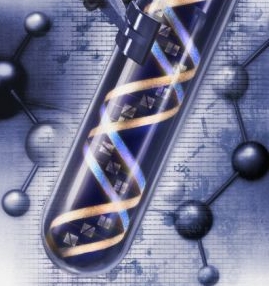
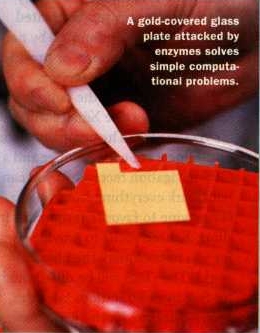
| DNA computing is very young, and for this reason, it is too early for either great optimism or great pessimism. Early computers such as ENIAC filled entire rooms, and had to be programmed by punch cards. Since that time, computers have since become much smaller and easier to use. It is possible that DNA computers will become more common for solving very complex problems, and just as PCR and DNA sequencing were once manual tasks, DNA computers may also become automated. In addition to the direct benefits of using DNA computers for performing complex computations, some of the operations of DNA computers already have and perceivably more will be used in molecular and biochemical research. New computers under development at the University of Wisconsin-Madison and other institutions are harnessing DNA for building computers. Researchers are turning to DNA's chief attributes - its microscopic size and powerful searrch function that can explore all possible answers simultaneously -- to build DNA computers. Someday these new machines could store information and tackle large computational jobs at speeds faster than today's supercomputers -- and their potential power underscores how nature could be capable of crunching numbers better and faster than the most advanced silicon chips. The UW researchers began work on their DNA computer after Leonard Adleman of the University of Southern California shocked the science world in 1994 with research showing he could solve a math problem using DNA . It is realised that DNA computing is not going to be turned into a desktop computer overnight or replace your current current PC for running a word processor. UW-Madison chemistry Prof. Lloyd Smith is part of Wisconsin's effort to scale up its early work by building a DNA-powered computer with 64 kilobits of memory - about as powerful as the computers of 20 years ago!!. With enough growing power -research going into this field, DNA computers can surely supplement the electronic ones if not replace them. For now, researchers are solving small problems with DNA that could be figured out just as easily with a PC or calculator. Transistors and electrical circuits written on silicon have been greatly reduced in size from the electronic circuitry of 25 years ago. Miniaturization has driven enormous growth in the speed and power of computer processing. But chip designers think they will hit a size barrier perhaps a decade from now, when transistors and circuitry become so small they contain only a few molecules. There are limits to how far the silicon chip can go, and once we got into the sub-nanoseconds of computing, it is left to speculation what comes next. The silicon chips that now power computers represent information as a series of electrical impulses using ones and zeros. The chips use mathematical computations to manipulate the ones and zeros into an answer. DNA, or deoxyribonucleic acid, represents information as a pattern of molecules on a strand of DNA. Each strand represents one possible answer. In the Wisconsin experiments, trillions of strands of DNA are embedded on a small plate of glass. In each experiment, the DNA is tailored so that all conceivable answers to a particular problem are included. Researchers then subject all the molecules to precise chemical reactions that imitate the computational abilities of a traditional computer. Molecules that make up DNA bind together in predictable ways, giving it a powerful "search" function. If the experiment works, the DNA computer weeds out all the wrong answers, leaving one molecule with the right answer. For now, researchers use a DNA sequencing machine, first developed in the 1970s, that pinpoints molecules and determines whether an experiment produced the right answer. Future research is aimed at developing a device that can read out answers more easily, perhaps on a traditional computer screen, especially if there is more than a single answer. A key advantage of DNA is its microscopic size. In a test tube smaller than the joint on your finger, you can put billions and billions of DNA strands,That is the appeal -- there is so much you can harness. At UW-Madison, researchers have developed a thin, gold-coated square of glass about 1 inch square that they believe is the optimum working surface on which to anchor DNA molecules. The tiny workplace lets researchers attach trillions of strands of DNA. Among other things, the Wisconsin team says that approach keeps out impurities, makes it easier for scientists to handle experiments and serves as a building block to scale up experiments to tackle bigger problems The University of Winconsin Research Group developing DNA based computers In the other approach of Adleman the DNA is let to float freely in a test tube while it grinds out calculations. Most experts think DNA will complement -- but not replace -- today's computers, and instead will specialize in large computational problems in which the number of possible answers is enormous. Adleman's research tried to answer a classic problem of mathematics: finding a way to organize the trip of a traveling salesman to seven cities so the salesman never visits the same city more than once. If he visited 30 cities, there are more than 1 billion possible trips he could make. Researchers from Stanford and Princeton universities have mapped a way in which a DNA computer could be used to crack messages encoded with the U.S. government's Data Encryption Standard, which is used to protect sensitive information. The practical uses of the technology is expected to come only later. The business history of computation is that the capability comes before significant applications !!! |
 |
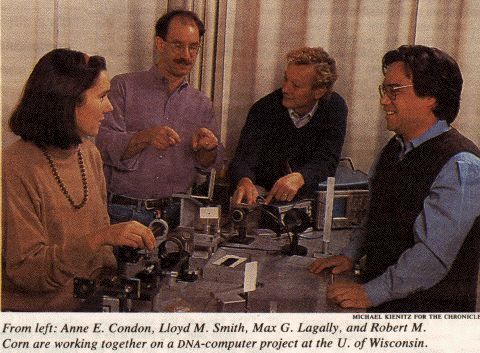 |
| DNA computer developed by the researchers at University of Winconsin. Madison |