| IT CAN DO MASSIVE PARALLEL PROCESSING ,BUT.. IS IT ERROR FREE ? |
| Rajiv welcomes you |
| rajiv welcomes you |
 |
 |
 |
 |
 |
 |
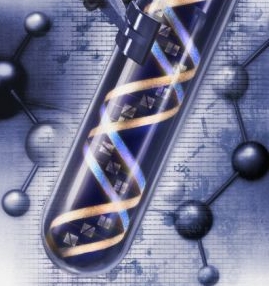
| The major advantage proposed for DNA computers is their ability for massive parallel processing and that too achieved in the most energy efficient way. The concern is the fragile nature of DNA compared to electronic counterparts, and the possibility of error while binding of strands, their amplification etc. DNA computing is advantageous if it is envisaged in its full potential comapared to any of the current computational strategies. It may be noted that the Adleman's procedure took approximately one week to perform. Although this particular problem could be solved on a piece of paper in under an hour, when the number of cities is increased to 70, the problem becomes too complex for even a supercomputer. The fastest supercomputers can currently perform 1000 million instructions per second (MIPS); a single DNA molecule requires approximately 1000 seconds to perform an instruction (.001 MIPS). Obviously of you want to perform one calculation at a time (serial logic), DNA computers are not a viable option. However, if one wanted to perform many calculations simultaneously (parallel logic), a computer such as the one described above can easily perform 10^14 MIPS. DNA computers also require less energy and space. While existing supercomputers operate 10^9 operations per Joule, a DNA computer could perform 2 x 10^19 operations per Joule (10^10 times more efficient). Data can be stored on DNA at a density of approximately 1 bit per cubic nm, while existing storage media require 10^12 cubic nm to store 1 bit. The major advantage of DNA computing is its ability for massive parallel processing. Besides it is a good medium for storing information an a compact and stable way. Double stranded DNA is quite stable, contains redundancy, and can be maintained in vitro with error correcting enzymes. |
| When acting as a static storage medium, double stranded DNA tends to maintain its integrity. However it is vulnerable to hydrolysis reactions. Hydrolysis will cause nicks in the DNA where a bond is broken between nucleotides. This decay can be repaired with ligase, and is probably not too much of an issue. When DNA is amplified by PCR it is subject to errors when being duplicated by polymerase. Taq polymerase, commonly used in PCR has an in vitro error rate of 1/9000 This error rate is not a big deal, given reasonable redundancy in data encoding. A compact disc with scratches on the surface has a much (much!) larger error rate than this, but will still play back perfectly, thanks to error correcting codes also stored on the disc. In fact, a large concern with traditional error correction coding is how to deal with burst errors, where long sequences of bits are corrupted. There does not appear to be an analogous problem with DNA. Hydrolysis and PCR errors are independent of each other and do not occur in groups. (Except of course when they randomly coincide). Error correction in DNA appears to be an easier problem than what standard error correction codes are designed for. Hence, minimal precautions with error correcting codes are enough to maintain data integrity with double stranded DNA encodings. DNA is a stable molecule suitable for storage of large amounts of information. However, the use of single stranded DNA in computational models of DNA present a problem for simultaneous computation and storage using these molecules. The inaccurate nature of hybridization presents several obstacles to storing information using oligonucleotides. Code words must be carefully chosen, and there are upper limits to the amount of code words available. To combat these problems, a DNA computer should attempt to convert inactive data to double stranded form to reduce the length of oligonucleotides sequences "exposed" in solution. Additionally it may be beneficial to use redundant, yet different encodings to reduce errors caused by unexpected hybridizations. |