| E-seal
Technologies
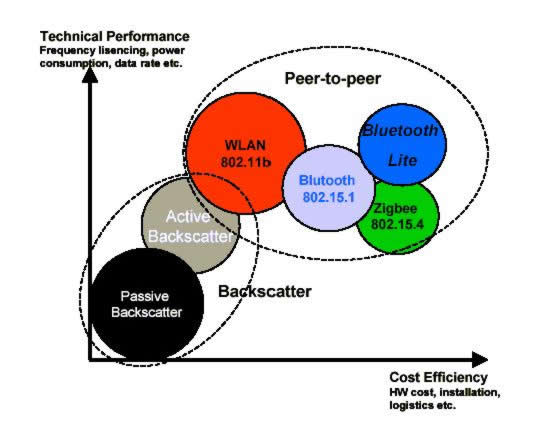
Peer-to-peer
Radio Technology
The
basics of the peer-to-peer radio technology were developed and
introduced
during the late 1990s. It originates from cutting edge radio technologies
used in
the computer industry to wirelessly connect computer devices and
peripherals.
Well-known technologies such as Wireless Local Area Network (WLAN
or
WiFI) and Personal Area Network (PAN, e.g. Bluetooth and Zigbee)
use peerto-
peer radio technology. The technology is specifically designed
for short-range radio
communication at extremely low cost and low power consumption,
but at still very good performance (reading range, reliability
etc.). The
international standardization for these technologies is gathered
under the IEEE3:
IEEE
802.11.b WLAN
IEEE 802.15.1 Bluetooth4
IEEE 802.15.4 Zigbee
Backscatter Radio Technology
Radio backscatter is a relatively expensive, high-power radio
and narrow-band
technology, originating from specialised applications (e.g. military)
and
developed in the early 1970s. Backscatter is based on combined
radar and radio
broadcast technology. Most RFID systems are based on the backscatter
technology. They generally consist of a Tag communicating with
a Reader. In
some cases, such as electronic sealing, the Tag is included in
an electronic seal
but has de facto the exact components as the Tag used for tracking
applications.
Backscatter can be either passive or active.
Bluetooth. Lite
The
Bluetooth. Lite radio technology, compared to WLAN, does not have
these
concerns since it is already using an un-licensed ISM band at
2,45 GHz. This
band shall not be confused with licensed frequency 2,45 GHz using
RFID
backscatter protocol. RFID at that frequency has bad performance
like short
reading range and multi-path problems in a steel environment like
container
terminals. However, peer-to-peer communication at 2.45 GHz will
actually
benefit from multipath environment where containers, cranes, trucks,
and other equipment as
reflectors (see Test Reports).
|