Class Information - Mr. Ron Lehr - Fall, 2002
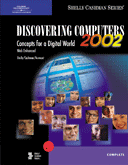
| Shelly, Cashman, and Vermatt. Discovering Computers
2002 -
Concepts for a digital World - Web Enhanced.
Course Technology - International Thompson Publishing, 2001. [ISBN: 0-7895-6185-9] Online: www.course.com and www.scsite.com/dc2002. |
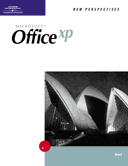
| Shaffer, Carey, Finnegan, Adamski, Zimmerman, et
al. Microsoft
New Perspectives on Microsoft Office XP - Brief.
Course Technology - International Thompson Publishing, 2002. [ISBN: 0-619-02096-2] Online: www.course.com, www.course.com/NewPerspectives/ and www.course.com/NewPerspectives/studentunion/ |
|
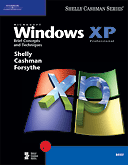
| Shelly, Cashman,
Forsythe. Microsoft Windows XP Brief Concepts and Techniques.
Course Technology - International Thomson Publishing Company, 2002.
[ISBN:
0-7895-6419-X] Online: www.course.com and www.scseries.com. |
|
| Shelly,
Cashman, and Walker. Discovering Computers 2002 - Study Guide.
Course Technology - International Thompson Publishing, 2001. [ISBN: 0-7895-6189-1] (Optional.) |
Similar Picture:
|
|
|
|
|
|
|
|
Computer
Chronicles (KVCR, Ch. 24) |
“Smart
Computing” |
(See me for details on the above and for additional references.)
CSIS-101 is a general introduction to computing systems and computing applications. This course provides a general introduction to computing systems with an emphasis on understanding the application of information technologies in an organizational setting. The student is introduced to the components of an information system (hardware, software, data, and people), the techniques for implementing these systems (program design and systems analysis and design), and the technologies for disseminating these systems (network and internet). Students will learn to use computing applications as a tool to improve personal productivity, with an emphasis on productivity applications.
This course is designed for students who are interested in how information technologies improve organizational effectiveness as well as how these technologies can improve personal productivity. This course is a computer literacy course that emphasizes how information technologies can be used in an organization, as well as how these technologies can improve the students own personal productivity. These concepts apply directly to any career path the student might choose in our information society.
The course provides the student with a comprehensive view of fundamental computer concepts, including:
Ø Major hardware components, technology, and terminology.
Ø Popular computer operating systems and application software.
Ø The four operations of the “Information Processing Cycle” (Input, Process, Output and Store).
Ø The use of the computer as a productivity tool in both personal and business use.
The course also provides the student with a ‘hands-on’ introduction to Microsoft’s Windows XP® operating system; and a ‘hands-on’ introduction and use of Microsoft’s Office XP® for Windows® (Ver. 2002) including:
Ø Word – the Word Processing program.
Ø Excel – the Spreadsheet program.
Ø Access – the Database Management program.
Ø PowerPoint – the Presentations Graphics program.
The overall objectives for the student in this class are:
Ø To learn the basic components of the computer and how they work.
Ø To learn how computers are used in the home and business environments.
Ø To gain introductory knowledge - through ‘hands-on’ experience - in using typical productivity software as used in home, small business and large business environments today.
Ø To gain computer and information literacy.
Upon completion of the course, the student will be able to do the following:
- Describe and provide definitions for each of the various categories of hardware: input, process, output, and storage.
- Compare and contrast the various categories of software.
- Describe the program development life cycle.
- Prepare a flowchart for simple process descriptions.
- Describe the basic communications model.
- Relate examples of data communications to the basic communications model.
- Relate the systems development life cycle to real-world projects.
- Describe the characteristics of database management systems.
- Evaluate and choose the most appropriate software application for a given task.
- Compose a document with a word-processor; create a spreadsheet, and set-up a database.
Specific chapter objectives are listed at the beginning of each chapter and unit in the course textbooks and are included as more detailed course objectives.
Class time will consist of lecture, demonstrations, short hands-on examples, discussion, homework review, tests, and test review. I may not be able to lecture on all the material in each chapter or unit; however, you are still responsible for studying all the material in each scheduled chapter or unit. Students should be aware that Lab time equal to or greater than class time is required for this course. [Lab time is defined as time spent in the MSJC Instructional Computer Lab and/or an available alternative computer access using the identical software for our course. Actual time required will vary depending on the individual student’s computer skills and ability.]
Chapter tests may consist of up to 50 written questions, may be a ‘take-home’ test, or may be another form of test. An individual written and ‘hands-on’ test will cover the Word Processing, Spreadsheet and Database portions of Office 2000.
All homework/extra credit must be done using Microsoft Office XP. (I do not accept homework/extra credit done in other software applications / suites or handwritten homework/extra credit). Some exercises / assignments in the textbook New Perspectives on Microsoft Office XP - Brief require files found on “Project Disk”. You may obtain a copy of these files on the MSJC Intranet via the Public Folders (Ron Lehr); or at www.course.com (Course Technology Web site - See inside back cover for additional information); or directly from me.
On ALL tests there will be a missed test penalty of 10% if the test is not taken when scheduled for your class. If you miss a regular test (non ‘hands-on’), you must take the make-up test, in the Computer Lab or Learning Center, within two weeks to have the score counted. If you miss a 'hands-on' test, YOU must make arrangements, on the first day you return to class, to make up the test. This test must be made up within one week of your return to class. If you do not, you lose the right to make up the test. Quizzes may not be made up.
Homework will NOT be accepted late, regardless of reason. However, the student will have ONE EXCEPTION to this policy: one (1) homework assignment will be accepted within one week after the due date [it will have an automatic late homework penalty of 10%]. Homework is due at the beginning of the class meeting on the due date shown in the schedule or given verbally.
You have three options to assure homework is turned-in on time (make sure the homework is to my attention, and has the assignment and due date on the cover page):
- You may turn it in early if you know you will be absent when it is due.
- Have someone else turn the homework in on time for you.
- Leave it at the Learning Center - making sure it is date / time stamped.
All homework that is returned should be kept so that if you later discover a mistake in the grading, you will have that work available to receive a corrected score. All homework should be kept on your personal diskette for the entire semester. ALWAYS bring your personal diskettes to each class meeting.
One current, course related article (not an advertisement), from a newspaper or magazine, may be turned-in each class meeting for 1 point of extra credit (this is not retroactive). The article (or photocopy) must be attached, summarized in your own words [Do Not Plagiarize!], and presented in typewritten form using only only Microsoft Word - Word Processor Tool. Other methods of extra credit, such as reviews of computer related TV. programs, or reviews of Internet sites, may also be available during the semester. Maximum extra credit points for the semester is 40 points. No extra credit will be accepted after the end of the 15th week of the semester.
“Non-assignments” turned-in (homework [not required to turn-in] or extra credit not included in the class schedule or verbally given to the class) will not be graded or given extra credit points. Please: Do not turn-in “non-assignments”.
Each student should get the name and phone number and/or e-mail address of three other students in the class. If you are absent or unable to contact me for assignments, handouts, or other information, you can contact one of these students and be prepared for the next class meeting [being absent is not a reason for missing an assignment].
Attendance and participation are very important in business and in this class. If you participate in every class meeting you will receive a 3% bonus; if you miss participating in only one class meeting you will receive a 2% bonus. Non-participation includes: often leaving class early; arriving late and by doing so, distracting or disturbing other students; or working on non-class activities during class.
Tests [short quizzes are counted as tests] will comprise 70% of your final grade and homework/extra credit will comprise 30% of your final grade. Your course grade will be calculated as follows: 1.) your total test score is divided by the total possible test score and multiplied by 70%. 2.) your total homework and extra credit score is divided by the total possible homework score and multiplied by 30%. These two results are added together. Any bonus percent is then added for the final course grade.
A grade sheet, listed by “Unique Student Code” (student created code name [alias], 4 to 10 alpha-numeric), will be posted showing “to-date” total scores for all tests, homework assignments, and extra credit, as well as your class grade (as of the date of the grade sheet). The grade sheet will not include your name or Social Security Number.
Each student should carefully review each grade sheet that is passed around the class and then posted on the wall to assure my entries are accurate. It is the student’s responsibility to point out – and have corrected – any unintentional input errors that are noted and confirmed on the grade sheet.
See interactive sample grade sheet.
The following grading scale will be used after the final total is determined:
| 90% to 100% | A |
| 80% to 89% | B |
| 70% to 79% | C |
| 60% to 69% | D |
If you have a score of 90% or higher at the end of the last regular class meeting (without participation bonus) you may elect not to have your final exam score count toward your final grade. However, you must take the final exam or receive a score of zero.
It is the STUDENT’S ultimate responsibility to drop this course. Any student who misses the first scheduled class meeting may be dropped unless arrangements have been made with the instructor. [ See “Dropping Courses - Procedure”, page 15 of the MSJC, Fall 2002 Schedule of Classes.
Your instructor reserves the right to drop you from class, without notice, if you miss five or more classes, regardless of reason.
AMERICANS WITH DISABILITIES ACT:
Mt. San Jacinto College is committed to providing reasonable accommodations for students with disabilities upon request of the student (in a timely fashion) and upon verification of disability. [For further information, see the Mt. San Jacinto College General Catalog, page 41.]
From the Mt. San Jacinto College Acceptable Use Policy:
“A user who uses the College’s computing systems to harass or make defamatory remarks, shall bear full responsibility for his or her actions. Further, by using these systems, users agree that individuals who transmit such remarks shall bear sole responsibility for their actions. Users agree that MSJC’s role in managing these systems is only as an information carrier, and that they will never consider transmission through these systems as an endorsement of said transmission by MSJC.”
“Many of the MSJC computing systems provide access to outside networks, both public and private, which furnish electronic mail, information services, bulletin boards, conferences, etc. Users are advised that MSJC, including members of the administration, faculty, and staff, does not assume responsibility for the contents of any of these outside networks.”
“The user agrees to comply with the acceptable use guidelines for whichever outside networks or services they may access through MSJC systems.”
“Further, the user agrees to follow proper etiquette on outside networks. Documents regarding etiquette are available through system administrators and through specific individual networks.”
“An account assigned to an individual must not be used by others without written permission from the system administrator. The individual is responsible for the proper use of the account, including proper password protection.”
“All users of MSJC computing systems must read, understand, and comply with the policies outlined in this document” [MSJC Acceptable Use Policy].
A full copy of the MSJC Acceptable Use Policy will be given to all students.
Students are expected to uphold Mt. San Jacinto College District’s standard of conduct relating to academic honesty. Students assume full responsibility for the content and integrity of the work they submit. The guiding principle of academic honesty/integrity shall be that submitted work, tests, projects, reports, and extra credit must be the student’s own work.
This principle is considered violated if the student:
Ø Represents the work of others as his/her own.
Ø Uses or obtains unauthorized assistance in any academic work.
Ø Gives unauthorized assistance to other students.
Ø Misrepresents the content of submitted work.
Any student found violating the principle of academic honesty/integrity is subject to the following actions (from “Mt. San Jacinto College District - Instructor Orientation Guide”, Fall 2002: Part IV, Section: A - ‘Instructional Policies and Procedures’, sub-section 2.b [page 43]:
Ø First
Offense:
“An
automatic “F”
on the assignment or examination in question and notification that a second
occurrence will result in a twenty-four (24) hour suspension from class.”
Ø Second
Offense:
“Instructor
suspends student from class for one day and notifies campus administrator of
that action, and confers with student prior to student’s return to class.”
Ø Third
Offense:
“Instructor
notifies the campus administrator to schedule an administrative review. This
will involve the administrators from Student Services and Instructional Service.”
If a student is unclear whether a particular situation may constitute a violation, the student should meet with me to discuss the situation.
For this class, it is permissible to assist classmates in general discussions of computing techniques. General advice and interaction are encouraged. Each student, however, must develop his or her own solutions to the assigned projects, assignments, and tasks.
Students may not “work together” on graded assignments. Such collaboration constitutes cheating. A student may not use or copy (by any means) another’s work (or portions of it) and represent it as his/her own work.
The following office hours are in the Computer Lab, Room 107A, or the office area in the Cutting Building for Business and Technology (beginning the second week of the semester):
| Tuesday | 9:30 to 10:00 a.m. |
| Wednesday | 9:00 to 9:30 a.m. |
(You may call 487-MSJC, x1668 during the times listed above.)
You are welcome to see me any time during my office hours. If needed, we can schedule a meeting time other than the office hours listed above.

The campus phone number is (909) 487-MSJC. Dial extension 1588, and follow the instructions to leave a campus message for me. My voice mail selection is "354".
My E-Mail addresses are:
| Mt. San Jacinto College | [email protected] [preferred] |
| MSJC CampusCruiser | [email protected] |
If you have any comments, suggestions, or criticisms regarding instruction, assignments, grades - or any other subject - please discuss your concerns with me.
Please visit www.schoolnotes.com (use zip code 92583) for tips on class assignments, various hints on upcoming class meetings, suggested web sites to visit, link to my CSIS-101 pages, or to send me an e-mail.

 Click to send e-mail to Ron Lehr
 Click to go to Student
Feedback Page
Click to go to Student
Feedback Page


 Click to return to CSIS-101
Home Page
Click to return to CSIS-101
Home Page
 Click to go to
MSJC Home Page
Click to go to
MSJC Home Page

 (Site best viewed with
Internet Explorer)
(Site best viewed with
Internet Explorer)
Ronald L. Lehr, MSJC Instructor.
Copyright © 1996 - 2002, R. Lehr / MSJC. All rights reserved.
Revised: August 18, 2002.