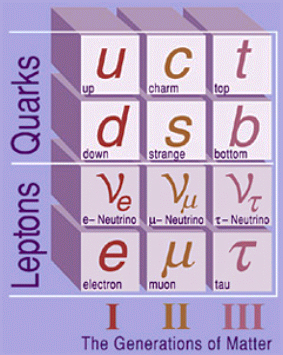
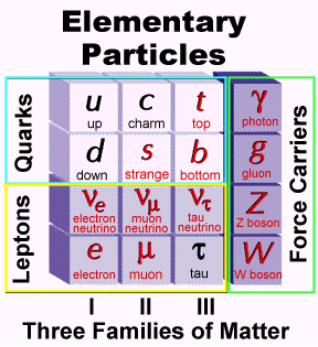
There are six types of quarks: up, down, charm, strange, top and bottom. Each type of quark has a mass and electric charge as shown in the charge below. Each kind of quark has an antiparticle (antiquark). Quarks and antiquarks exist in 3 types of �colours�. Quarks can be red, green or blue and antiquarks can be antired, antigreen or antiblue. The �colours� of quarks does not refer to the colours visible to the human eye, but represents a quantum property. When quarks are combined to form hadrons, only certain colour groups can make quarks be existent. Hadrons are made of various combinations of the six types of quarks.
Gluons are hypothetical. Some theorists suggest there is a �diquark� model, which concludes that gluons do not exist. However most physicists agree there are eight types of gluon and that gluon is part of the strong nuclear force. They believe that it has no mass, no charge and is a subatomic particle that carries the strong force between quarks.
Quantum Chromodynamics (QCD) is the theory that tries to convey the behaviour of quarks and gluons in forming hadrons. According to QCD, the strong nuclear force that combine quarks and gluons together to form hadrons, also intervene the forces between hadrons. Therefore the strong nuclear force controls the formation of a nucleus. In addition to the theory, it is not possible to separate quarks or gluons from hadrons. This is because as the distance between quarks or gluons get larger, the strong force gets stronger, hence snaps them back into hadrons. Physicists cannot test the properties of QCD directly, but there is a large amount of indirect facts that support the theory.
The mass gap property describes that quantum particles have mass, even when they travel at the speed of light. This property was discovered in experiments performed by physicists. Computer simulation has verified this property and that the mass gap does exist.
The question is asking:
-if we are able to understand through mathematic calculations how quark and gluon bind together
-if we can prove through mathematic calculations, in QCD, that quarks and gluons can never escape hadrons
-if we can understand through mathematic calculations the mass gap that exist
????? WHY CAN�T WE ANSWER THIS QUESTION ?????
As mentioned before, gluon is hypothetical. Even though most physicists believe that gluons do exist, there is no direct proof. QCD is also another theory that cannot be proven directly, although there is a lot of indirect evidence. These are some factors that play a part in why the question cannot be answered.
Assuming that QCD is correct and that gluons do exist, physicist have tried to prove through calculations that quarks and gluons cannot be separated. The calculation results in a bizarre answer that makes no sense.
Even though the mass gap has been proven that it does exist, physicists cannot prove that there is a mass gap using mathematic calculations. The reason being that the mass gap contradicts the Einstein�s theory of relativity (theory that anything that has mass, will have a mass that equals zero when it travels at the speed of light).
 Description