Mean Squared Error
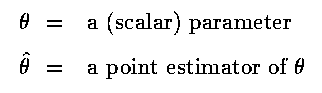
Let

Notes:
- The mean squared error (MSE) provides a measure of the quality of an estimator. We generally prefer estimators with small MSE, the smaller the better.
- Estimators with small bias
and standard errors have small MSE as can be
readily seen from the fact that

The alternative expression for MSE given above is an immediate consequence of the definition

and the fact that both the estimator and its estimation error have the same variance.
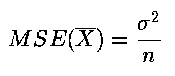
- As an example, the MSE of the
sample mean derived from a random sample is
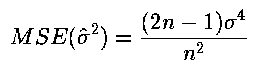
If based on a random sample from a normal distribution, the MSE of the biased variance estimator may be shown to be given by
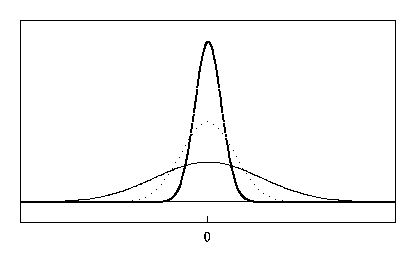
- The figure below shows the probability densities for the errors
associated with three different unbiased
estimators. Here, MSE equals
var(e) since all three estimators have zero bias and so
the error distribution with the smallest (largest)
spread corresponds to the estimator with the smallest (largest)
MSE.
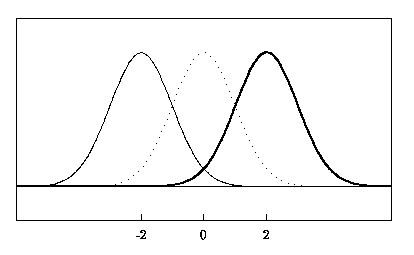
- The next figure shows the probability densities for the errors
associated with three different estimators. The error distribution
in the middle corresponds to the estimator with the smallest MSE
since all three error distributions have the same variance but only the
middle one has a zero bias.