


Bias of a Point Estimator
Let
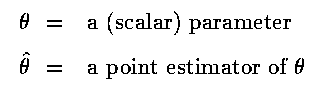
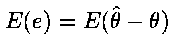
Notes:
- Unbiased estimators have zero bias for all values of the parameter (or estimand). Such point estimators are appealing since, on average, they tend to be "on target".
- An equivalent condition which an unbiased estimator must satisfy is
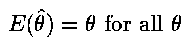
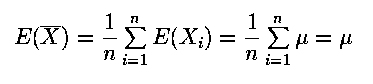
For example, the sample mean derived from a random sample is an unbiased estimator of the the population mean since
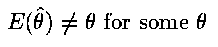
- Biased estimators are those point estimators whose bias are not equal to zero for some value(s) of the parameter. Thus, for certain value(s) of the population parameter, a biased estimator tends to be "off target" on average.
- An equivalent condition which a biased estimator satisfies is
The following intuitive estimator of the population variance
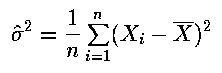
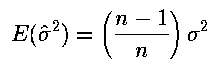
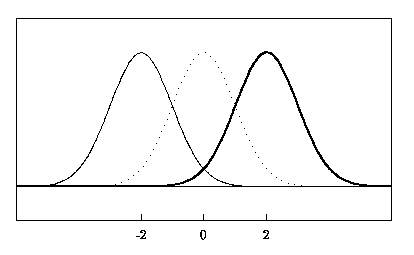
if the above variance estimator is based on a random sample. - The figure below shows the
probability densities for the errors associated with three different
estimators. The diagram indicates that two of the three estimators are
biased while the remaining one is unbiased.
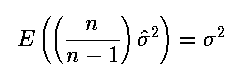
- When the bias is a linear function of the parameter (or estimand),
one can easily perform a bias correction to derive an unbiased
estimator. Essentially, all you need to do is to start with the
expression for the expected value of the estimator and then rearrange
terms so that the parameter is isolated on the right hand side of the
equal sign. The correction process will require you to exploit certain
properties (e.g., linearity) of expectations. For example, when
the biased variance estimator given above is subjected to such a
correction, we obtain
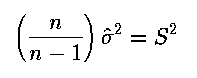
As suggested by the preceding equation, the unbiased estimator we derived is none other than the usual sample variance.
