


Error Bounds
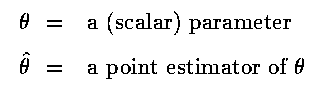
Let
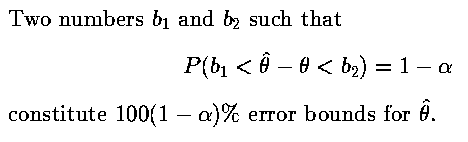
Notes:
- If the error distribution is symmetric about zero, we can obtain
the error bounds by solving for b in

and then setting b1 = -b and b2 = b. In this case, b may also be interpreted as a bound for the error magnitude. Thus, if b is a 95% bound, then we have the assurance that the estimator is within b of the parameter (or estimand) with probability 0.95. - When the error distribution is normal
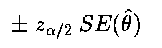
with zero mean, the error bounds are


- As an example, suppose the sample mean
is used as an estimator of the population mean. When
based on a random sample from a normal distribution, error bounds
for this point estimator are
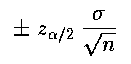
since in this case
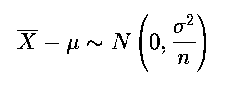
In practice, the population standard deviation is usually unknown and so we use
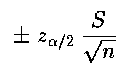
as estimated error bounds for the sample mean where S is the usual sample standard deviation. - Similar error bounds may also be easily obtained for the usual estimators of a population proportion, difference of two means, difference of two proportions. Essentially, all you need to do is determine the standard errors of the relevant estimators.
