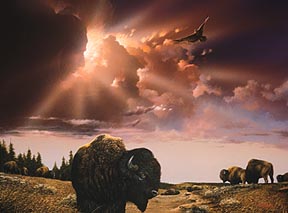
My first experience with a buffalo was on a trip through Yellowstone National
Park. One magnificant buffalo bull was walking down the mountain using the very
road our car was travelling on. We pulled over and watched him as he passed by
the car. I grabbed my camera to take a couple of pictures. When I returned from my trip, I
had the film developed and it was then that I could truly see this massive creature for whom
God had created...so powerful, so magestic...I knew I was hooked for life.
The white man nearly drove these beautiful creatures to extinction, not hunting them for food as our
Native American brothers did, but for their hides and tongues for sale and the hope to starve the red-man off
the land that THEY now wanted. With the help of public awareness and the love of others for the
buffalo, these animals are making a comeback. But that is not the wonderful ending I want to share
with you. There are still people today, that would like to see the mighty Buffalo removed. Their
superstitions and greed for pasture land to put cattle on, have prompt the DOL into taking actions
against these beautiful animals. There is now a massive endeavor to haze buffalo as they make their
ancestrial journey to spring patures to graze and have their calves. This is what the Buffalo Field
Campaign has to say:" The so-called random shooting at the Montana borders is actually eliminating or depleting entire maternal lineages,
therefore this action will cause an irreversible crippling of the gene pool. Continued removal of genetic lineages will change
the genetic makeup of the herd, thus it will not represent the animal of 1910 or earlier. It would be a travesty to have people
look back and say we were "idiots" for not understanding the gene pool." Bison have developed a natural resistance genetically
as long as thay have enough to eat, limited stress and are not consumed by other disease. There is no magic bullet in wildlife
disease. Therefore management is important. Vaccines are one management tool and one component, but genetic structure is
neccessary for future management. Every animal which is removed from the breeding population can no longer contribute to the
genetic variability of the herd."

(This issue is so important because the Yellowstone buffalo are the only wild, free roaming
buffalo left. If they are not protected - that wildness will be lost for all future generations. Buffalo in the Yellowstone
Ecosystem are the last wild remnant of the more than 60 million buffalo that once roamed North America.
They are the most distinct and unique herd of buffalo on the planet and a critical reservoir of biological
diversity. As a keystone species, essential to the maintenance of native liediversity within the Yellowstone
ecosystem, they have immense ecological and evolutionary importance. As a powerful symbol for all Americans,
and especially American Indians, they have enormous cultural and spiritual significance and power.)
This summer I was fortunate to be able to communicate
with an organization called Buffalo Folks that have been faithfully monitoring the buffalo in
Yellowstone. Their reports are terrifying! Here is one of the reports I have received (the latest):
July 22, 2001
Howdy everyone -
Here it is the 21st of July, and there is a buffalo bull outside of the park. Last reports
yesterday evening were that he was somewhere off highway 20, near hostile lands. As soon as someone called us
about the bull, we were on our way. We reconned the area for about five hours, didn't find him. the two local DOL
agents were out looking too, it appears that they didn't find him either. We have two patrols out today, if
anything happens, we'll be there. This is the same area where the bull was killed a few weeks ago. We will keep you posted.
�
The Bison
Bison, the largest terrestrial animal in North America, where it is commonly called buffalo.
Biologists prefer the term Bison, which is based on the animal's Latin name, as it distinguishes
it from the cape buffalo of Africa and the water buffalo of Asia. The bison is characterized by
a hump over the front shoulders; short, sharply pointed horns (in both sexes) curving outward and
up from the sides of the massive head; and slimmer hindquarters. A mature bull of the North
American bison is about 2 m (about 6.5 ft) high at the hump and 2.7 to 3.7 m (9 to 12 ft) long
and weighs 850 to 1100 kg (1800 to 2400 lb); the female is smaller. The head, neck, forelegs, and
front parts of the body have a thick coat of long, dark hair. The rear part of the body is
covered with much shorter hair. The adult bull usually has a black beard about 30 cm (about 12
in) long.
Bison are usually found in groups, except for old, solitary bulls. Most of the year females with
young form small bands, and immature bulls may stay with them. Mature males have their own
groups. The bands may congregate in large herds in the spring or fall to search for food or
water. Bison grunts and snorts are audible at short distances. The roar of rutting bulls,
audible at nearly 5 km (nearly 3 mi), is heard most often in mating season, mainly July to
September, when bulls go looking for cows and try to ward off rivals. Breeding bulls have little
time to eat and lose more than 90 kg (about 200 lb) during mating season. Gestation is eight to
nine months, and a single yellow-red calf is born. After a few days the calf can keep up with
the herd and follows its mother until the following spring.
The bison originated in Eurasia and is one of the few members of its family to have crossed
the Bering Strait land bridge in prehistoric times to North America, where two subspecies,
the plains bison and the wood bison, survive. The European bison, or wisent, taller but lighter
than the American bison, is almost extinct; a few exist in parks and zoos.
Until the 19th century, as many as 60 million bison lived on the Great Plains from Mexico into
Canada, and some were found east of the Mississippi River. They were central to the existence
of the Plains peoples (see Native Americans), who used them for food, hides, and bone implements;
even the dried dung, called buffalo chips, was used as fuel. From 1830 to 1889, methodical
destruction by encroaching white settlers, for sport and for hides, reduced this number to less
than 1000. Today well over 200,000 bison live in protected areas and on private ranches.
Scientific classification: Bison belong to the family Bovidae. The plains bison is classified as
Bison bison bison, the wood bison as Bison bison athabascae, and the European bison as Bison
bonasus.
�

�
This Site Has Been Visited


Home
Special Thanks to: (For use of their graphics)



Created by: Quannah Jenkins
Date: July 24,2001