| The Pantera Cooling System By Chuck Melton |
| I Introduction II Background Basics III Stock Limitations & Solutions a) Coolant Tanks b) Air in System c) Radiators d) Fans & Relays e) Temperature Gauge f) Other Issues g) Cleveland Thermostat |
| While I am restoring my car, I am analyzing the various systems. One system in particular that gets a great deal of interest is the cooling system. Much can be said about it, much has already been said about it, and much should be said about it. I�ll try not to sound like someone with a Doctorate in Thermal Dynamics, (Which I am not) so let me use leaps of faith now and then. I would appreciate comments, suggestions and corrections to this article. |
| I Introduction |
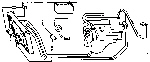
| First, lets cover some basics. An internal combustion engine creates energy in basically three forms. The obvious is the energy that drives the wheels, next is the energy (heat) out the exhaust, and finally the energy (again heat) that is transmitted into the coolants (water and oil), which is dissipated thru thermal transfer into the air. I heard somewhere that the energy that powers the wheels is approximately 1/3 of the total energy the engine actually creates. If this is true, and if the balance is split evenly between the exhaust and the coolants we get some idea how much energy our cooling system must transfer or dissipate. I�ll guess that the water handles more of the coolant load than the oil, so I�ll refer to coolant as the water portion versus the lubrication (oil) portion. Here is a basic diagram of our coolant system. The engine creates heat, the water pump pumps coolant around the cylinders, and the heat is transferred to the coolant. This heated coolant is pumped up to the radiator. As it flows across the fins some heat is dissipated. |
| II Background Basics |
| The coolant is now at a lower temperature, perhaps as little as 15-20 degrees, which then returns to the heat generator to begin the process again. A mid engine car needs a more effective cooling system than a front engine car because less air flows around the engine itself. How does this general cooling system summary relate to our Pantera ? I believe the stock system (correcting some flaws) in good working order would work for the stock engine. (Please hold your laughter !) Flaws in the stock cooling system and errors in the maintenance of the system reduce cooling efficiency to the point where the system is overloaded and a failure (e.g.- burping coolant out of the overflow tank) occurs. Most failures occur not at speed, but in slow traffic, at idle or after shutting the engine off. When the Pantera was new, it earned a poor reputation due to this overheating. |
 |
| Special thanks to Richard Barkley and Jack DeRyke for their contributions and fact-checking. |
| IV Power Upgrades and Capacity Upgrades a) Water Pump b) Large Radiators c) Hood Vents d) Coolant Transfer Tubes e) Heater Valves f) Pipe Routing g) Pump Hoses h) Clamps i) Replace Hoses j) Coolant & Coolant Filter V Summary |

|