| c) Radiators |
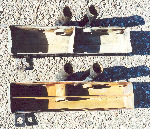
| The weak design of the original radiator was a frequent contributor to overheating. The early design of the radiator end tank contained a vertical baffle. Coolant was directed to the front half (face) of the radiator, across to the other side, then back across the back half of the radiator. The later design, identified by the Ford TSB #8, dated 4/5/73, changed the baffle to a horizontal position, where the coolant flowed across the full depth (rows of the fins) across the top (or bottom) half of the radiator, then back across the bottom half of the radiator. Right, is an image of the two baffle designs. The top tank in the picture is the later design. |
 |
| Either of these two designs is described as a 2-pass system. A problem with this design is that it was common for the baffles to break loose allowing the coolant to bypass the radiator, running from the in pipe directly to the out pipe. This often occurred when the car would overheat, and the increased pressure in the system resulted in noticeably blowing some steam, but it would also pop the seams around the baffle. The later design is actually slightly less efficient, but the benefit of this change is that a smaller baffle (horizontal) is less likely to flex and leak. |
| You've probably noticed that most cars do not have 2-pass radiators. Two reasons probably. 1) A 1-pass is probably cheaper (a few bucks), 2) Most cars overheat struggling going up a grade maybe pulling a trailer. Clearly if a 2-pass were better they'd all be 2 pass. |
| A single pass SHOULD be better at high speeds because is will have a lower back-pressure and thus the water pump should be able pump more water through it. The more water that is pumped through a radiator, more heat that will be transferred. The laminar versus turbulent flow factor should not be an issue. A single pass COULD be better a low speeds too, but probably isn't. This is because at low water flow rates the resistance to flow is (apparently) not as important as getting turbulent flow and increased heat transfer at least for our radiators. |
| The longer the water is in the radiator, the lower the exit temperature will be. However, capacity is the product of the temperature change and the volume of flow. The temperature change (all else being equal) is proportional to the difference in temperature between the water and the air: the bigger the better. The average temperature in the radiator is difference between the in/out temps/2. If you double the flow rate, this difference will be 1/2 and the capacity will be increased. |
| Given the same number and size of tubes (same total cross section) the time the water is in the radiator is the same for either type, single pass or double pass, for a given water flow rate. A single pass should work better at high speeds where the resistance to flow is 1/4 as much and the water flow rate will be higher which will increase capacity somewhat. Also, the higher the flow rate (less time) in a radiator the more capacity a radiator has because the water in it will be at a higher average temperature which will transfer more heat to the air. If this were the only factor, a single pass would have greater capacity at both low and high speeds since with less resistance there would always be more flow. |
| Right is an image of a radiator, which has been modified to be a 3-pass radiator. |
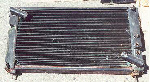 |
| The coolant in this radiator would enter the lower right side, cross the core, then due to the �V� cut into the tank, it would then pass through the middle third of the core, then back to the left to exit. Note the locations of the temperature sensors. The first reads the incoming coolant temperature, activating the first fan. The second sensor would read the coolant after the middle pass to activate a second fan. It would likely be a more efficient design to test the coolant at the end just prior to being returned. This might make the second fan turn on less frequently. The �V�s cut into the end tanks would eliminate the broken baffle problem. |