| Radiator Construction |
| Jack DeRyke, Pantera Master Mechanic, reports that, �Ford found that wider [core] tubes would increase heat transfer but would require thicker-walled tubes to prevent ballooning and subsequent tube blow-out. Then-currently used brass radiator tubes in Fords were �� wide ovals with a wall thickness of .005�. Something on the order of .016� wall thickness was required for a 1� oval tube, whether brass or aluminum and this made the brass radiator unacceptably heavy for reasons of fuel economy. By going to aluminum, 1� wide tubes with .016� walls could be used for equivalent heat rejection rates to a brass radiator and a 60% weight reduction. In addition, aluminum radiators are all welded which makes them stronger than the lead-soldered brass radiators. Corvette radiators use 1-1/4� wide oval tubes with a purposely-roughened inner surface. This forces coolant to tumble and splash through the tubes instead of flowing smoothly, promoting even more heat transfer (somewhere around 25% more water-to-tube contact).� �Many small tubes tends to form a barrier to air flow, actually reducing cooling. Some of the Winston Cup Fords found in their wind tunnel tests a few years ago that increasing the number of tubes or rows of tubes in radiators caused the air to �dam up� in front of the car instead of flowing through the radiator. This increased drag and slowed the car while overheating the engines. The proper fix was to decrease the number of tubes and increase the diameter of the remaining tubes. [As a result,] airflow went up, water flow went up, and engine temperatures went down.� In summary, an aluminum radiator with 1� or greater tubes, and not too many rows seems to be the best solution. For another opinion, review this comparison test. |
| Lay forward radiator modification |
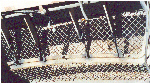
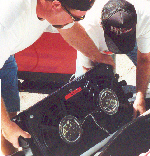
| To change to a lay forward position it is only necessary to have the upper brackets on the radiator swapped or rotated such that they point towards the back, versus point in front of the radiator. The bottom of the radiator has two points that fit into two brackets with a hole. These brackets can accommodate either radiator position. If a car currently has hood vents, a lay forward radiator may provide a straighter path for a portion of the air to flow through, then up and out the hood. At least one vendor markets a radiator with the fins angled to be level with the airflow when the radiator is laid-forward. |
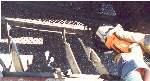 |
| To lay-forward, it is not necessary to cut out the stock fan brackets as was done on this car. And for structural reasons, it�s a good idea to leave them in. There could be issues with fitting the fans under the in/out pipes (some may not fit) and the hook up of the pipes going down from the radiator, or interference with the headlight bar. |
 |
 |
| Jack DeRyke comments on a common misconception about lay-forward radiators in his recent article (POCA June 2001), that a lay-forward radiator only works if you have a vented hood. He disagrees because the cross-section of various vents (The common Hibachi-style used by DeTomaso and aftermarket copies fitted by others is 10� X 3� X 2 vents equals 60� square) is less then 25% of the area of the radiator face. Under optimal conditions 75% of the airflow would still flow down under the car. �A lay-down radiator may indeed create a bigger �reservoir� of hot air in back, and a more gradual downturn of the huge volume of air flowing through the grille, but don�t look for a big increase in cooling with a lay down system [after] putting vents in your hood.� |