| e) Temperature Gauge |
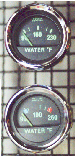 |
| The temperature gauge was made by Veglia (Italian), but the sensor is a Ford part. It is possible that the gauge is not calibrated to the sender unit. One way to test this is to use a cooking thermometer. Start with a cool engine. Hang the thermometer in the coolant tank (primary tank, not the overflow tank) and run the engine. With the sender mounted in the block, you will see the temperature slowly rise on your gauge, through the rear window. When the thermostat opens there will be a rush of hot water into the primary tank. Take a reading from the cooking thermometer. Remember that the hot coolant will mix with the cool coolant in the primary tank, so give the thermometer a few moments to stabilize. This will tell you at what temperature your thermostat opens, and it will also help to calibrate your gauge. It is also a reasonable idea to test a thermostat in a pot on the stove. |
| A test of various temperature gauges, wired to the same sending unit demonstrated that the gauge(s)are not consistent from gauge to gauge. Each gauge tested displayed a different temperature, and the results varied widely. It is a good idea to test your particular gauge. |
| There are two gauges offered in the (U.S.) Pantera. The first has a range of 90 to 230 (degrees Fahrenheit), and later gauges range from 90 to 260 degrees. One �solution� that was implemented to fix the high gauge reading was the factory installed a 10 Ohm, 0.5 Watt resistor in the line to the temp gauge. Although this sounds dubious, it brought the gauge reading closer in line with the actual temperature. |
| f) Other Issues |
| Something not always considered is how the engine is tuned. Too little timing advance, or too much timing advance will cause the engine to operate at a higher temperature. Also, as Richard Barkley pointed out many times, the power at idle is roughly linear with rpm. So at 1200 rpm versus 800 rpm requires about 50% more heat to be dissipated. He remembered a post a few years ago from a guy (I think from Vegas) whose car was overheating �. at an idle of 1500! |
| g) Cleveland Thermostat |
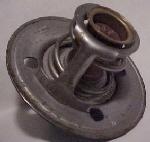
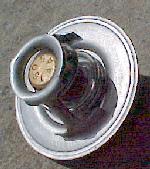
| The Cleveland thermostat differs from most other thermostats. Unfortunately, other thermostats are common, and fit. However other thermostats won�t work unless the assembly is modified. The block has a bypass port, just below the thermostat that circulates coolant within the engine when the thermostat is closed. When a Cleveland-specific thermostat opens, this port is blocked by a brass ring, so all coolant then is directed to the radiator. If another thermostat (without this unique feature) is used, there is nothing to block this bypass hole. Some coolant will continue to circulate within the engine, never making it to the rest of the cooling system. Engines have been known to overheat just from this mistake. In the left image is a Cleveland thermostat right is a common thermostat. Note the differences. This Cleveland thermostat has had 4 holes drilled into the support ring, by the owner, to enhance flow. (This will allow some coolant to flow to the radiator during warm up period, which causes the warm-up to take longer.) The purpose of these holes is to assist air bleeding. Some owners choose to modify their system, and block the bypass hole with a brass plug, and then can run non-Cleveland thermostats. |
 |
 |
| Photos by Matt Wells |