The artist and monk are distinct from us not because
of what takes place in them, but because they apply themselves self-consciously
to transformation. They educate themselves for an end they have chosen.
By contrast, most of us are educated by others and for ends we have not
chosen. Traditionally, artists, philosophers, and religious figures have
formed that small, self-conscious segment of society that engages in the
important if often painful business of introspection and prophetic critique.
They sense the dangers of an unthinking, habitual mode of seeing and know
the need for tireless renewal.
Arthur Zajonc in "Catching The Light"
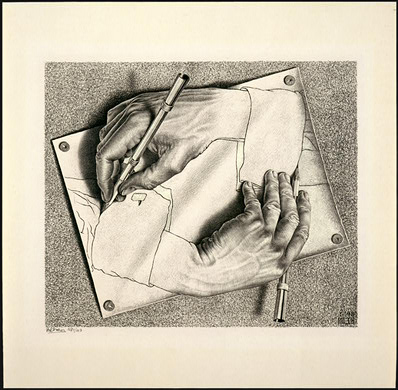
"Drawing Hands" M. C. Escher (1948)
Contour Drawing.
A contour drawing is a drawing in which lines are
used to describe the edges, boundaries and three dimensional relationships
of the forms that comprise one or more objects. If a line is used to record
the itinerary of the contour-seeing eye,
it will result in a contour drawing.
DO THIS:3 hours (not all at once.)
Place a large (18 by 24 inch) sheet of white drawing paper in a comfortable
position on an easel or a table. Leave it in the pad or tape it down with
a few sheets beneath it as padding. Put the point of a sharpened number
two (or HB) or softer pencil near the center the paper. If you are right-handed,
hold your relaxed, slightly crooked left index finger aproximately 10 to
20 inches from your face, pointing at your right shoulder. Lefties, vice
versa. Find the point on your fingernail's edge where it first appears
coming out from under the skin on the side of your finger. Pretend your
pencil's tip is on this point on your fingernail. In your imagination,
link your pencil's tip to this "point" of your eye. When you feel they
are one, start to move your eye in the manner of contour
seeing. As you move your eye, move your pencil in a corresponding manner.
DO NOT LOOK AT YOUR PAPER.
Continue moving your eye/pencil until you come to the end of the contour
which will be where your nail's edge slips under the skin on it's other
side. Of course, if your nail is damaged from biting or otherwise, the
contour may end sooner. When the contour ends, stop moving your eye. Do
not jump to the skin or next contour. Lift your pencil off of the paper.
ONLY NOW MAY YOU LOOK AT THE LINE YOU DREW.
Next find the beginning of the edge of the skin as it appears coming out
from under the nail and heads back toward your cuticle (define).
On your paper, position your pencil on this point relative to the line
you previously drew. Pause while you "marry" your pencil to your eye. Then
move your eye/pencil along this edge of skin, noticing every slight bump
or flatness and responding with a corresponding bump and flatness in your
pencil's movement. As your eye moves along this edge you will soon come
to the cuticle. Everyone's fingers are different. You will have to decide
whether the contour of your finger's skin becomes part of the very (primary)
edge of your cuticle, or whether it leads more directly to the boundary
(secondary) crease that marks the division of the cuticle from the living
skin of the finger.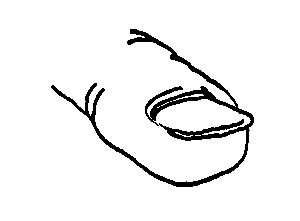
Continue moving your eye along which ever path you choose until the contour
ends, probably as it dives under the nail on the side opposite where the
contour started. Stop. Lift your pencil from the paper. Look at your line.
Do not dismay if it did not end where it should have relative to
the first line you drew. This is to be expected since you were not watching
and guiding the pencil as it drew. You were properly concentrating on maintaining
the unity of your pencil and your eye. Looking at your pencil would destroy
that unity. In fact, the "wrongness" of your lines is evidence of the correctness
of your efforts. If your lines are perfect, you will be suspected of cheating
by having looked as you drew them!
Continue in this manner with the rest of your hand. Proceed to your
unshod foot. And your foot in a shoe.
tips
Relax.
Let your hand enjoy its freedom from the controlling eye.
Let your muscles and bones assert their wisdom.
Give your critical mind a sabbatical (define).
Let your eye dig into pure seeing, relieved of its supervisory task.
Revel in the mystery of what your unwatched hand is creating.
Find pleasure n the suprise when you see it.
Let go of your preconceived notions of what is a "good" drawing..
Try to draw these contours larger than life so that you can magnify
all the vagaries (define)
of the edge. Try not to draw long lines. Be supersensitive to the ending
of a contour. It is the beginnings and the endings that convey the most
information about the contour relationships of an object. Think microscopically
about breaks on the surface. If your eye has to jump a space on the surface,
no matter how small, consider that the end of the contour and styart a
new one. So, when in doubt whether or not a line is ending, End it! Besides,
ending a line gives you an opportunity to assess your progress.

Continue in this manner until fatigue reminds you how much concentration
this requires, especially for novices. Then, stop. Come back to it when
you are refreshed. It is essential that you not force yourself and not
be tempted to speed up. It is much more important to experience this existential
process than to whip out a lot of line mileage or make accurate proportions.
Second assignment.
Pallas' First Day Handout.
Macomb Community College.
Jim Pallas Homepage.