Guitar Tutorials
|










 |
Google for guitar tutorials and see
how many results you get. The number may range to millions. While I have to
concede the fact that some of the sites offering tuts are extremely useful,
unfortunately most of them come with a price tag that is, in most cases, a bit
too much for our tattered pockets. Free advices and tuts are there but they
are usually too low in the rankings and as such you won't get your hands on
them until you spend a few of your precious net hours surfing through all the
pages till you get some quality information in a link in, say pg. 52. This is
what I had to go through when I first started on my mission to control the six
steel strings. And this is what I intend to save my dear friends from. I can't,
in any way, claim to be an ace guitarist. In fact it still hasn't been a year
when I bought my first guitar- a True Tone Spanish steel-strung O-cut Jumbo
Acoustic at Rs. 2000. It was the 16th of February, 2005. It was as if I met my
valentine two days late. And believe me that was the time I understood what people
mean by love at first sight.
Ok. Let's not lose focus. As I was
saying, in my case, I had to suffer from a sheer lack of quality advice as to
how I should go about the job. Should I straight away start with Pink Floyd or
go ahead playing Yankee Doodle? And this is the problem most newbies face. They
usually get a lot of advices from the various guitar forums but most of them are
not suitable for rookies as they start straight away without any basic info on
the subject. That's why I decided to come up with this. I have fresh in my mind
the exact problems that beginners face and that's exactly what I intend saving
them from. So here comes my tutorial. I'll be publishing the lessons at regular
intervals and you may
mail me your queries. I'll be more than happy to oblige.
|
One more thing. This tutorial doesn't
mean that you don't have to take any personal coaching. Though most people say
that self teaching is the best way to get the hang of anything, I insist that
you enroll with some professional teacher (not someone who plays in a band or
something like that) as he is the one who is actually going to be guiding you.
However it has been long since he had started playing and as I've said before,
he won't really remember what he had to go through when he first started his
journey. And its only then that I and my tuts come in. So here we go folks.
Index :
Lesson 1 - Guitar
Basics
First of all we turn our attention to
the technicalities of the instrument.
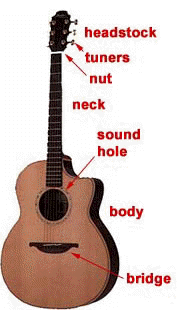
Parts of a guitar |
A guitar consists of a hollow box and
a wooden rod attached to it called the neck. The sound is produced by the
vibrations of six (usually) strings passing over the neck (and connected to the
bridge) and is amplified by the air inside the hollow body of the guitar. The
bigger the volume of the box the more the volume and depth of the sound. On the
neck there are some metal strips called frets. In all probability you'll find 20
of them for your first guitar. When you press down a string just above a fret
(press it until the string cuts into your flesh and it really hurts) then only
the length of the string below that particular fret vibrates. As the length of
the vibrating part of the string changes you get different notes. But keep it in
mind that for you to get a clear sharp sound you must press the string on to the
neck keeping the tip of your finger at right angles to the plane of the neck.
Press it as hard as you can. At first all you will get to hear is a dull 'phut'
kind of sound. Experiment with different finger positions and check which of
them suits you most. Do not go for the one in which your finger hurts the most.
The note should ring out clearly and perfectly. You're ear will tell you when
you get it right. Oops. Looks like I'm getting off the
track. Let's focus on guitar basics at the time being and we'll come back to the
playing part later. Now what are the different types of guitar. Broadly speaking
there are four types of guitar:
-
Spanish steel-strung acoustic
(maybe Jumbo or normal, or o-cut or f-cut)
-
Spanish nylon string flamenco
-
Semi-acoustic (usually f-cut)
-
Solid body electric
|
Lets turn our attention to the
different types- one by one. The Spanish steel-strung acoustic is, in all
probability, the one that you'll be starting out with. It is easily the best bet
for a beginner and is widely used for rhythm accompaniments. As the name
suggests the strings are of steel (four of them as brass-coated, as far as I
know) and cause considerable blisters on your fingers. The sound is a bit
metallic but if you aren't really in the classical mould this is the baby for
you. If the hollow body of the guitar is large then its a jumbo acoustic. It
gives an increased depth and volume and also results in a noticeable improvement
in the quality of sound produced. However owing to its size its not too popular
unless you are performing solos. I won't recommend this for girls though guys
can give it a try and see if it suits them when they go to the store. Though I
started out on this type I don’t feel this suitable for beginners.
Nylon string guitars were the first
ones in the scene. You must have seen Antonio Banderas playing it in Desparado.
This is the classical Mexican instrument used by the Flamenco style guitarists.
Among the contemporary guitarists, you can see this type being played by Mark
Knopfler (Dire Straits). Also who can forget the original Hotel California by
Eagles (there's also an acoustic and an electric version of the song)? Instead
of plucking with a plectrum as in acoustic guitars this type is played by the
finger picking style. Not recommended if you aren't hell-bent on Western
Classical.
A semi-acoustic guitar is similar to
the acoustic guitar except that in addition to a hollow body it has a pickup and
can be played over an amplifier like an electric guitar. So it can function both
as an acoustic as well as an electric guitar. Personally I feel this is a
Jack-of-all-trades kind of instrument but it can be used for playing rythm in a
band. Used by Bryan Adams in all his performances except MTV Unplugged where he
plays a jumbo acoustic. Gives a sound of warmth in between its acoustic and
electric cousins. However an acoustic guitar can be converted to the
semi-acoustic one once you fit it with a pick-up. The cost-factor encourages
many emerging guitarists to use this as a stepping stone before they step out
into the world of electric guitars. However if you do plan to shift to electric
guitars (as is the case with most rock fans) a bit early without going into the
nuances of the acoustic kind, then my suggestion is that when you buy your first
guitar make sure you get one that doesn't have too bulky a body. That's yet
another reason not to get yourself a jumbo guitar.
Electric guitars are the most popular
these days. The easiest to play it has an amazing array of features like
distortion, tremolo, overdrive (which are mere terms for us at this point), etc.
They have a solid body and have to be accompanied by an amplifier and a
processor (recommended). Just below the next there are 3/4 pick-ups which are
nothing but magnets along with magnetic field sensors. The magnets create a
field around the strings and when the steel-strings vibrate as you strike them
the sensors pick up the change in the resultant field caused by them and send
them to the amplifier which reproduces the sound via speakers (included in the
amp or external). Too costly because they are of no use if you don't have a
quality amp. A bad amp makes a good guitar sound horrible and a good amp can
mask a bad guitar. A processor with pedal gears are a must once you play as a
professional.
In addition to these four broad types
there are bass guitars which have 4 (or 5 in some cases) strings which play the
bass of the songs. There are 12 string guitars like the one you see in Hotel
California. There are also double neck or triple neck guitars in which strings
in different necks are tuned differently or one neck may have 6 strings with the
other having 12 strings.
So now what are the good brands that
you get in Kolkata? Well for the acoustic guitars you can go for Hobner, Givson
or Gibtone in their o-cut versions. I would recommend Givsons though the ones
that you get here are just mere shadows of their US counterparts. However True
Tone (exclusive Braganza products) come very cheap and are in no way inferior to
their branded cousins but only you have an experienced guitarist to choose the
right babe for you. If you are going into electric ones you better import an
Ibanez or Yamaha or Les Paul from the US. But they are too high in price
(ranging even to lakhs) and for people like us Samec gives good value for money
provided you have a decent amp and processor to go with it. Whatever you do I
don’t think its worth to spend more than 3000 bucks on your first guitar. And
its highly recommended that you start on an acoustic guitar, fit a pick-up and
turn it into a semi-acoustic after 9 months of learning and then get yourself an
electric guitar with tremolo and a good enough amplifier. It should come
anywhere around Rs. 10000 to 12000. After a year with this get yourself a
processor (or some call it a sound-box) for another 6000 bucks. However these
prices apply to you only if you are in Kolkata.

Lesson 2 - Music
Basics
Before we start playing our first
notes let’s foray into the basic theory of music. You’ll hear many people say
that music is the food of life. But I bet most of them haven’t any idea about
the recipe. Now we don’t want to be like that, do we?
Let’s start from an Indian context. In
Indian music (applies to both Hindustani and Carnatic- the two main schools of
Indian Classical music) we come across seven proper notes or ‘sur’ which
complete the music cycle. The notes in order are Sa-Re-Ga-Ma-Pa-Dha-Ni-Sá. The
last Sá is an octave of the first one. That means that starting from the first
note there are 7 notes in between before we reach its octave. The nature of the
two notes is the same. Only, you may say that the scale of the second one is
higher than the first. These notes are called pure notes or ‘shuddha sur’s and
complete the music cycle.
In Western Classical, these notes are
named Do-Re-Me-Fa-So-La-Ti-Do. The character of the notes are essentially
similar though the Western concept of scales is different from the Eastern
school. Here also the second Do is an octave of the first. To bring in the
concept of scales we use a different nomenclature for Western notes and name
then as A-B-C-D-E-F-G. To complete the cycle next comes A again with the second
A being an octave of the first one. Since we are learning guitar and not music
in general we shall chiefly adhere to the Western conventions of A-B-C-D-E-F-G unless need
arises.
However in between these pure notes we
have flat and sharp notes which are essential for bringing out notes sharper
than the previous pure note but flatter than the next pure note. For example
between A and B there is a note which is sharper than A but flatter than B. We
call it A sharp or B flat (whatever we feel like). A sharp note is denoted by a
‘#’ while a flat note by a ‘b’ as subscript. So we write the note as A# or Bb
. So now the music cycle stands as A-A#/Bb-B-C-C#/Db-D-D#/Eb-E-F-F#/Gb-G-G#/Ab
. These 12 notes complete what we call the Music Cycle. Keep in mind that
there are no notes in between B-C and E-F. In Eastern conventions we name the
sharp notes as 'kori' or 'tivra sur's and the flat ones as 'komal
sur's.
Another convention widely used by
Western artists playing Eastern Classical is the numeric system where the notes
correspond as 1-2-3-4-5-6-7-1 corresponding to the seven basic notes (Sa to Ni)
and the octave of the first (Sá). But that won't find too much significance in
our studies at this point of time.
In Eastern music we come across
'raga's. Now the concept of ragas is such that it can't be expressed in a few
words. According to 'Wikipedia', ragas are are the melodic modes used in Indian
classical music. A raga describes a generalized form of melodic practice; it
prescribes a set of rules for how to build a melody. It specifies rules for
movements up (aarohanam) and down (avarohanam) the scale, which
notes should figure more and which notes should be used more sparingly, which
notes may be sung with 'gamaka', phrases to be used, phrases to be
avoided, and so on.The result is a framework that can be used to compose or
improvise melodies, allowing for endless variation within the set of notes.
Carnatic music and Hindustani music,
have independent sets of ragas. There is some overlap, but more "false
friendship" (where raga names overlap, but raga form does not). In north India,
the ragas have recently been categorized into ten thaats or parent
scales. South India uses a somewhat older, more systematic classification scheme
called the melakarta classification, with 72 parent (melakarta)
ragas. Overall there is a greater identification of raga with scale in Carnatic
Music than in Hindustani Music, where such an identification is impossible.
Some Hindustani (North Indian) ragas
are prescribed a time of day or a season. During the rains, for example, many of
the Malhar group of ragas--associated with the monsoon--are performed. Some
musicians take these prescriptions very seriously.
Now that we have discussed notes let
us consider another important part of music- chords. In music and music theory,
a chord is two or more different notes sounding simultaneously, or nearly
simultaneously, over a period of time. For example, if you simultaneously play
any three (or more) keys of a piano, you have just played a chord. Likewise, if
you simultaneously play three or more strings of a guitar, you have just played
a chord on the guitar. Every chord is given a specific name, based on the notes
that constitute the chord and the distances, or intervals, between them.
Originally, a chord simply meant the sounding together of different tones, or in
other words, the resultant of these tones. Broadly, any combination of three or
more notes is a chord, although during the common practice period in western
music and most popular music some combinations were given more prominence than
others. This is because some combinations appear to be more musical than others.
So as you can realize, there are hundreds of chords (ranging from minor chords,
augmented chords, suspended chords, power chords, sevenths, ninths, and lots
more). In total 'chord theory' is an extensive chapter which we shall cover slowly at
different points of time during our journey.
After chords it is fitting that we delve deeper into the
concept of music scales. Western Scale System can be broadly divided into two
categories- Major and Minor (1-b3-4-5-b7) pentatonic
scales. The major scale can be further divided into
- Ionian (1-2-3-4-5-6-7)
- Dorian (1-2-b3-4-5-6-b7)
- Phrygian (1-b2-b3-4-5-b6-b7)
- Lydian (1-2-3-#4-5-6-7)
- Myxolidian (1-2-3-4-5-6-b7)
- Aeolian (1-2-b3-4-5-b6-b7)
- Locrian (1-b2-b3-4-b5-b6-b7)
Eastern Music doesn't have so much of an elaborate scale
system (as far as I know). For the time-being, we'll focus only on the
Pentatonic Major Ionian Scale and then we shall come back to more about scales
and chords in Advanced Music Theory.
Practice:
Ok. Time to pick up your guitar. Note down the following
finger exercise:
|
Note: |
E |
F |
G |
A |
B |
C |
D |
E |
F |
G |
|
String: |
4 |
4 |
3 |
3 |
2 |
2 |
2 |
1 |
1 |
1 |
|
Fret: |
2 |
3 |
0 |
2 |
0 |
1 |
3 |
0 |
1 |
3 |
|
Finger: |
2 |
3 |
- |
2 |
- |
1 |
3 |
- |
1 |
3 |
As the table goes, the first row indicates the notes you
are playing. The second row gives the number of the string you are plucking
(striking with your plectrum held between the thumb and the index finger of your
right hand). The thinnest string is numbered one, the one just above it is
string 2 and so on. The third row gives the number of the fret just above which
you are pressing firmly with the fingers of your left hand. Fret: 0 means
plucking an open string, i.e., striking a string with your plectrum without
pressing down any fret on the neck. The number of the finger with which you are
pressing that particular fret is indicated in the fourth column. The index
finger is denoted by 1, the middle finger by 2, the ring finger by 3 and the
little finger by 4. Play the notes one after the other as fast as you can. And
try to get into a rhythm while plucking. You can give yourself a beat by tapping
the ground with your left foot as you play each note. Start the exercise slowly
and gather speed as you keep on repeating it.
To be continued...