Making a Difference
 |
 |
 |
 |
 |
 |
In South Africa, 60 children a day are raped. Before she was a year old, this girl became one of them
No one here can explain why violence, especially sexual violence, is soout of control. As STEPHANIE NOLEN reports, the crisis -- especially the unique horror of infant rape -- has spoiled the hopes of the 'rainbow nation' 10 years after apartheid
By STEPHANIE NOLEN
Saturday, October 18, 2003
[published in the Globe and Mail, Canada’s national newspaper]
Page F1
Claudia Ford has a story she tells her daughter, Princess, before bedtime."You're my special girl," she begins, and Princess squirms with delight. "Do you know why?" Ms. Ford asks. "Because I saw you in the hospital, and I said, 'Look at that special baby. I want to take her home with me.' "
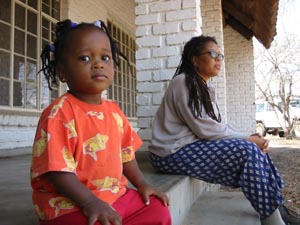
Princess, an eagle-eyed two-year-old, loves the part about how she's special. And Ms. Ford tells her each night, in her calm and measured voice. But she is braced for the day when Princess will ask the natural question: "Why was I in the hospital?"
Princess was brought to the hospital by her biological mother on Dec. 2, 2001, with massive internal injuries. Horrified staff determined that her perineum had been cut open with a piece of a glass bottle and she had been raped repeatedly. It later emerged that her mother had been drunk and left her in a seedy hotel with two male acquaintances; she came home hours later to find the baby screaming and bleeding.
The surgeon who tried to repair the damage to the baby's genitals and digestive system later told Ms. Ford that he could hardly tell what he was doing, so massive was the trauma. "He said, 'I just sewed, did the best I could and prayed,' " Ms. Ford recalls. She heard about the five-month-old on the news, and went to the hospital with a group of others to visit the baby eight days later.
Princess's mother, who was still in a drunken daze when she brought the baby in, had disappeared; police were hunting for her and investigating the rape. Ms. Ford heard there were plans to discharge Princess to an orphanage. "I thought, 'No way. Not after what she's been through.' " And so at the age of 48, with her own sons already in their teens and 20s, she found herself mother to a massively traumatized infant.
Ms. Ford, an American-born development researcher who now teaches at Johannesburg's University of the Witswatersrand, has become something of an expert on the horrifying phenomenon of infant rape in the course of caring for Princess (who has had a final round of reconstructive surgery, tested negative for HIV after a six-week course of drugs, and is today a remarkably cheerful and well-adjusted toddler).
Ms. Ford speaks out on the issue because, she says, so many South African mothers cannot talk publicly about the sexual assault of their children.
Two rapes of babies were reported outside Cape Town this week, one of a nine-month-old, one of a girl just shy of 2. The nine-month-old baby has been dubbed Baby M. Her grandmother says she found her bloodied and screaming in her township shack. The mother had disappeared; a 35-year-old man appeared in court charged with the rape on Wednesday; the baby remains in hospital. Police are still investigating the rape of the two-year-old, who has been discharged from hospital.
The infant rapes make headlines here -- they are the most shocking examples of South Africa's epidemic levels of rape and other violent crime. But rapes and assaults on women and older children are now so common as to pass unremarked. There can be no question that something is terribly wrong.
It is 10 years since the end of apartheid, since the moment when newly democratic South Africa was held up as a beacon of hope to the world. In 1994, this country had the highest rate of rape in the world; that is still true today. South Africa also has the world's highest rate of child rape, 60 a day -- a 400-per-cent increase in reported assaults in the past eight years. Only 5 per cent of perpetrators are convicted.
Black South Africans never rose up in the mass rampage against whites that some predicted at the end of the apartheid years -- the rage has taken another form, the vast majority of it assaults by black men on black women and children, committed in squalid township shacks.
"It's not saying good things about the rainbow nation," says a grim Mike Earl-Taylor, a researcher in the MTN Centre for Crime Prevention at Rhodes University in Grahamstown. "It seriously tarnishes the image."
Government ministers, police, doctors and sociologists all say they are baffled by the gratuitous level of violence, especially sexual violence, that is the hallmark of crime here.
"What is causing the serious and violent crime?" Safety and Security Minister Charles Nqakula asked when the latest crime figures were released. "Why do people who go into a house to steal, then murder those who are in the house -- even the elderly, or children? This is the challenge we must give to our sociologists and our psychologists. I don't understand it."
Ask Mr. Earl-Taylor, who studies the perpetrators: "The actual psychological motivation for that is at the moment beyond our understanding."
Ask Tina Sideris, an expert on gender and violence. "Some of these things are in the realm of the incomprehensible."
Ask Ms. Ford, who soothed her gang-raped baby by holding her in front of a garden fountain for hours. "Sometimes you have to believe in absolute evil."
There are some theories about violent crime in South Africa. Mr. Nqakula outlined a handful: Overcrowding, rampant substance abuse and grim living conditions in the squatter camps and townships outside the cities; an extreme gap between rich and poor South Africans, the widest such polarization in the world; the proliferation of firearms in the past decade; the large presence of organized crime, including international drug cartels.
As well, everyone agrees that part of the reason rates have increased so sharply is that much more of the crime that has always existed is now being reported, as people gain faith in the police service. And South Africa's crime statistics are routinely compared with those of countries such as Canada, not its African neighbours such as Angola and the Democratic Republic of Congo, where there is no such record-keeping.
But for South Africa, Mr. Nqakula's question is the crucial one: Why, for example, do car-jackers routinely execute the drivers of the Hondas they want, instead of simply pulling them out of the car? Why do burglars drag women around the house by their hair before raping them in front of their partners? Why do home invaders open the diapers of sleeping babies, looking for girls?
The minister blamed "the degeneration of moral fibres of our society." Last year, his government launched a national "moral regeneration campaign" in an effort to instill values in young people. "We believe that something is wrong within the fabric of our society," said deputy president Jacob Zuma, kicking off the effort. He spoke of this as an unexpected threat to South Africa's "hard-won freedom and democracy."
Prof. Sideris, of the Wits Institute on Social and Economic Research, begins her attempt at an explanation by noting that "this has always been a very violent society." Luke Lamprecht, who runs the Teddy Bear Clinic for Abused Children in Johannesburg, specifically cites the legacy of the war fought on South Africa's borders in the apartheid years, and of the unnamed civil war that raged here in the years up to the first democratic election in 1994, as the African National Congress and the Zulu Inkatha Freedom Party fought savagely for power.
He notes, too, that with that election, South Africa went from being one of the world's most restricted societies to one in which suddenly all kinds of things were permitted, a shift many people are still struggling with.
"But what sets us apart is the high level of sexual violence," says Superintendent Andr? Neethling, provincial co-ordinator for the police family violence, child abuse and sexual offences unit in Gauteng, the province that contains Johannesburg. There were 52,000 reported rapes in South Africa from April, 2002, to April, 2003; police estimate that perhaps one in eight assaults is actually brought to their attention.
"We are a rape-prone society," says Mr. Earl-Taylor, describing a "culture of entitlement" to the sexuality of women and children, who are regarded as possessions. In the apartheid years, women in the black townships were terrorized by a phenomenon called "jackrolling," the abduction and gang rape of women, usually by groups of armed youths, who assaulted their victims in public places and made no attempt to hide their identities. While township crimes were rarely policed or reported in the apartheid years, the police have in recent years made a specific effort to encourage reporting of child and family violence.
At the same time, traditional ideas about women's place in society have changed dramatically in the past decade. A government affirmative-action program has pushed women into new educational and employment opportunities -- and there is a corresponding level of resentment from men, Mr. Lamprecht says.
Furthermore, he says, the first democratic election brought "a promise of sudden equality," but many men haven't seen it come true, especially the overwhelmingly black ranks of the 50 per cent of the population who are unemployed.
"There is a felt experience among many men of insecurity and vulnerability," Prof Sideris says. "And it may be one of the factors that plays into violence in an intimate sphere. Unemployment, no hope for future, no place in society -- intimate relationships are where one might be able to assert some kind of authority."
In almost 90 per cent of rapes reported in the past year, the victims knew their attackers. Prof. Sideris hastens to add, though, that plenty of men in difficult situations do not rape women or children, and so this is only a limited explanation.
Mr. Earl-Taylor says his study of the crime statistics suggests that the sharpest rise in violence against women comes in areas where women were, until recently, most tightly controlled.
But why the rapes of children? "Most of us who work in criminology can understand the economic basis for some crimes, the burglary and stealing -- where people are hungry, where there is no work, no way out," he says. "But apartheid can't cause someone to rape a six-month-old baby."
Fourteen per cent of rape victims here are younger than 12, but the statistics do not separate the 10-year-olds from the 1-year-olds, even though, as Supt. Neetland points out, the pathologies of the rapist in those cases are quite different. An estimated 85 per cent of the assaults of children here occur in intimate situations -- assaults by uncles, scoutmasters or teachers -- statistics similar to Canada's.
But Mr. Earl-Taylor says the number of opportunistic attacks -- like the two rapes in Cape Town this week -- is climbing steadily.
One factor is the so-called "virgin cure," the idea that sex with a virgin will either cure HIV or prevent a man from contracting it. It is not a new idea; in Europe 400 years ago, men tried to cure syphilis by having sex with virgins, and recently it has been reported as a factor in child rape in Thailand, Cambodia and across southern Africa.
"It can't be discounted as a factor here," Mr. Earl-Taylor says. "Some of these men are motivated by the factor that there is no cure and the government here is doing nothing."
Certainly, the AIDS crisis adds to the air of desperation. South Africa has more infected people than any other nation -- about five million. Six hundred of them die here every day, and 45 per cent of those arrested for rape test positive. However, Mr. Lamprecht says that of the 250 assaulted children he dealt with last year, there was only one case where the "AIDS cure" was the cause.
But what about cases like Princess, or Baby M (who took a few cautious first steps in the Cape Town hospital on Thursday, after surgery to rebuild her anus)? In Mr. Earl-Taylor's research and Supt. Neetland's experience, the baby rapes happen in a particular environment: The offenders are ill-educated, unemployed members of the lowest economic groups. They are usually drunk when they commit the attack. The victims' caregivers come from similar backgrounds, also abuse alcohol, and leave the children poorly supervised.
Infant rape presents particular challenges for the police: The victim is too young to provide a description, and the chemicals in diapers that are designed to keep babies dry also serve to destroy possible DNA evidence.
The pathology of it is different, too. "To be blunt, if it is committed with a penis, it has to be painful for the perpetrator as well," the police officer said.
The best explanation anyone can come up with for the baby rapes is vengeance -- not on the infant, but on the whole society.
"There is this kind of hate, of wanting to punish someone by raping a baby," says Supt. Neetland, who has been investigating these crimes for 12 years.
The situation with the home-invader rapists is similar, he says. "It's not because they feel like sex at this stage. It's giving expression to their hate, saying, 'You, Mr. Rich Man, here's how much I hate you, here's how powerful I am.' I'm very sure there is some kind of motive of revenge."
Mr. Lamprecht told of groups of township teens who go after young women who are seen as "wanting to be white" by dressing better, speaking better and going to school. "They can't get them in the traditional ways and so they take them. . . . It's a way of saying, 'This is how desperate we are.' And it's not just for money. There is no fiscal gain -- it has a pure vengeance motive," he says.
David Potse, the Louisville township man who was convicted of raping a nine-month-old baby in a high-profile case last year, had dated the infant's 17-year-old mother the previous year. "He told me that something will happen to me one day to make me regret ever leaving him," she told the court. "There was anger all over his face."
In addition, men who are abused in childhood are at increased risk of becoming abusers. The national children's rights group Childline reported that in 43 per cent of the cases it saw in 2000, the assailants were under 18, nearly children themselves.
After she took Princess home, Claudia Ford helped to heal her sliced perineum with daily applications of olive oil and comfrey tea, using skills she had learned as a midwife. She rocked the baby when she woke up screaming hysterically in the night, and held the little legs down with her own when it was time for a painful change of the tiny colostomy bag.
Today, Ms. Ford tries to keep the issue of rape of children in the public domain here, wondering if anyone will have found the answers when Princess is 6 or 10 or 14, and wants to know, "Why did they do this to me?"
"I gave up trying to figure out why on some levels," Ms. Ford says. "On the other hand, I know I'm going to have to answer that question.
"The horror of it doesn't really recede."
Stephanie Nolen is The Globe and Mail's Africa correspondent.