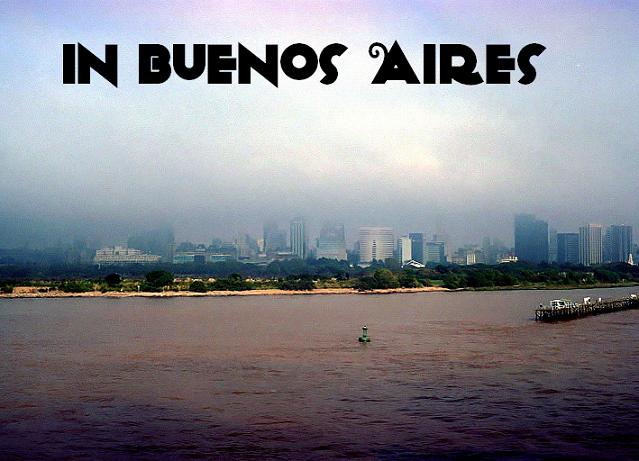
The "Paris of the South", the cradle of Tango, Buenos Aires. I never thought I'd end up here. I was only passing through, four years ago, on my first and - so I thought - only visit to the country and the continent, because I wanted to see Patagonia. A friend of a friend gave me a whirlwind tour. Buenos Aires passed by me in a blur of palm trees and hot sunshine, beautiful nineteenth century buildings, tree-lined boulevards, thin women, flocks of screeching green parrots in a park, cafés with tables outside where they served the most wonderfwul coffee. By the end of that day, I heard myself thinking, I could live here.
Four years later, I boarded a plane bound for South America once more, to make my home in Buenos Aires for the next six months.
February March April (Patagonia) June Life has been hectic for a while. I lived in my flat in San Telmo for a month, then moved to lively, noisy, brash Once. Barely a week after that, I left for a first trip to Patagonia, to the Andes, to Esquel, and that incredible weekend in the mountains with the Mapuche. After my return to Buenos Aires, I had another week in Once, trying to find my way around, and then, a friend from London arrived for three weeks, and we went off down south again, to Patagonia again, but the east coast this time. We spent two weeks there, and she stayed another week in Buenos Aires. General Videla. Photo from website http://www.izquierda.hpg.ig.com.br/ditaduras/argentina.htm They made substantial alterations to the Argentine constitution, dissolved Congress, suspended all political and trade union activity and removed most government officials from their posts. Photo from website http://www.izquierda.hpg.ig.com.br/ditaduras/argentina.htm Photo from website http://www.izquierda.hpg.ig.com.br/ditaduras/argentina.htm
364 detention centres were opened all over the country, the worst of them ESMA, the Navy's School of Mechanics. People disappeared, Marxist students, trade union leaders and political activists. Then the net was cast wider: now it included students in general, people who read a lot, people who looked as though they would read a lot, people with long hair. In the end, it was anyone who, in the eyes of the generals and their henchmen, appeared 'subversive'. The Mothers of the Disappeared -- Madres de Plaza de Mayo. Photo from website http://www.izquierda.hpg.ig.com.br/ditaduras/argentina.htm Today, the Mothers run a bookshop and café in central Buenos Aires, on Plaza del Congreso; as well as a 'Popular University' with courses in social work and politics. They are a radical organisation; in the bookshop, there is a whole shelf given over to Marxism, another, to Che Guevara. The mural outside the Mother's café. (Photo by Susan Gardner)
Every Thursday afternoon, the Mothers still hold a demonstration on Plaza de Mayo, going round and round. To this day, not all the bodies of their sons and daughters have been found. * * *
Returning from Patagonia to Buenos Aires the first time - after my week in the Andes with the Mapuche, and in my friend Dana's house - was a real shock. In the Andes, the air had been crystal clear and cool, the light bright. There were mountain peaks outlined against the sky everywhere I looked. There was space. Nature. Emptiness. * * *
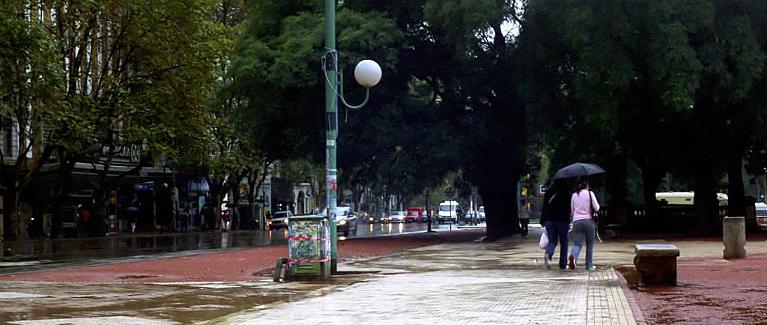
We spent two weeks in Patagonia, about which I will (eventually!) write in the Patagonia section of this Blog, and hopefully also, in the fullness of time, in a book about my travels in Patagonia that I am currently working on. Plaza de los dos Congresos in the April rain
Easter comes and goes, and autumn is in the air.
This late April morning is bright and cool; the sky full of brilliantly white cotton-wool clouds. The sun is hot but there is a cool wind blowing, and it's cold in the shade. Leaves are lying on the pavement, and there is a smell of autumn in the air. After breakfast, I wander further along the streets. I'm out exploring. * * *
It is cool on the top deck of the ferry, there is a bit of a breeze, and I clutch my hot coffee thankfully. Then the boat shudders, and begins to roll a bit from side to side with the movement of the waves. We're off.
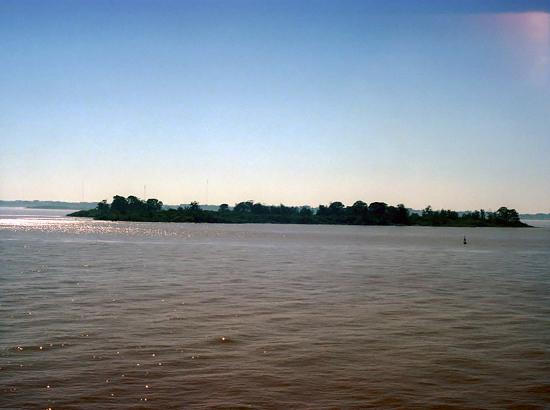
Buenos Aires slowly fades away into the mist. I feel as though I'm out on the high seas. The mouth of the river is so wide that soon, I can see no land at all on either side. And that although we're travelling upstream, away from the sea.
We pass a couple of islands, and then land appears on the horizon, and there is Colonia. The harbour looks a bit like a smallish railway station; there is a waiting hall and customs offices, a parking lot, and a road leading off into town.
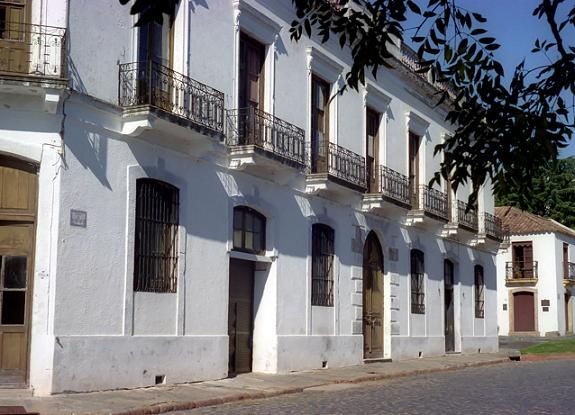
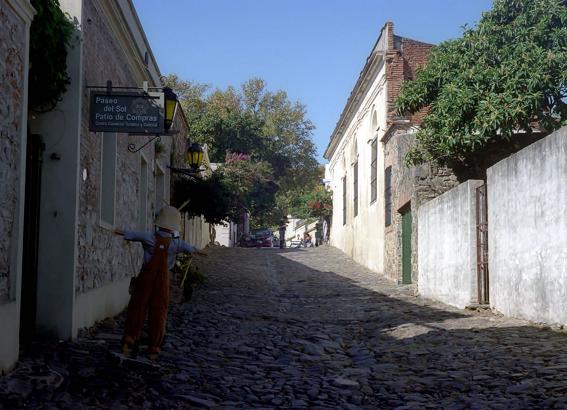
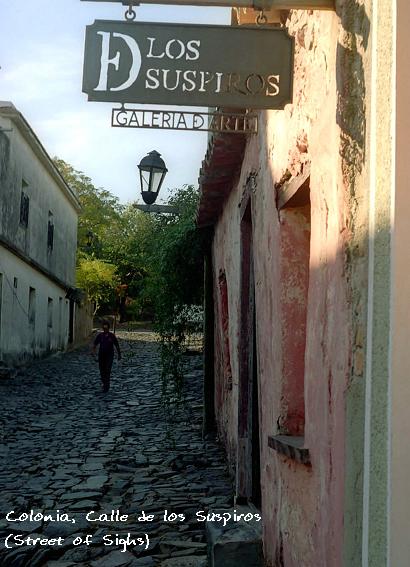
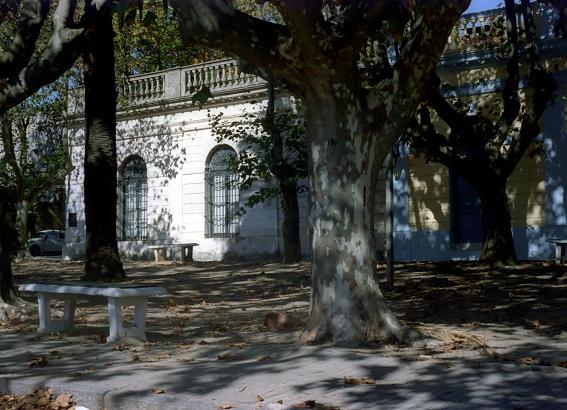
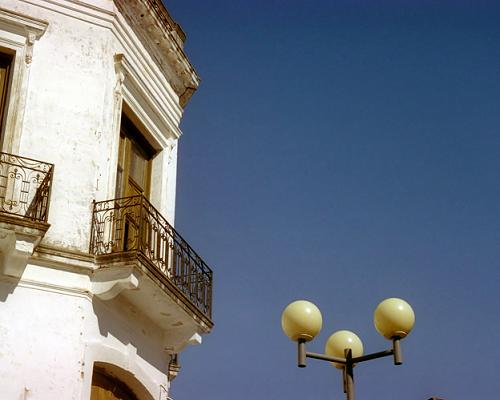
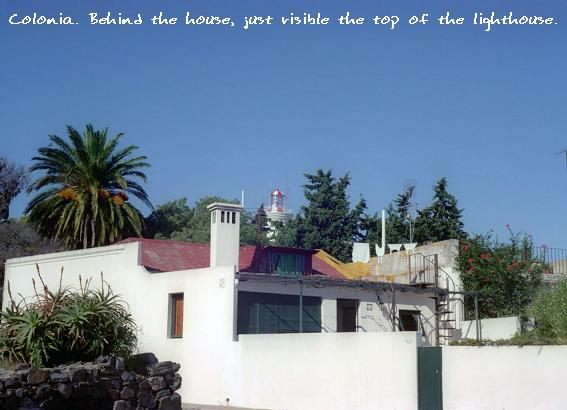
The place truly is incredibly idyllic. I had suspected that the pictures I have seen had been taken with great cunning, while the photographer had their back to, say, a gasometer, or a tower block, an oil refinery or a scrapyard. But no. It really is picturesque and beautiful; lovely old houses and a profusion of plants and flowers, a lighthouse white against the deep blue sky, dogs sleeping in the shade.
(c) all content 2006 I.R. Herrad unless otherwise stated Disclaimer: The Author of this site is not responsible for the content of external websites.
July
August (Patagonia)
March/April
It is lovely seeing my friend again, having company, being with someone from my 'other' life on the other side of the world, being with someone who speaks English. Actually, speaking English again after two months of barely using the language at all is a bit of a challenge for me at first. I keep having to pause and search for words. 'There is a, um, what d'you call it, er, a thingy, um, an event where people come together because X years ago something happened...'
Over time, she becomes quite good at guessing at my riddles. 'A commemoration?'
A commemoration. It is the 24th of March, and thirty years ago today, the generals took power of Argentina in a coup, and began what is referred to here as 'the last military dictatorship'. I find it quite chilling that it is not merely themilitary dictatorship, as I think of it, but the latest in a series of dictatorships. There have been several of them in Argentina over the course of the twentieth century. The government of Juan Perón (himself a general) and Eva Perón, Evita, in fact had some traits of a dictatorship, and Juan Perón was known to be an admirer of both Mussolini and Franco.
But there were other oppressive governments, genuine dictatorships. There is a saying in Argentina, a play on words: General elections in Spanish are Elecciones generales. People say that you get both, alternating: Elecciones, generales, elecciones, generales; elections, then generals, then elections, then the generals again...
The arguably worst dictatorship of recent Argentinean history was that of generals Videla, Viola and Galtieri between 1976 and 1983. There had been a lot of political instability in the early 1970s. Juan Perón and his new wife Maria Estela Isabel Martinez de ón, self-styled 'Isabelita', had come back from exile in Spain, the latter hoping to become a second Evita. But she possessed neither Eva Perón's fire nor her passionate 'love for the poor, and hatred for the rich'. Juan Perón was an old and tired man, but he projected a powerful myth.
The left saw in him the bringer of social justice, the champion of the underclass, the cabecitas negras, the 'black heads' of the dark-haired, darker skinned urban and rural poor.
The right expected him to restore order to the country, rein in the Marxist rebels and guerrillas, the Montoneros and rule with an iron hand, like General Franco did in Spain. In 1973, he was elected president with an overwhelming majority, but in the event, Perón failed on both fronts. After his death a year later, his wife Isabelita (who was already vice-president) took over the presidency of the country, but she was no more than a weak and power-hungry marionette whose strings were pulled by the generals. When under her rule, the economy continued to stagger, inflation rose further and the trades unions continued to call nationwide strikes; when Marxist groups kept kidnapping rich people for ransom and the right-wing squadrons kept shooting and sequestering 'subversives' and the country generally continued in unrest and instability, the generals decided to take over in earnest. On 24 March 1976, they staged a coup and seized power.
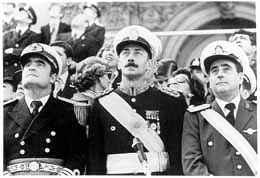
Despite this, many people were relieved at first, hoping that now order and quiet would be restored. Business was even happier. The Ford motor company took out one-page ads in the national newspapers of Argentina, welcoming the generals into power and expressing the hope that everybody could now get back to business. Governments throughout the Americas (including that of the United States) supported the military junta. Of course, many of those other Latin American governments in the region were also military dictatorships -- Chile, Brazil, Peru, Bolivia, Paraguay, and Uruguay just across the River Plate.
The generals in Argentina suffered from an obsessive fear of 'communism' and 'subversion', and they instigated a reign of terror in which disappearances, torture and extra-judicial murder were commonplace. The right-wing squadrons now operated under the wing of the government.
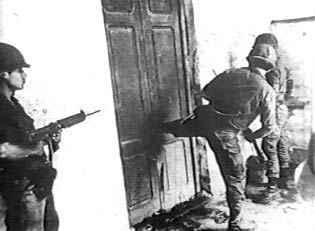
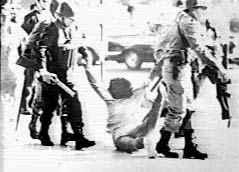
The prisoners were kept in tiny wooden cages, chained to the walls, forbidden to talk to their fellow inmates. Pilar Calveiro, a disappeared person who survived her detention, wrote in Poder y desaparicion (Power and Disappearance):
It was like a body storage, everything in absolute order, people stacked, immobile, unable to see, without a sound, as though already dead. As though this power, this claim to God-like authority precisely because it was a power over life and death, could kill before death; erase almost all that was left of a one's humanity, preserving only one's vital functions for a possible later use.
30,000 people were disappeared, sequestered, tortured and killed in the seven years of the latest military dictatorship. Not all their bodies have been found. Many were drugged and thrown out of planes or helicopters into the wide mouth of the Río de la Plata, the River Plate. Mass graves still continue to be found; only the other week one was opened in what had looked like an unused part of a cemetery in the city of Córdoba. Argentinean forensic archaeologists are renowned the world over and have worked in countries in Central America, in Bosnia and Iraq, helping to identify the bones of the victims of state terror.
One of the very few groups to resist the generals and demand answers in Argentina were the Mothers of the Disappeared, Las Madres de Plaza de Mayo. On 20 April 1977, Azucena Villaflor and thirteen other mothers whose - mostly student - sons and daughters had vanished, started demonstrating on the Plaza de Mayo in front of the Casa Rosada, the president's official residence. They demanded to know what had happened to their children. Public assemblies and demonstrations had been banned, an assembly or a demonstration being defined as a stationary meeting of people in the open. So the mothers walked, round and round the Plaza de Mayo. In the beginning, they had no posters, no placards. As a badge of identity for each other as much as for the outside world, they wore white headscarves: the nappies they had once used for their disappeared children.
All they were was a group of women demanding to know what had happened to their sons and daughters. But to the generals, they appeared extremely threatening. Here was a group that could not be called subversive. What would the people say? Mothers are held in very high regard in Argentina, at least middle-class, married mothers as these were. A government agent infiltrated the group.
Azucena Villaflor and three other mothers were disappeared. It is known that Villaflor was taken to the ESMA detention centre. Her remains and those of the two other women were not found until the middle of last year.
Today, a street in the chic new district of Puerto Madero, Buenos Aires's Docklands, is named after Azucena Villaflor, and a plaque explains who she was.
Leadership of the Mothers Association was taken over by Hebe de Bonafiri, who is still the president and spokesperson for the Organisation. Over the years, they became a potent force, a rallying point for resistance to the general's regime.
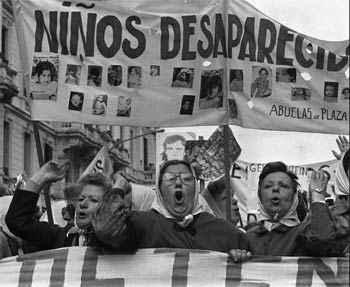
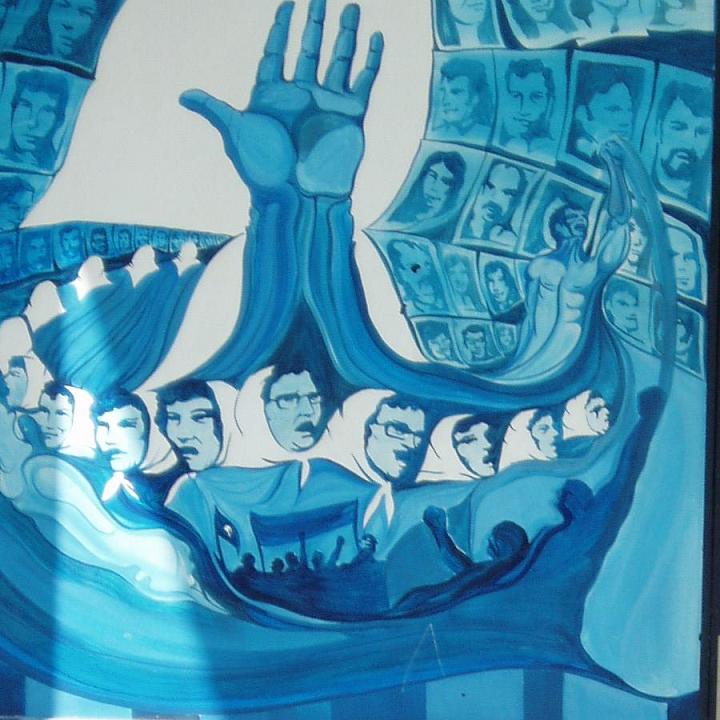
The Mother's website (in Spanish only) is here.
So. My friend has arrived in Buenos Aires, and tonight on Plaza de Mayo, a commemoration is being held of its being 30 years since the coup. I want to go.
I expect speeches, a political rally. But in fact, the closer I get to Plaza de Mayo, the louder the music becomes. The closer I get to Plaza the Mayo, the less I can move. The square is filled to overflowing with people. A good ten, twenty thousand must be here tonight. I wiggle through the crowd until I can see a little bit of what's going on.
A stage has gone up on the square across from the Pink House, Casa Rosada, where President Kirchner resides. On the stage sings Teresa Parodi, Argentina's Joan Baez, a protest singer. The Mothers sit on benches to the right. When Parodi sings her song about them, about the Mothers who went into the fight with their heads held high and their hands joined, the women - old now, in their sixties and seventies - join hands again, and their raised fists show the world that they are still ready to fight. A lot of young people are here, teenagers who've come for the music, maybe, but who still will get a good dose of politics tonight. Most of them were born after the end of the dictatorship. Actually, maybe I do them an injustice and they have come, like me, for the politics of the occasion.
I'm glad that so many people have come tonight. There is still a lot of fear in Argentina after 'the last military dictatorship' and the ones that have gone before it.
No te metes, was my friend Consuelo's mother's advice during the 1970s. Don't get involved. Between 1976 and 1983 in Argentina, you looked away, kept your head down, didn't stick your neck out, didn't get involved in other people's business. Even if that business was people disappearing. Por algo será, one would say if a neighbour had been dragged into a Ford Falcon (the favoured vehicle of the squadrons) and was seen no more: He'll have done something.
Consuelo is almost sixty now, old enough remember what life was like in the seventies. 'It wasn't safe to do anything!' she says. 'What would you have done? They would have come for you as well! It's easy to say now that we should have done something. You weren't here then, you don't know what it was like.'
She has a point, of course. But still...
'We didn't know what was going on,' Consuelo says. 'My mother went to Spain on holidays in 1980 and they told her of the disappearances, and she didn't believe them! She said, Rubbish, nothing like that is happening, we'd know!'
I don't know what I would have done back then. Perhaps Consuelo is right, and it is easy now to say, with hindsight, that somebody should have done something. Everything was secretive back then, nobody knew anything for certain. That, of course, was part of the regime's strategy.
It wasn't possible just to shoot people. ... Argentinean society wouldn't have accepted that. ... At the time the reasoning was thus: if it is let out that there are dead, questions will be asked which cannot be answered: who died, where, how?'
So said in 1998 ex-general Videla.
(Note how impersonal his language is. Not, 'We thought at the time...', 'If we let out that people have been killed', 'Questions that we cannot answer'. No, 'it is let out', 'There are dead', 'Questions that cannot be answered' etc.)
People in Argentina were afraid at the time. There had been a lot of instability, kidnappings, shootings. The generals played on people's fears. There were exhibitions of 'subversive' material -- and the definition of what could be subversive was very wide indeed; it included, for example, typewriters and cameras. Other exhibits were of terrorists in uniform, every star or stripe of every rank carefully annotated. The terrorists had by that time mostly been killed or captured, but that didn't stop the generals from using them as bogeymen and a continued justification for their regime of state terror.
There were other, disturbingly familiar sights: ceremonial burnings of books, large-scale sport events, youth organisations parading in uniform.
If I look at images from Argentina then, I am reminded of nothing so much as Nazi Germany. Consuelo is right, it is easy for me today to say, But why didn't you do something? Why didn't you say something?
Of course she's right. I'm free to say what I want. I haven't grown up under a repressive regime. And yet, and yet... Her mother must have known something wasn't right if she told her daughter not to get involved. My grandmother in 1930s Germany must have known something wasn't right when the neighbours kept disappearing at night. People in Germany claimed to have known nothing of what went on. Of course, in 1930s Germany things were so much more obvious, the propaganda that much more rabid, the disappearances on a much larger scale.
What would I do if I lived in a place like 1970s Argentina: in a climate of general, constant, low-level fear with a government hostile to criticism, where asking questions is not allowed, where 'getting involved' might mean getting punished; where keeping one's head down is beneficial, where blameless, quiet people are rewarded with being allowed to lead their lives in peace? Where, furthermore, people who do stand up and ask questions, people like Azucena Villaflor or the French nun Leonie Duquet, vanish without a trace? Would I have the courage to notice that something isn't right, to see, to register, to ask questions, to resist in some shape or form?
Yes, it is easy for me to say to Consuelo today, 'Why didn't you, then...?'
And still. If Consuelo and you and I and all the other ordinary people, the women and the men in the street, don't keep our eyes open, if we don't register what we see, if we don't get involved, if we don't ask questions if things aren't right... who will? What will happen, one day, under the next military dictatorship, if we don't?
April
The Buenos Aires I returned to was a city of leaden skies and - so it seemed to me - bad-tempered downpours. It was humid and dank, the air not quite cold enough to be refreshing, but not exactly warm either. There was no air in the air whatsoever; it was composed entirely of car exhaust, diesel fumes from the buses (the noisy, clattering, smoke-belching, driven-by-maniacs buses of Buenos Aires), and humidity. I really did not want to be back there. I looked out from my balcony over the hundreds of houses containing thousands and thousands of people, listened to the traffic noise and breathed only when it could not be avoided. I wondered what on earth had possessed me to want to live in the city for six months. It took me days to settle back in. I counted the days (not many, actually), when my friend from London would arrive and we'd hit the road again, bound for the south.
By the time she arrived, a week to the day after my unwilling return to the city, I was in truth quite reconciled to living in Buenos Aires. On the day of her arrival, the commemorative event for the 30 years since the military coup took place in Plaza de Mayo by the Mothers of the Disappeared. The day after that, the official act was held, in the presence of the president and lots of public figures. I hadn't realised when we'd planned our trip south that our departure was going to be on exactly this day. From the coach on our way south, we could see the electronic traffic signs that usually admonish motorists to adhere to the speed limit, not use a mobile whilst driving and give way. That day, they displayed other messages: 30 años, memoria y justicia - '30 years, memory and justice' and Nunca más - 'Never again', also the title chosen by CONADEP (The Commission for the Investigation of the Disappearance of Persons), for their final report on the probable fate of the Disappeared. Putting those messages up on those boards all over the city that night was a small thing, an easy thing to do, a token maybe and perhaps something all too quickly forgotten the next day, but I was still cheered by it. Twenty years ago, Raúl Alfonsín, the then president, signed into being (under pressure from the military) the Ley de Punto Final (literally: the 'Full Stop' Act or Law), which was meant to draw a final line under the period between 1976 and 1983, and sweep under the carpet once and for all the unpleasantness of prosecuting honest army officers for so-called human rights abuses. It sent a devastating message to perpetrators and survivors and victims' families alike: that those guilty had got away, literally, with murder. While those who had suffered were not even allowed to seek redress. Remembering, talking about what had happened, was discouraged. It was deemed best to forget about the past and look forward to the future.
Now, those times are over. The Ley de Punto Final has been repealed. Justice moves far, far too slowly: the first trial for torture, murder and the disappearing of persons is only now finally about to start in the Argentinean courts. People have been removed from office, military officers compelled to leave their posts, but this is the first actual trial to come to court. It is too little, too late, perhaps, but a hell of a lot better than nothing.
Meanwhile, as they say, in Buenos Aires....
My second return from Patagonia is markedly different from the first. I am actually glad to be back in the big city. The week by the sea has been fabulous; I went jogging on the beach every morning, and now I miss the beach and the sea. But I spent my second week in the small town of Gaiman, founded by Welsh settlers at the end of the 19th century, while my friend went further south and west, to the glaciers and the high peaks of the Andes. Gaiman is small and provincial, and although I enjoyed my previous visits here, this time for some reason I am much more aware of its small-town-ness, and find much less to enchant me than I did on previous occasions.
Also, I miss the Andes. During that week in Esquel, I fell in love with the mountains in a way I hadn't before, perhaps because this time I really went out into the country, and got to know it - and its people - at a much deeper level. Now, I miss the shapes the mountains make against the sky in a way that is almost physical. I miss hearing the peaks breathe at night. They do breathe. I heard them.
Also, having met more of the Mapuche and seeing how they live has made me lose my patience somewhat with Gaiman's obsession with the exploits of the Welsh settlers. It if hadn't been for the Welsh, I think, somewhat unfairly, this would still be the land of the Mapuche and Tehuelche who used to live here; and their descendants wouldn't have to live precarious lives on the margins of Argentine society. This is not entirely fair, as the Welsh settlers, prejudiced as they were with Victorian thinking on the superiority of Western civilisation and the Christian religion, nevertheless were perfectly happy to coexist peacefully with the indigenous Patagonians, and made friends with many of them. There were marriages between Welsh and Tehuelche (the tribe most in touch with the Welsh); and much trade beneficial to both sides. (It must be said that some of the Welsh, although themselves teetotal, sold spirits to the Tehuelche when they saw how much they were going to benefit financially. But most of their fellows didn't agree with this.) It wasn't the Welsh who sent an army to destroy the Indians at the turn of the last century, it was the Argentinean government.
That chapter, the genocide, is mostly edited carefully out of the stories today's Argentinean Welsh tell of their forefathers and foremothers. The Indians are always referred to in the past tense. No mention of the fact that there are still some Tehuelche and a lot of Mapuche around in today's Patagonia.
Perhaps, after three weeks in the provinces with one short week in Buenos Aires in the middle, I am simply growing tired of the country. I long for city air, cafés, shops, bright lights, cars, buses; above all people, lots and lots of people: hurrying along Buenos Aires' potholed pavements, sitting in its many restaurants, talking on mobiles, crossing the road a hair's breadth before the wave on oncoming traffic, not giving a damn. I miss the city's brashness and noise, its infinite variety. When after 19 hours my long-distance coach finally pulls into Retiro, Buenos Aires' central coach station, and opens its doors, I draw my first deep breath of humid, polluted air and know that I am home.
Now I finally have the chance to bond with my new flat, my new neighbourhood of Once. I moved here four weeks ago, but of those four weeks, I only spent one actually in the city.
I go out exploring, to get a sense of what Once is like. And also, on a more practical level, I need to find my way around the place: where to go to buy milk, veg, bread; where to wash my clothes, get my shoes fixed, buy socks, find a locutorio with computers with a USB connection so I can use my memory stick. BBC Radio 4 has recently started to make some programmes available for download, and I am delighted. One of the things I really, really miss here is good radio. In London, I didn't have a TV but listened to Radio 4 almost all day. I'm hooked on the Today Programme. Getting up without knowing what's going on in the world, I feel disorientated. It's silly, because knowing that another bomb has gone off in Baghdad and killed more innocent people; that Tony Blair still clings on grimly while his ministers tumble like dominoes and Gordon Brown, presumably, wrings his hands; and that the Guantánamo Bay prison camp continues merrily, doesn't make any difference whatever to my life. But I feel cut off from the world when I don't know what goes on in it.
My flat doesn't have telephone, let alone internet access; and I cannot locate the World Service on my shortwave radio. There is no comparable news programme on the radio here. So far, the only station I have found that doesn't continually interrupt its programming for mind-numbing and aggressive ads is Radio Cultura, which broadcasts mostly classical music. It's lovely, and I enjoy it, but in the morning, I need a voice from the ether telling me what's going on in the world. I have cable TV, and indeed BBC World TV, but they continually repeat short news bursts, and the jingles drive me nuts. Argentine news TV suffers from similar shortcomings. I guess I'm spoilt by radio.
But now, I can download BBC news and even bits of the Today Programme and take them home to listen to on my PC. I turn Canal Nueve on in the morning for the Argentinean news and weather report, and then listen to the news on the Beeb via download.
Slowly, I am beginning to settle in again. The past four weeks brought lots and lots of change with them, and I have begun to crave some routine and ordinariness. When the cold that I caught in Patagonia has finally faded away, I take up jogging again. I miss the quiet back streets of Hackney, where I could just fall out of bed and go running in my neighbourhood. Here, there are no quite back streets. Every street is noisy, busy, and full of cars and people. Even early in the mornings, I have to dodge people on the pavement. I feel silly and awkward and sure that I must be only jogger in Once. (I'm not, I see a few others every now and again, and that makes me feel better.) The pavement is in a state of staggering disrepair. But the worst is the air. Or lack of it. Even early in the morning, the streets are choked with cars and buses. I return from my jog coughing with the car exhaust. This is not going to do my health any good.
Weekend mornings, the streets are quiet and I can go running, but during the week, I have to think of something else.
It feels very strange to have Easter in autumn. It is a after all spring festival, celebrating the return of life and the growing crops. To have Easter bunnies and eggs amid the falling leaves is a curious experience. Somehow, it feels even more wrong than Argentinean Christmas cards with unseasonal images of snow-covered trees, and the Christmas lights in Buenos Aires during the height of summer. The Catholic church arrived in South America long before the beginnings of Globalisation (although one could argue that the conquest of the Americas and the resulting - unequal - transatlantic trade was, in fact, the beginning of Globalisation), and Christianity was often mixed with local customs and beliefs (more so in places like Bolivia, Brasil or Mexico than Argentina with its mostly white, European population). So although it is an export, implanted and imposed on the New World, Latin American Christianity is now also its own thing, a new, hybrid creature that has evolved over the past five centuries.
Nevertheless, this upside-down Easter in autumn feels to me like one more example of the West (or in the case more correctly, the North) imposing its ways on the rest of the world, regardless.
The rain only lasted one short weekend, then the weather turns cool, bright and sunny again. Apparently this is the driest April Argentina has had in decades. After the rain has gone and the sun returns, it doesn't feel much like autumn to me. Not much happens. Temperatures cool down to nine, eight, seven degrees at night. Mornings are cold and clear and beautiful. Then the sun climbs and the temperature climbs with it and people shed their clothes. In the middle of the day, it feels like summer (like British summer): warm sunshine and 20 or 21 degrees. Every day, fewer leaves are on the trees and a few more leaves on the pavements, but that's it. There seem to be no howling autumn gales, no migrating birds, no lashing rain. It doesn't seem to be autumn, just a slightly cooled-off summer.
And while I miss some of the drama of autumn, I am also very happy in the sunshine and the continuing light-filled mornings. I'd been a bit worried about whether it had really been a good idea to come here at the end of the Argentinean summer, stay through autumn and most of winter, and then return to Europe in August, at the end of the summer there, and another autumn, and another winter. Now, I worry about this less. Winter in Buenos Aires might be cold, but I will have sun and light. I miss the rain, but I console myself that I will have plenty of that in a few months' time, back in London.
Meanwhile, I make the most of Buenos Aires.
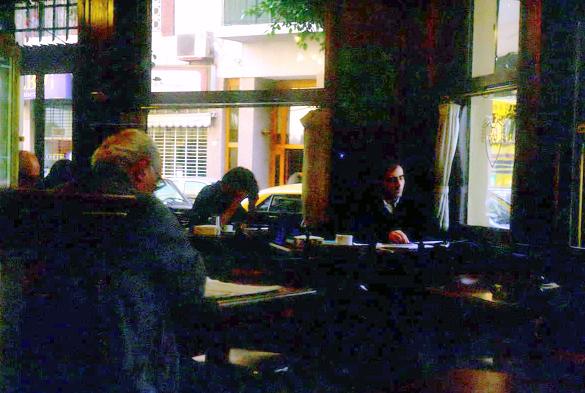
On one of my excursions into the neighbourhood I have come across a café of the type I like best: a slightly-old fashioned café on a street corner, with plain wooden tables and chairs and a mostly local clientele. I like to walk there some mornings early, for a breakfast of café con leche and a couple of croissants, medialunas, over a book or the morning paper. The café is called 'La Orquídea', and according to the information printed on its napkins it is open 24 hours a day. There are a few cafés like that in Buenos Aires; I know of a couple in bohemian San Telmo and the city centre, but I wouldn't have expected one here, in this neighbourhood. I am delighted, and I decide to come here one day at three in the morning for a cup of coffee and medialunas (will they have medialunas in the middle of the night?), just for the hell of it. What kind of people will be here at that hour of the night? Will the waiter be leaning against the bar, dozing on his feet?
At the moment it's just after 8 AM, and the sun hasn't quite risen high enough to peek into the café's windows. The other patrons sit and drink their coffee in silence, some read a paper, or talk on their mobiles, others just sit and sip and slowly get ready for another day.
A few blocks away on a small green square is a street market: boxes of colourful fruit and vegetables piled high - oranges and tangerines, lemons, apples, pears, bananas, pineapples; cabbages, cauliflower and broccoli, fennel, spinach, courgettes, aubergines, various sorts of beans, carrots, lettuce, squash, sweetcorn, tomatoes, onions, avocados. The fruit and veg here tends to be seasonal; you can actually tell what season it is from what's on offer. Sometimes I am brought up short by the fact that something just can't be had, so used am I to the unnatural availability of almost everything all year round in Europe, strawberries in February and apples in May; but mostly I like it. You get what's in season, that's the way nature is; the way it should be. The fruits and vegetables here have little blemishes, aren't always perfectly shaped, but the tomatoes aren't just round and red, they actually taste like tomatoes. They smell of tomato. I'd forgotten that tomatoes used to have a scent, because it's so long since I smelt it last.
According to my streetmap there's a park not too far away, so I decide to go there next. But the park, when I reach it, is closed for refurbishment. Around its perimeter has sprung up a flea market selling everything from second-hand clothes and shoes (some of them very much worn, and more fourth or fifth hand, by the look of it), souvenirs, bric-a-brac, herbs and spices, CDs. The CDs cost five pesos a piece (the equivalent of one pound), and are home-made copies. The covers have been made on a colour printer, but the CDs themselves are clearly CD-Rs with the titles - rather endearingly - scribbled on in black pen. Besides the usual suspects - Tango, Latin, Rock and Pop - I find, bizarrely, a copy of NOW that's what I call Music 2005 - Arabia. Which I buy, delighted, and play non-stop for the next week.
The spice stall sells a largish bag of saffron (real saffron!) for 50 centavos. (That's ten pence. (!!)) I consider bulk-buying Argentinean saffron and making a small fortune reselling it in the UK.
May
I have now been living in Buenos Aires for three months. I can't believe how fast the time has gone. Three months! And at the same time, it seems as though I have been here much longer than that. I am beginning to feel that I live here. I have put down some roots, not yet very solid or long, but there they are. I look down at my feet and I see tendrils growing from them and disappearing in the soil of the Reserva Ecologica, the tarmac of the roads, between the cracked slabs of stone on the sidewalks.
My English is becoming more Americanised. Is that to do with the fact that I live in América now? Is the continent somehow seeping into me - through my newly grown roots, perhaps? Since coming to live in Argentina (I know that after a mere three months, it sounds a bit ridiculous to talk about living here, but my existence here feels more permanent than a mere extended visit) -- since coming to live in Argentina, I have begun to appreciate that there are some things - historical, cultural, architectural even - that appear to be pan-American. The rectangular grid of the street layout with roads intersecting every one hundred metres at right angles, for example. Astronomical house numbers: A friend of mine lives at number 4673 - not because there are 4672 other houses in her street, but because her block of flats stands 4673 metres from the beginning of her street. Each cuadra or block (ie. the length of road between two intersections) measures one hundred metres. See, I'm using American terms now to describe this. There are no intersections in Britain; and no one would describe a stretch of road between two side roads branching off as a block there. This beautifully logical way of town planning is a Spanish invention, and the Spanish brought it with them to the New World. The only part of Buenos Aires where the roads twist and bend and defy all reason is in the very exclusive barrio of Palermo Chico, the equivalent, one could say, of Belgravia. There, exquisite villas stand in the shade of old, gnarled trees (including the biggest palm tree I have ever seen), and the roads meander like snakes.
I am beginning to know my way around the city without having to look at street signs to check where I am. I go by my own landmarks now -- that building, this shop, the heladería (ice cream parlour, many selling home-made and utterly delicious ice cream in at least thirty flavours) with the dark blue chairs out on the pavement, the bingo hall (oh! I must tell you about playing bingo one day), the multistorey car park with the trailing flowers on the first floor, the bakery with the golden lettering on the window, the little park there on the right...
The city is becoming familiar in more intimate ways. I walk along the street and without looking up and looking around, I know where I am. I develop a feel for its layout; even when walking further afield, in areas I don't know or don't know well, I can anticipate roughly where I am in relation to parts of it that I do know.
Every four streets - roughly and on the whole, though not invariably - comes an avenida, a main road. In San Telmo, I lived in a side street off Juan de Garay. Four streets further north comes Avenida San Juan, then Belgrano, Independencia, Rivadavia, Corrientes, Cordoba, Santa Fe. I didn't have to look their names up to write them down just now; I know where they are.
(Digression: In Argentina (again as in the US, and I expect other American countries too, north and south) the words 'street', 'road' or 'avenue' don't form part of the street name. You just say, 'I live in Venezuela', 'I live in Eva Perón'. I have just tried translating this to London street names, and it is extremely confusing: 'I live in Turnpike', 'I live in Stoke Newington Church'. But in Spanish, it works.
Digression end)
When I was living here first, doing anything at all was a chore, was work. Going out to buy an adapter plug for my laptop, for example: where does one get an adapter in Argentina? There are almost no chain stores here, so you can't just head for the nearest Rymans (do I mean Rymans? I begin to forget what they're called, and I can't say I'm sorry about that). I tried electrical goods shops, shops selling lamps and household goods, poundshops even (after I had sussed out that they're called bazar, and in which part of town to find them). Finally, someone told me that what I wanted was a ferretería, an ironmonger's. (I had to think a while to remember that word, what instantly popped into my head was 'hardware store'.) All of that was an expedition into the unknown; it was scary and exhausting. I exaggerate, of course, it wasn't that bad, but I had to be constantly alert, think, plan every move. It was an effort.
Now, I know that spices (whose absence in the supermarkets had puzzled me) are best bought on the market or at the impromptu vegetable stalls some Bolivian women set up along the road. The small cornershop-type supermarkets run by Chinese and Koreans are nicer and cheaper than the big-name supermarkets. Fruit and veg is best and cheapest at the greengrocer's or on the market, not from the supermarket. I know my clothes and shoe size, know the words in Argentinean Spanish for T-shirt, sweatshirt, jumper, hoodie. A lot of words in Argentinean Spanish are totally different to those given by the dictionary, which tends to be the European variant, and a fruitful source of misunderstandings.
Three months in Argentina. It is my half-way mark. It also means that my tourist visa (good for 90 days) has come to an end, so I need to go abroad and then re-enter Argentina to get my passport stamped with a new entry visa. Luckily, abroad is just across the river: Uruguay. I know nothing about Uruguay except that it is known as 'the Switzerland of South America' (secret bank vaults and numbered bank accounts), that Tango is as much a creature of the Uruguayan capital Montevideo as it is of Buenos Aires, and that the latter is just a few hours away by ferry from Buenos Aires. (Disclaimer: I am sure that there is lots more to know about Uruguay, and shall endeavour to learn more about it. I do not mean to imply that this is all there is to know about the country!)
There is also a place called Colonia del Sacramento, a couple of hour's drive from Montevideo, a Portuguese colony established on the River Plate in the 17th century, much renowned for its picturesqueness. It is a popular day trip for tourists. I decide to go to Colonia to get my passport stamped, and for a day out. I've seen pictures of it: old pastel-coloured houses, romantic cobblestone lanes (although straight as if drawn with a ruler, not crooked at all), old trees casting dappled shade on outdoor cafés.
I'm excited; I loved going to Patagonia, but I'd been there before, I'd known the place. Colonia will be a new place, my first visit in Uruguay.
It is a grey, foggy morning, early still, not quite nine o'clock. The cranes on the docks look like sleeping beasts, huge preying mantises in the fog.
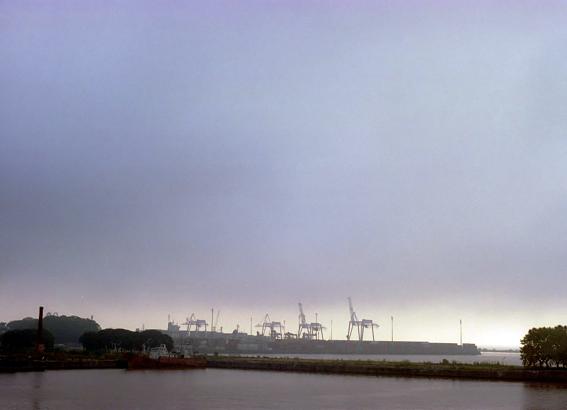
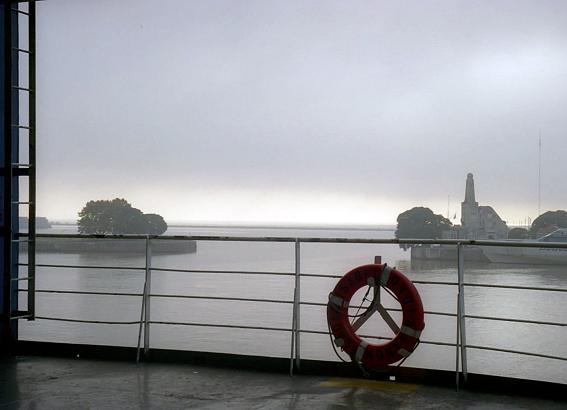
Slowly, the sun burns off the fog, the sky turns from grey to white to blue, and I take off layer after layer of fleece. By mid-morning, it's hot and sunny.