February March April (Patagonia)
May
We're at the end of autumn now, but it doesn't feel like that at all. There has been a brief cold spell a couple of weeks ago with night frosts and temperatures mornings and evenings around three or four degrees centigrade. That felt properly wintry, and I got rather excited about it. Night would fall with a last red glow of the sun in the western sky, the streetlights came on and the air smelt sharp and cold and of woodsmoke. I thought I'd imagined the woodsmoke until I realised that the homeless had rigged up little stoves in metal barrels or tin buckets to keep themselves warm.
At least one extended family of homeless cartoneros lives and works on Plaza Once near my house. Every morning, smoke from their home-made stove curls into the sky while they boil a kettle of water for maté. Where do they get the water from, I wonder. In summer, homeless families did their washing in the public fountains downtown. I'd never thought about where homeless people did their washing, either; or perhaps I had vaguely assumed that they would go to a launderette. But a wash costs three pesos. For a kilo of oranges you pay one peso, for a kilo of bread two. * * * I have found a solution to my jogging problem. I can't go running in the streets near my house on week day mornings, because even before seven, there are lots of buses and cars about, and a haze of exhaust fumes in the air. The parks of posh Palermo (think Kensington, Chelsea, Wimbledon) are reasonably near, but I don't like Palermo. And there are lots of joggers about there even at an early hour. The joy of going running early in the morning for me is not only the exercise, and how good I feel afterwards, but also the fact that it is a solitary exercise. While my body is busy running, I put my brain in neutral. It gets an hour off and is free to do whatever it pleases. I love early mornings, but I'm slow to wake up, and grumpy around other people until about midday. Pounding along in the midst of a herd of other joggers is not my idea of fun. Early morning along Avenida Rivadavia. I leave the house around seven, seven-fifteen, when the sky is still dark, or just changing from night black to a pre-dawn inky blue. During the cold spell, at this hour of the morning the temperature was three, maybe four degrees. But somehow, I didn't mind the cold.
There are few people out and about; cars and the occasional bus on the road, but the city is still quiet. Or at least it feels quiet, in the dark; I can almost sense that most of its inhabitants are still asleep, or just now waking up. There is a very different atmosphere to it than there will be even an hour from now, when rush hour will be in full swing.
By the time I reach the Congreso, the sky is getting light. The stone angels on top of the building stand on tiptoe, trumpets pressed quiveringly against their lips. They seem to be waiting only for the right word, a sunbeam at just the right angle, to come to life and burst, triumphantly, into blasts of music. On the Plaza de los dos Congresos in front of the Congress building, a square of red sand and large old trees stands an ornate fountain, all allegorical maidens and muscled young men and eagles. Last time I was here, in November 2004, the homeless slept on the benches around the dry fountain at night and, judging by the smell, used some of its less visible parts as a toilet. Since I arrived in Buenos Aires this February, the fountain has been surrounded by scaffolding and a plywood fence (presumably to be restored, although I have seen no sign of activity there at all).
July
August (Patagonia)
June
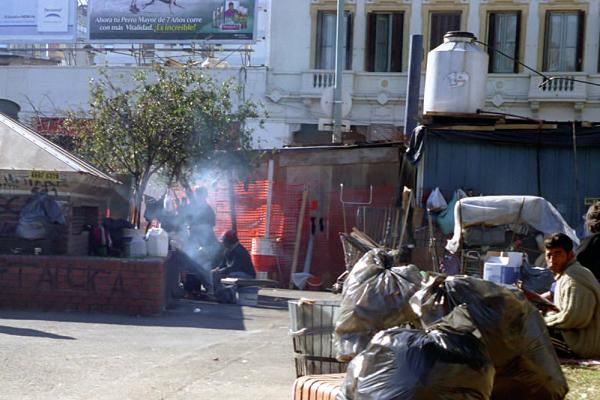
There is always a small group of homeless men hanging around by the railings of the little park down the road from me. We exchange hellos when I walk past. At night I see them sleep, huddled bundles wrapped up in blankets, in doorways along the road.
Along 9 de Julio, the wide avenue and one of the main traffic arteries of the city, homeless and / or unemployed young men are trying to make some money by washing the windscreens of cars stopped at the traffic lights. There's two or three of them at most traffic lights downtown. Hugo, Violeta's boyfriend, told me to be careful around them, especially as I will insist of wearing my USB memory stick round my neck at all times, usually outside my clothing and clearly visible. I don't feel complete without the USB stick, all my writing is backed up on it, and I (almost) jokingly refer to it as my heart. Not everyone might know what a USB stick is, but it is clearly recognisable as some piece of computer hardware, or might be mistaken for an MP3 player. It certainly looks like something reasonably valuable and saleable. Hugo has told me how a friend of his, out at night with her husband, passed a group of car window cleaners. They asked her to give them some change. When she refused, one of them ripped her necklace off her neck.
So when I am in the process of crossing 9 de Julio and, standing at a red traffic light, see a couple of car window cleaners looking at me, I remember that story. On the whole, I'm not afraid to walk around the city, day or night. The worst treatment I've experienced here was not to have a greeting or a smile returned. One of the window cleaners comes nearer and says something to me, and I wonder whether I really am too naïve and idealistic, and whether Hugo may not after all have been right. The USB stick dangles from my neck, clearly visible.
'Hola,' says the window cleaner. 'That green hair is great.' He smiles. 'It goes really well with your lovely green eyes.'
A bit flustered, as well as rather pleased with the compliment, I smile back, we chat briefly, and then the lights change and I go on my way while he goes back to his windscreens.
I know it's anecdotal. People do get robbed and mugged in Buenos Aires. But I think that sometimes we're scared of the poor out of a feeling of guilt, because we have and they have not, and surely they must want what we have.
Encounters like this one always cheer me up, because they're simply about contact between two people, as equals, not about have and have-not, or giver and taker.
There is one other large, green space not a million miles away: my beloved Reserva Ecológica. I look at my map and the bus routes and decide to give it a try. If I leave the house around half seven and catch a bus in the avenida a couple of blocks away, I'll get to the Reserva at eight when it opens, do my run, catch the bus or the underground back, and be back home by around nine thirty .
I do this a couple of times, but then realise how silly my time-keeping is. One of the reasons why I'm spending half a year is Buenos Aires is to slow down my manic pace of life a bit, re-learn to take things easy, chill. My morning run, even back home in London, is time out, 'me time'. So trying to be back on time for a day spent as I chose is just silly.
I love walking. I love being out early in the morning, witnessing dawn and sunrise, watching the city wake up. It's about three miles from my house to the Reserva. Instead of waiting for a bus, I'll set my own pace. I'll walk.
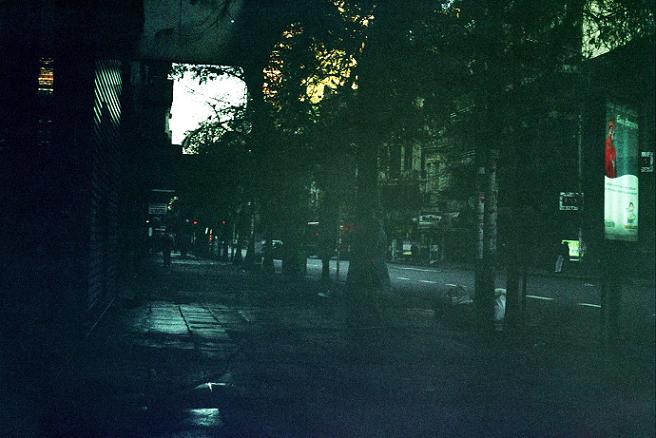
Recently the weather has switched back to warmer again, and in the mornings it's a very mild twelve or fourteen degrees when I set out. The air is crisp and clear and sharp, clean still this early in the morning.
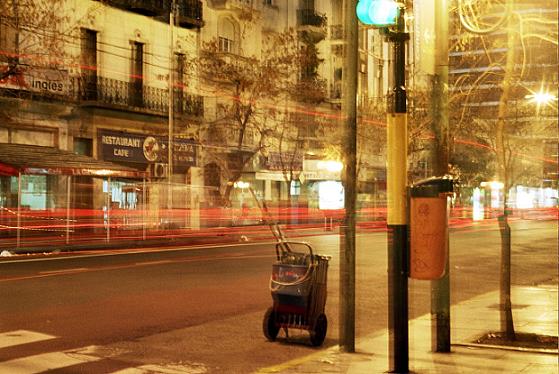
Now, just after seven, Buenos Aires is yawning and stretching and reluctantly waking up to another day.
The café round the corner is already lit and open, yellow light spills out on to the pavements while inside, drowsy figures droop over coffee and croissants and the morning paper. To the side, a flap in the pavement is open. From a lorry parked by the curb a man is handing down sacks of oranges and vegetables into the café's basement.
The pavement is wet and glistening. The caretakers are out, scrubbing the sidewalks. Every apartment building in Buenos Aires has its caretaker. The posh buildings in barrio norte have porteros, doormen round the clock; but even in the scruffier parts of town like Once or San Telmo, every edificio, apartment block, has its encargado, the caretaker or janitor. It is his or her job to keep the building clean, empty the rubbish, take in the post, keep the sidewalk clean.
My way down the pavements of Rivadavia is a sort of obstacle course, avoiding the sudden floods caused by encargados hosing down the pavement, or sweeping dirt and water before them with a broom. They wear wellies to do this job; the women's small and smart with wedgie heels, the men's large and no-nonsense, or else narrow and shaped like riding boots.
The avenida is dark and wet and silent. Most shops and cafés are still closed. Inside the all-night cybercafes, tired computer-junkies are slumped over their machines, surprised perhaps by the arrival of the morning. I love being out here on the tail end of the night, walking into the new day. I don't think I'd ever get enough of it, not even if I saw every daybreak of every day of my life.
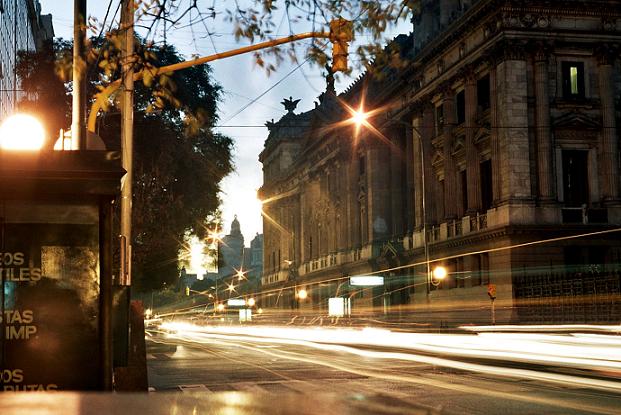
I wish they would, it might wake the politicians up.
'Congress is just for decoration,' is an opinion I've heard more than once. First, there was the dictatorship, then democracy, followed swiftly by President Menem's neo-liberalist policies in the 1990s, when everything at all was privatised and sold off and the president's friends and family waxed rich. After a century of recurring dictatorships, Argentineans' trust in the organs of the state is not high. There are vociferous demonstrations outside Congreso and Casa Rosada - the seat of government - almost every day, and god knows, much to protest about, but not a lot seems to change.
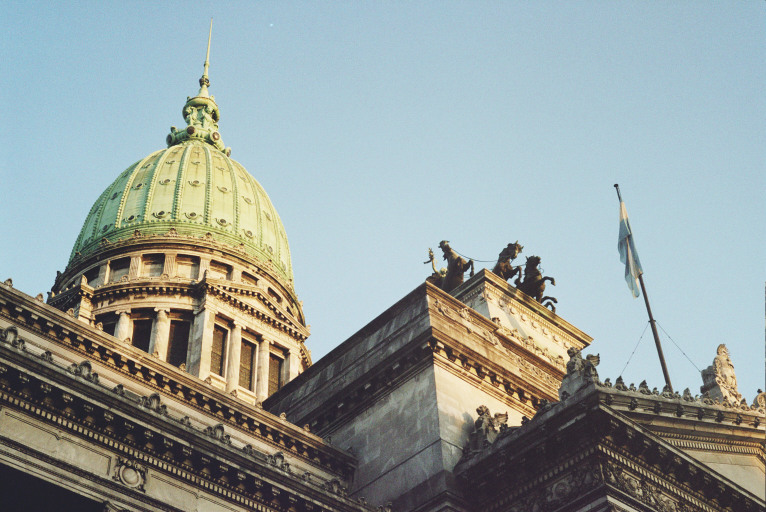
Some mornings another jogger is making her way round the Plaza, dodging people and the hordes of pigeons that live here.
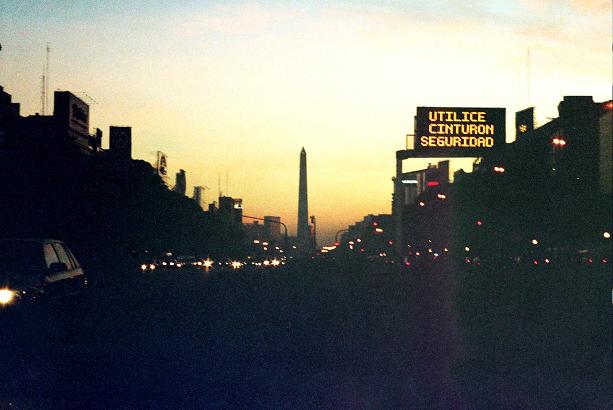
The roads are getting quite lively now. 9 de Julio is noisy and busy as always; I have been here at three in the morning and cars have rushed past, on their way to who knows where. Commuters come bursting out of the underground exits all at once and flood all over the pavement. Some of them eye me curiously as I stride past in my running gear, clearly not on my way to an office. Buses and cars clog the roads, with taxis kerb-crawling, looking for customers. After the economic crash 2001 in which so many Argentineans lost their jobs, lots of people became taxi drivers. Or rather, lost of men. I think I've seen one woman taxi driver in Buenos Aires so far, and a couple of women bus drivers.
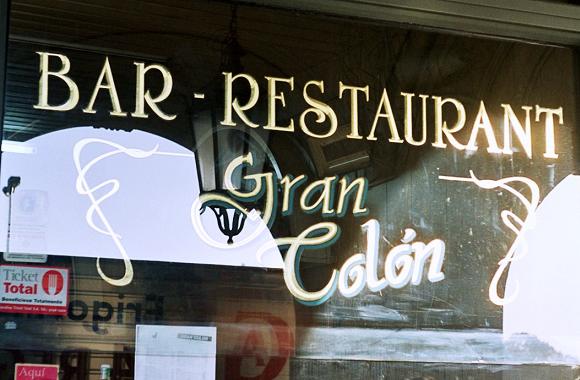
The cafés in Avenida de Mayo are beginning to open up. In one, the shutters are still half down and lights low, and a yawning waiter is slowly taking the chairs down from the tables. In another - which has for some reason a stag's head affixed to the wall - a customer who looks a bit stuffed himself is sitting stiffly in front of an espresso, while the waiter leans on the bar, watching the news on television.
Other cafés are already ablaze with lights and full of people drinking coffee, smoking, reading the papers.
In my experience, porteños (the inhabitants of Buenos Aires, Argentina's national port) are generally a lively, noisy, chatty and vivacious lot. But at this hour, they appear rather grumpy. Hardly anyone in the cafés is talking, and even the waiters look as though they've gargled with vinegar. I find that rather endearing. A body can wake up slowly here.
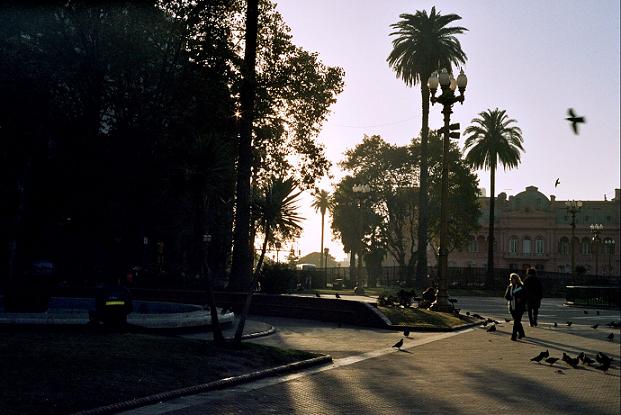
If I time it right, I see the sun come up just as I arrive on Plaza de Mayo at Casa Rosada, the Pink House, the seat of the Argentine government. It's a beautiful moment. I'd have thought I'd get sick of Plaza de Mayo; it's such a famous sight, on all the post cards of the city. In the past couple of years, before coming to live here, I developed a passion for webcams. I'd go to the site of the Buenos Aires city government every day and look at the snapshots of the city's traffic cams, little magic windows in space that allowed me to get glimpses of everyday Buenos Aires in real time. A couple of cameras are on Plaza de Mayo, and at first it felt strange to be in the place I'd seen on the computer screen so often. I felt as though on a film set for Evita, in a guide book, in a webcam snapshot. It didn't seem real. Then it just became a square downtown, a place to avoid if at all possible during the summer, when it was choked with tourists and souvenir vendors and beggars, all of them surveyed and glared at by the policemen guarding the Casa Rosada, who clearly felt very important.
Perhaps because it's winter now and the tourists have gone and I have Buenos Aires and the porteños all to myself; or maybe because I see Plaza de Mayo at this early hour, when neither the city nor I have combed our hair yet or put our make-up on - whatever the reason, I have come to like Plaza de Mayo very much. I wander through the commuter crowds, enchanted by the piercing first rays of sunlight, the sharp cold air, the waving fronds of the palm trees, and whatever my general mood may be, just then life is good and beautiful and I am exactly where I want to be.
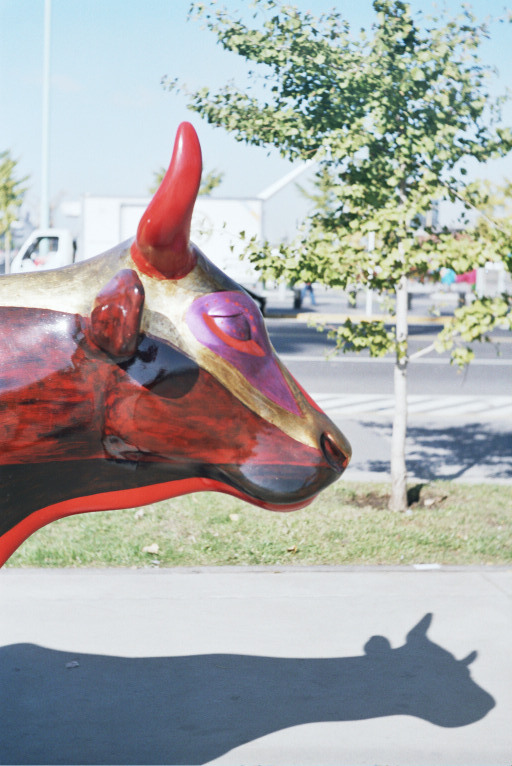
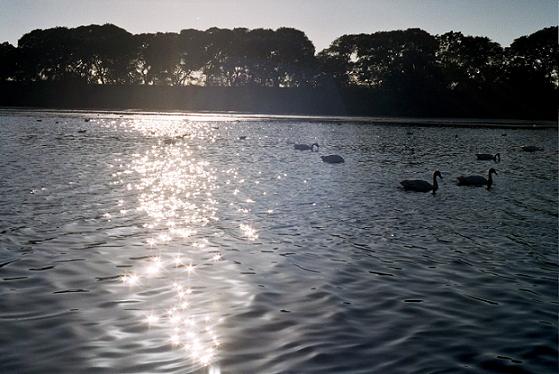
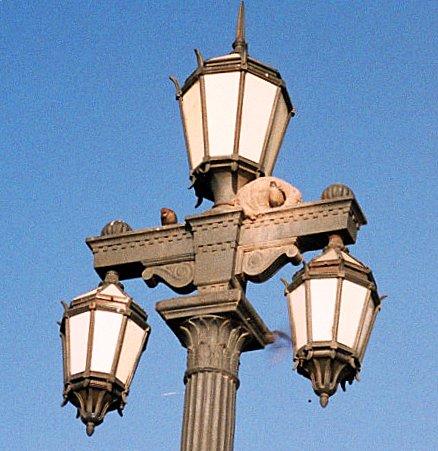
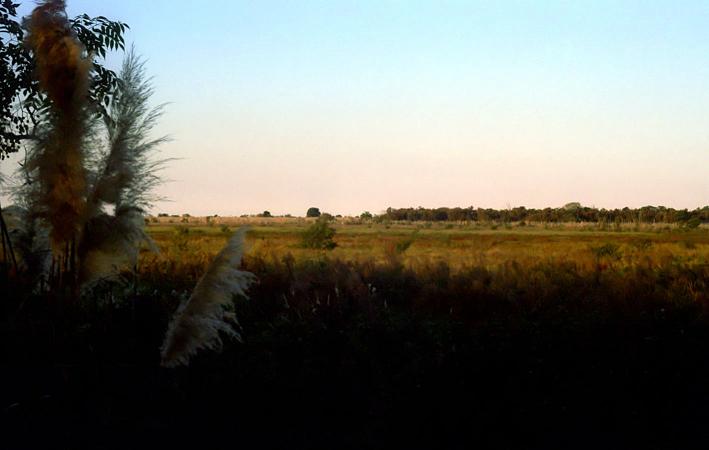
* * *
Mid June * * *
I can remember how worried I felt when I had an entire half year in Buenos Aires ahead of me, and how I wondered whether I would stick it out
Now, there are less than two months left of my time in Buenos Aires, and I'm feeling worried that I'll have to leave soon.
Not easy to please, me.
I am very much looking forward to seeing my friends on the other side of the world again. I also really miss London's lesbian bars and clubs. I have found myself a lesbian discussion group here that meets up once a week, and when they threw a party the other week I went and danced the night away and didn't leave until three in the morning (early by Buenos Aires standards, where most clubs don't open until 1 AM, but seeing as I usually get up just after 6 AM, I thought it was pretty good going). I enjoy the discussion meetings and I loved the night out, but the scene here is tiny, and has little of the variety, or the shouting, vibrant, colourful, I-don't-give-a-shit-what-anyone-thinks-ness of at least some parts of the London queer women's scene. Although civil partnerships are now recognised in the city of Buenos Aires, it's a very different story in the rest of the country, and even in the capital there is much overt and covert homophobia.
When I was in Patagonia, I had a spirited discussion with three nice middle-aged women who did their best to convince me that being lesbian or gay was unnatural, and therefore Not At All A Good Thing. There are lots of people here who think that way, and lots also who are just plain hostile. Then there is the Catholic church, which, although society is in practice pretty secular, still has a strong hold on morals, and quite a few tentacles in politics. (The top ranks of the church hierarchy approved of the moral stance of the Generals between 1976 and 1983 and their clean-up of godless leftists and anarchists. They have somewhat cleaned up their act since then, but I would still hesitate to call the Argentine church 'progressive'.)
My writing is going more slowly than I would like, and I see the days rushing past and worry that I will have too much left undone by the end of my time here. But perhaps the looming deadline of my return to Europe will concentrate my mind, and act as a stimulant. I hope so.

* * *
(c) all content 2006 I.R. Herrad unless otherwise stated
Disclaimer: The Author of this site is not responsible for the content of external websites.