Last updated 14 July 2006
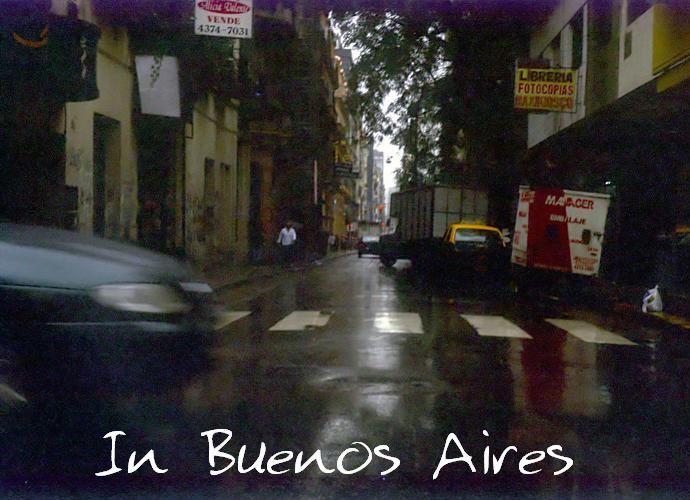
The "Paris of the South", the cradle of Tango, Buenos Aires. I never thought I'd end up here. I was only passing through, four years ago, on my first and - so I thought - only visit to the country and the continent, because I wanted to see Patagonia. A friend of a friend gave me a whirlwind tour. Buenos Aires passed by me in a blur of palm trees and hot sunshine, beautiful nineteenth century buildings, tree-lined boulevards, thin women, flocks of screeching green parrots in a park, cafés with tables outside where they served the most wonderful coffee. By the end of that day, I heard myself thinking, I could live here.
Four years later, I boarded a plane bound for South America once more, to make my home in Buenos Aires for the next six months.
February March April - Patagonia
May Actually, although it has been grey and rainy for a couple of days last week, today is cool and brilliantly sunny, with a cloudless blue sky.
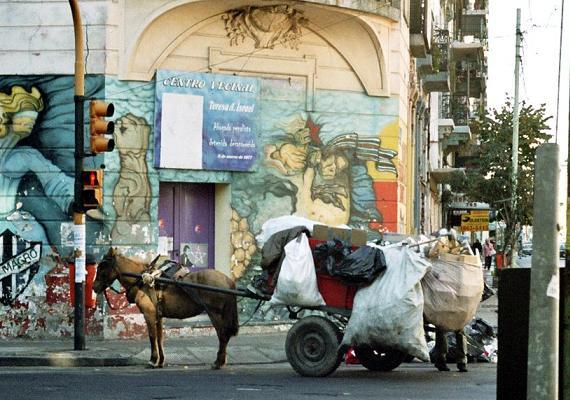
In the midst of this idyll, a reminder that I am still in Buenos Aires, after all: a cartonero systematically going through the rubbish bags by the roadside, looking for recyclables: paper, plastic, glass. I've seen a few cartoneros with a horse and cart recently; I wonder where they stable the horse, and where on earth to get hay and straw for it in the city.
June
August
July
After five months, I am beginning to get used to the rhythm of the weather here. It appears to happen in cycles, and from what I can see, all year round. It is dry and sunny most days. Slowly, the temperature builds up -- in summer, to thirty-five degrees centigrade or more; but even recently, in what theoretically is the middle of winter, we had a couple of days with twenty degrees. I will miss this 'winter' when I am back in London. The build-up lasts around two weeks, sometimes more. And then there is a thunderstorm - we had a most spectacular one yesterday, with lightning flashing all over the Buenos Aires skyline, and thunder rumbling for an hour or more. And the temperature drops sharply.
I've still not quite got accustomed to those sudden drops in temperature. In summer, it went from thirty-five degrees one day to sixteen a couple of days later! For me, that's going from summer to autumn in less than 48 hours.
I love the brilliant sunshine and the immaculate blue sky we have here, even in winter, but I have found myself missing rain and clouds and change lately. The day before yesterday was just grey and dull, the kind of weather I most of all. But yesterday itself was beautiful and dramatic, clouds massing and a sharp wind blowing and a lowering grey sky over the deep green trees in the park. I was walking through the downtown financial district at the time, which was completely deserted. And then the rain started, which to me always seems an intimate kind of weather, a private thing somehow. Sunshine is public weather, with everybody coming out to enjoy and share it. A city in the rain is empty of people, those that are still out hurry along and don't much look at each other. There was Buenos Aires in the rain, and I had it all to myself; and I loved it.
After the rain had stopped, the temperature had dropped from twenty to around seven degrees, and I had caught a cold.
It's only very mild though, and it didn't stop me going out clubbing with some of the women from the Lesbian Discussion Group Las Fulanas ('The Others') last night.
Another thing I'm getting used to is the hours Argentines keep. We were to meet up at a café around 11 PM before going on to the club. I got there at half eleven, fearing everybody had already left, but they were still there, chatting away and drinking coffee. I had a coffee too, and around half past midnight we started making our way to the club.
It was still early when we got there, and nobody was on the dance floor yet. It's a lovely place with a relaxed atmosphere. The walls were draped with rainbow flags and pictures of notable figures of queer history: Virginia Woolf, Marlene Dietrich, Oscar Wilde -- I couldn't make any of the others out in the dim light. Anyway, I was too busy dancing.
I was the first to leave, and that was at a quarter to four. The others remonstrated with me: 'Why are you leaving already?!'
I walked home along quiet, but by no means deserted streets, Violeta's warnings a bout it not being safe to be out walking in Buenos Aires at this hour, but nobody at all accosted me, and the four or five young men standing about on the pavement talking and laughing loudly, whom I had eyed somewhat nervously, politely made way for me.
The café on the corner of my street was still open and lit at 4.30 AM, showing football on a big TV screen; a sprinkling of people sitting at the tables: eating pizza and steak with chips, drinking cups of coffee. It didn't look much different from what it does during the day. They're all vampires here. I suppose when I fell into bed at half past five, the lot from Las Fulanas were still dancing, and probably kept on doing so till sunrise.
The majority of the lesbian and bi women I have met here are in their thirties and forties, with a sprinkling of younger ones, which makes a welcome change from the London scene, where it can sometimes feel as though everybody else is about 23. I suppose in a society like Argentina's with its pretty much unquestioning assumption that everybody is straight and will get married and have children under the - supposedly - benevolent eyes of the Catholic church, it is a greater struggle and takes people longer to give up the straight life, to make the decision to come out to themselves at least, if not to their families. About half the women in the Las Fulanas group are out to some members of their families, the other ones aren't at all.
Apart from one party at Las Fulanas I haven't been out since coming to Buenos Aires, and I had missed it.
I have done other social things here I never have the time and energy to do in London, going to (free) classical music concerts, of which there are quite a few in Buenos Aires, even though the city government is - like the rest of the country - pretty strapped for cash. I do like living in a city that believes access to Mozart and Bach is important for its inhabitants. There are all sorts of things that ought to be done as well -- battling unemployment, homelessness and the fact that ten per cent of the city's children are not attending school; and on a less grave note, the potholes (some the size of small craters) in the pavements; and sometimes I am uneasily aware that classical music is a very middle-class kind of pleasure. But a love of culture still is not a bad thing, and the free concerts are always attended to capacity.
So I have been feasting my ears on Mozart and Chopin (some of whose music, I have discovered, I am beginning to like rather) and Eastern European baroque music (the latter a concert given in a wonderfully overdecorated, very baroque church full of gold whorls and bulging cherubs, and glorious acoustics).
I have decided to learn Portuguese. The Asociación Brasileira of Buenos Aires offers a four-week intensive course. It's good value by Argentinean standards, and compared to what I am used to paying for language classes in London, it is incredibly cheap. Brazil is, after all, only a few hundred miles away, and I have already decided to go there for a bit at the end of my stay here anyway. Back home in London, I'd never have the time or the energy to study two hours of Portuguese every day for a month (not to mention homework).
Portuguese is very similar to Spanish, but dissimilar enough to make it hard work, nonetheless. The pronunciation is completely different, and the grammar - if possible - even more complicated that Spanish grammar. According to my book of Portuguese verbs, there are fifteen tenses in the language. Good grief. I haven't even quite got to grips yet with Spanish tenses. Spanish has an Imperfect and a Preterite tense (I did, I was etc.), a Subjunctive Present and two Subjunctive Past tenses. Portuguese also has a Subjunctive Future and other horrors I haven't even dared look at. And of course the rules governing them are just different enough from Spanish to confuse me utterly.
The curious effect this has had on me though that it has catapulted the status of my Spanish in my own mind from OK but not really fluent to fluent. I emerge from the Portuguese class, where I have spoken haltingly at the speed of about five words a minute, to deluge the greengrocer on the corner (who has the best apples of Buenos Aires) with a torrent of newly liberated Spanish.
I enjoy speaking Spanish, I love the sound of it and enjoy the way it works. I take great pleasure in the way I am getting ever deeper into its inner workings; how particles and conjunctions, the way certain phrases are constructed, are becoming an automatic part of the way I speak. Silvia from the lesbian group asked me the other day whether, when I spoke Spanish, I was translating from German or English or whether I thought in Spanish. I had to stop and think for a moment to work that one out. My thoughts are still part German, part English, as they have been for years, but when I speak Spanish, I just open my mouth and words come out, unless I'm talking about something very complicated and have to think about how to phrase it. But in ordinary conversation, Spanish has become automatic. When I make notes to myself now (half in English, half in German), Spanish words and constructions sneak in.
(I saw a facsimile copy of Karl Marx' Das Kapital in the British Library once. Marx spent more than fifteen years living in London, and although Das Kapital was first published in German, he wrote it, in fact (much like my own notes) half in German, and half in English. There are sentences that start in German and half-way through switch into English.)
I enjoy the way Spanish has become part of me now, on an almost physical level (it has become part of my flesh and I would say in German). It's as though a further dimension had been added to my life. The other night, I dreamed in Spanish for the first time, and that pleased me immensely. I had lived in London for several years before I'd started having occasional dreams in English. I don't know how these things work, but I find it interesting that, although my spoken German is now, after eight years if living in London, rather halting when I go back to Germany, my written German has remained unchanged. And although I write more in English now than I do in German, there is obviously a reluctance in me, at some level, to loosen the grip on my first language, even in my sleep.
I went for a walk around Palermo Viejo the other Sunday.
I'm not a great fan of the barrio of Palermo, but I may be about to revise that opinion in places. I had known Alto Palermo, a chic district of opulent modern apartments blocks and shopping centres. (The Spanish for shopping centre is un shopping. Vamos al shopping.) I used to know someone who lives in Alto Palermo, but the last time I stayed at her flat (living room the size of a small football field, three balconies, round-the-clock doorman downstairs, one chic plush front elevator and one round the back for tradesmen and domestics) she had a live-in maid, and that really freaked me out. The flat, which couldn't have been older than forty years at most, had a built-in servants' quarter at the back of the kitchen: a small windowless bedroom and small bathroom giving on the utility part of the kitchen balcony where the washing machine lived. The maid was called Eugenia and was the same age as my friend's student daughter, nineteen. In the mornings, I would find Eugenia in the kitchen, making a cup of tea for the daughter, who was seemingly incapable of performing that simple feat for herself. Eugenia would pick up dirty washing from the floors and make the beds, clean, cook, make coffee. It unnerved me. I don't like hierarchies and inequality. There was nothing different about the daughter and Eugenia, they were two young women of the same age, only that one was privileged and the other wasn't. I'm not naïve. Lots of people have servants in all Latin American countries; I have seen uniformed domestic maids in parts of London (and there, too, the sight made me shudder). But to experience at such close quarters the fact that there are held to be first class and second class people; and from someone I'd considered a sort of friend, without her questioning this system in the least... It weirded me out, as they say, and I found it seriously unsettling. I spent more time in the kitchen chatting with the maid than I did with my friend, who was a very comfortably-off cosmetic surgeon. Her commentary on the economic crisis blighting Argentina was that times were so hard now, she could only afford to travel to Europe or the United States once a year now for her holidays, whereas before she'd been wont to go two or three times.
I'm not in touch with her any more.
So you'll see why my impression of Palermo is not the happiest.
But the other Sunday I decided to go for a long walk vaguely in that direction, mostly because I've by now exhausted most other directions. Buenos Aires lies along the River Plate, and the best bit along the river is the Reserva Ecologica, which I by now know rather well. I've been south into Constitución, which is very run-down and not pretty and west into the barrios of Once and Flores. Which left north, the posh barrio norte.
I hadn't been aware of the fact that the part of Palermo called Palermo Viejo (Old Palermo) really is pretty viejo, and rather lovely with it.
The barrios of San Telmo, Barracas and La Boca are among the oldest of the city. This is where the elite used to live in beautiful town houses, until a yellow fever epidemic in the nineteenth century caused them to relocate further north, away from the river. Although the barrios are today a bit unkempt, the beautiful old houses still stand, and are dilapidated to just the right degree to make them charming rather than imposing. What I had seen of Palermo was, like Alto Palermo, modern, wealthy, and - indeed - imposing.
But now, as I go further north and west of Avenida Córdoba along quiet, tree-lined streets, it feels almost as though I had strayed into a small town in the country.
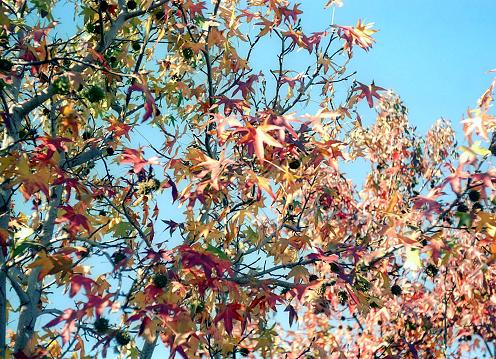
There is hardly a person out on the street, and very few cars. The long green hair of the weeping willows rustles in the breeze. The sky is autumn blue and the air as warm as late summer, and it smells of dry leaves, not exhaust fumes.
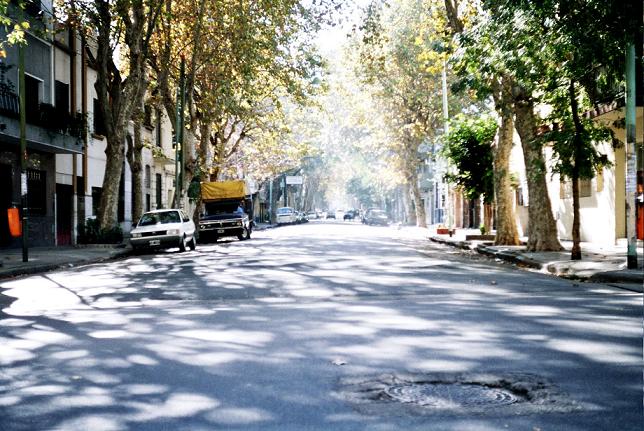
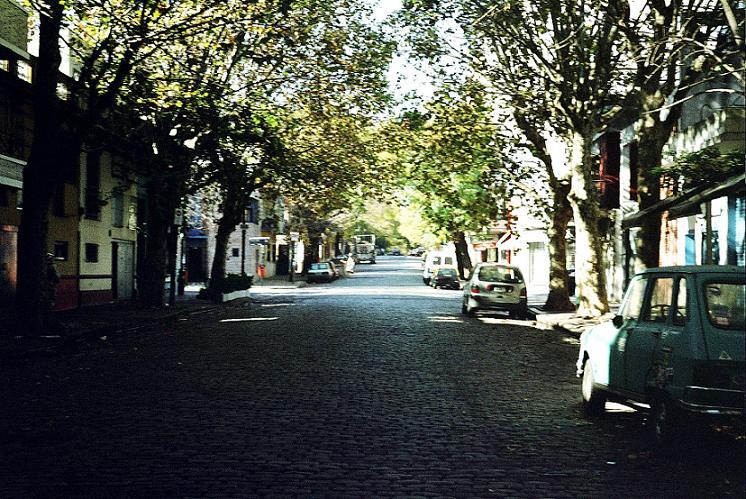
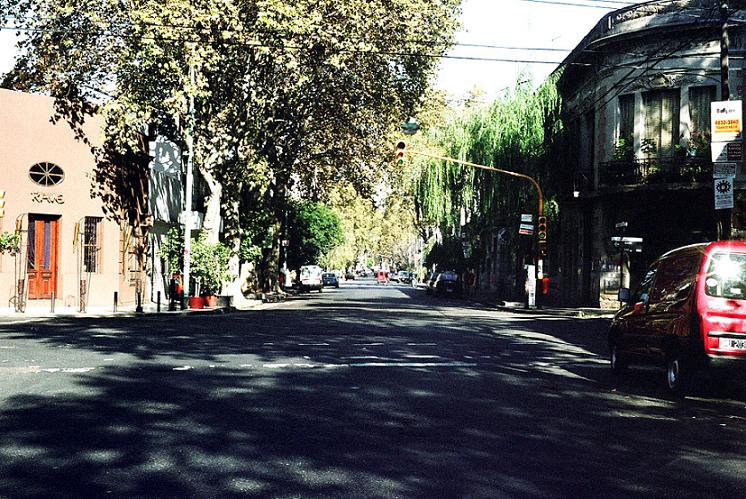
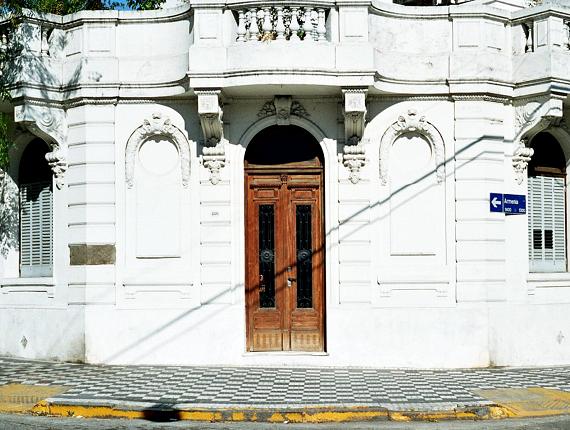
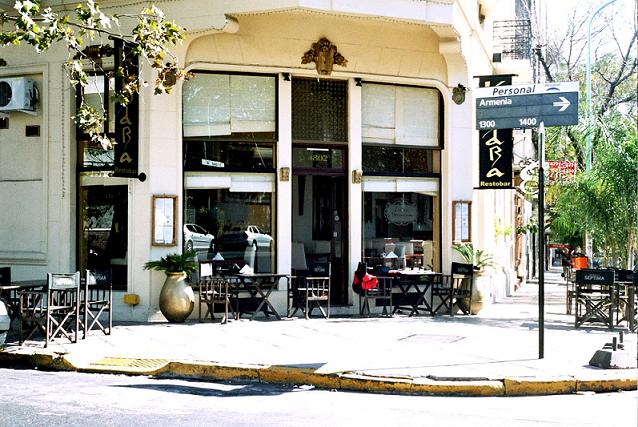
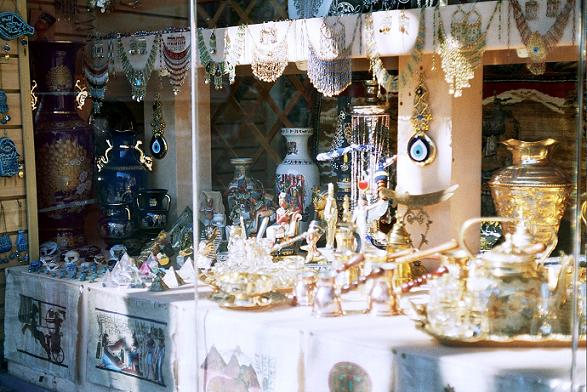
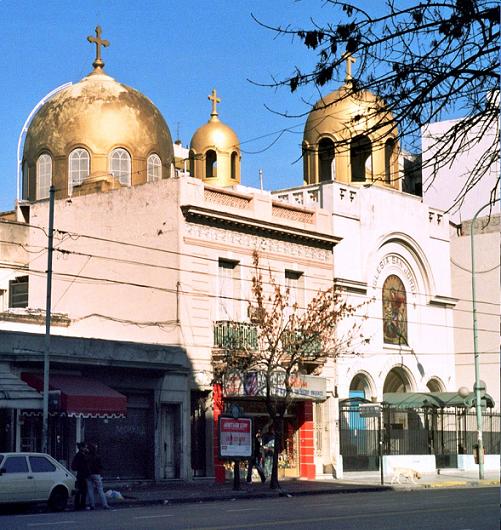
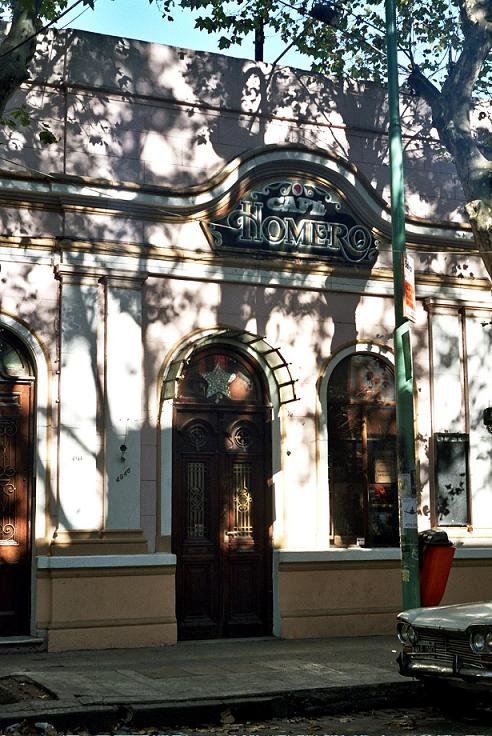
Around the road called Calle Armenia are scattered quite a few Armenian and Arabic restaurants; weirdly, an Egyptian-style gift shop, and a patisserie specialising in baqlava. I have no idea whether this is a coincidence or whether Calle Armenia was named after the immigrants, or whether they settled there because they liked the name.
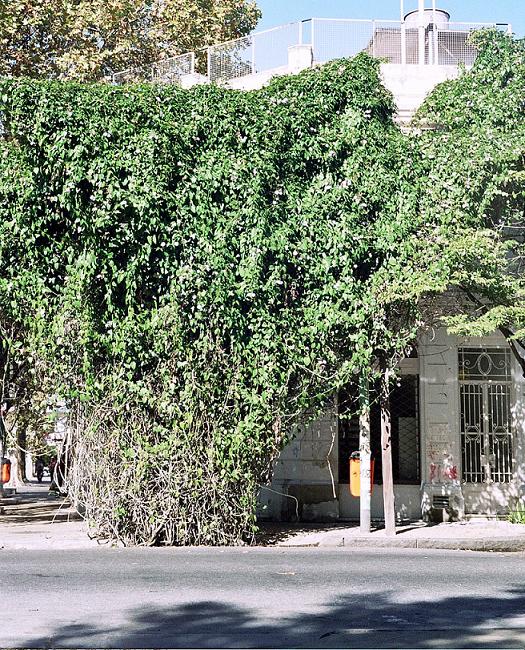
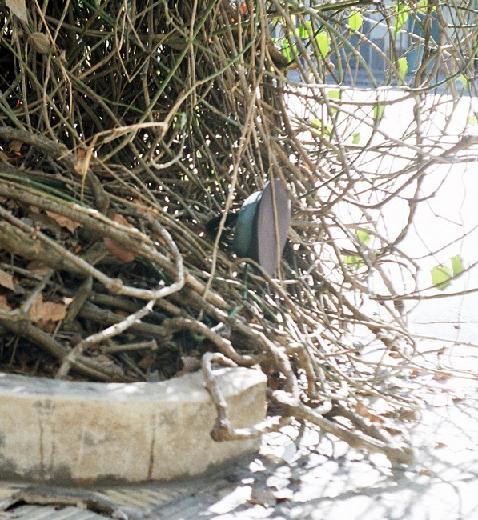
I first noticed the big green curtain from the other side of the road, while I was waiting for a couple of cars to pass. That gave me a minute to study it. This whole great big thing is one vine, growing all over the front of the house and spreading further to the left and right along the electricity cable. It made me think of Audrey II from the film 'Little Shop of Horrors'. Perhaps, in another few years, the whole house will be covered and hidden from view by the rampant vine....
At the bottom of its multiple stems, near the root, was caught a policeman's helmet. I'm sure I'm being fanciful, but it looked to me as though this was all that was left of its erstwhile wearer, and I could just see the vine spitting out the helmet after devouring the man.
I swear it looked exactly as in the photo, and I didn't arrange anything.
Have I mentioned traffic in Buenos Aires yet? * * *
Time is flying. What a cliché. I know. But it really has. I can't believe I've been here more than five months already. It doesn't feel like anything as much as five months; and at the same time, it feels as though it's been at least a year. Living in Buenos Aires now feels natural to me. I do miss my friends in Britain, and strange things like baked beans (of all things!) and old grey London town in the rain, the Cypriot shops on Green Lanes in North London where I used to live, Black people in large numbers, and Bhangra music, and the Welsh Hills (well, at least this last isn't strange at all; I miss those frequently when I'm in London, and I haven't seen them since October). I am vastly looking forward to seeing (hearing) all of those things again. Only I wish it could be accomplished without my leaving Argentina. I really don't want to go. I'm not going yet, I have nearly another two months left in South America (some of that time I will spend travelling, and I am really looking forward to getting to know Chile and Brazil!), but already I'm having to think about planning things like flights, and what I'll do when I'm back in the UK (earning some money comes quite high up on that list ... my credit card statements are not a pretty sight). I love arriving, but I do leaving.
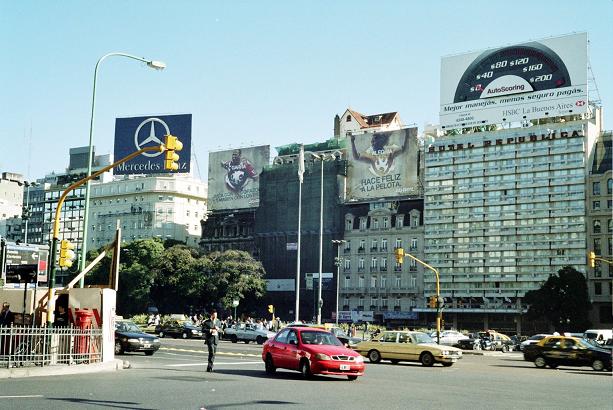
Zebra crossings seem to serve mostly as road decoration. Even when they are accompanied by traffic lights, and the light is green for pedestrians, cars turning right or left will by no means wait politely until all pedestrians have crossed the road, but will wiggle or rush across the crossing in between them. This demands flexibility on both sides (and, occasionally, agility on the part of the pedestrian), and mostly works well. But sometimes, a driver just doesn't feel like waiting and pushes forward regardless. I have to keep an eye out at all times when I'm out walking.
The fact that a car coming down the street is indicating to the left may or may not mean that it is, in fact, going to turn left. Or indeed right.
The fact that a car (or a bus, or a lorry) is not indicating may or may not mean that it is going to turn right, or left, or carry on straight ahead.
Something I'm getting very excited about is that I'll be going down to Patagonia again soon -- really soon, at the end of July.
On the 28th of July 1865, the first Welsh settlers arrived on the beach somewhere along the Patagonian coastline, in a place that is today the thriving port of Puerto Madryn. This is a big date in the history of the province Chubut (one of the five that make up Patagonia on the Argentinean side). There is a village and a transport company called 28 de julio in the area.
And every year on 28 July, the descendants of those Welsh settlers celebrate Gw ÿl y Glaniad, the Landing Feast. So far, I have always been in Patagonia in spring or autumn, when it was nice and sunny. I want to see what it was like in the middle of a howling gale in winter, and I'm getting very excited thinking about the trip. Even the thought of two nineteen-hour coach trips within six days doesn't put me off. Also, I might get to see whales. Southern Right Whales come to the Patagonian coast in winter to mate (the females have harems of half a dozen or more males), and last time i was there I've been told that sometimes they come right into the bay and can be seen from the city itself. So there'll be me standing on the pier of Puerto Madryn in the gale, looking out for whales.
The only cloud on my horizon is the fact that I haven't got as much writing done as I'd hoped. The approaching 'deadline' of my departure from Buenos Aires in mid August has concentrated my mind somewhat, though, and I have been getting much more done recently. I really, really hope that I will have a first draft of my book of travel writing about Patagonia finished before I'll leave here. The mystery novel is done, to all intents and purposes, I just have the last few pages to write and loose ends to tie up. (I wrote the last couple of chapters of it here, it was already four fifths finished when I got here in February.) If all goes well, I'll have two finished books (or at least, one finished manuscript and one finished first draft) to take home with me. Then all I'll need to do is polish them to perfection and find a publisher for them who will give me a large cheque.
That was the idea behind the whole Buenos Aires scheme, you see, to write books to finance further travels.
I used to dream of arriving at a point of financial stability when I'd be able to have my own flat or house as a base from which to travel and to which to return. I still dream of this, but I'm not counting on it any more. Cutting myself off from most of my belongings and going to a far-away place just with myself and a suitcaseful of things has made me realise that things aren't that important to me. They are anchors, and I have missed some of my things (I don't count books as things, books are vital like food and drink and friends) here, but not that much, and I'm sure I will return to unpack my boxes of possessions and wonder why on earth I ever thought I needed all this stuff. I plan on throwing out more stuff when I go back. I want to travel more lightly. I don't need so much stuff. I feel rather liberated at the thought of roaming around the globe with little. My memories I'll carry in my head (and if it didn't sound so soppy, my heart); I'll have stacks of photos (of course) and notebooks full of writing, some pebbles and a handful of penguin feathers.
You can't take it with you is true, of course, for the last journey of all from life to ; but it is true, too, for the journeys I make now. I can't take everything with me. And I'd rather travel than not. And I think I'd rather travel and spend my money than save it to buy a place to live. I'll manage, somehow. The lord will provide. My books might pay. Something will come up. I have fallen in love with the great big world out there, and I want to see more of it, and live in more of it. I want to come back to Argentina, without any doubt at all. I want to go to Cairo and learn Arabic. I'd love to live in Syria or Lebanon for a while. And in Mexico. And who knows where else. I never thought I'd end up in South America, after all. Then I thought I'd just visit here once. And look what happened.
* * *
* * *
(c) all content 2006 I.R. Herrad unless otherwise stated
Disclaimer: The Author of this site is not responsible for the content of external websites.