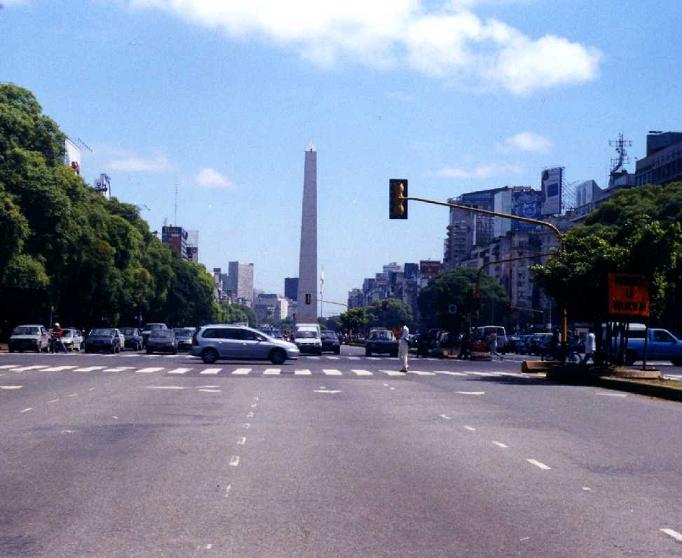
Avenida 9 de Julio
The "Paris of the South", the cradle of Tango, Buenos Aires. I never thought I'd end up here. I was only passing through, three years ago, on my first and - so I thought - only visit to the country and the continent, because I wanted to see Patagonia. A friend of a friend gave me a whirlwind tour. Buenos Aires passed by me in a blur of palm trees and hot sunshine, beautiful nineteenth century buildings, tree-lined boulevards, thin women, flocks of screeching green parrots in a park, cafés with tables outside where they served the most wonderfwul coffee. By the end of that day, I heard myself thinking, I could live here.
Four years later, I boarded a plane bound for South America once more, to make my home in Buenos Aires for the next six months.

February 2006
Week One
My home for the next few weeks is a swish modern loft-style flat on the outskirts of fashionably bohemian and beautifully old, somewhat decaying San Telmo.
In mid March, I'm going to move to a cheaper place in a less fashionable barrio (neighbourhood).
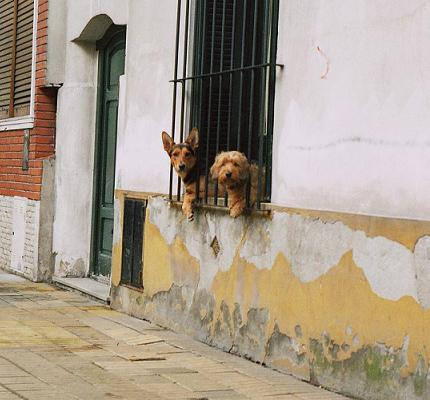
The local neighbourhood watch
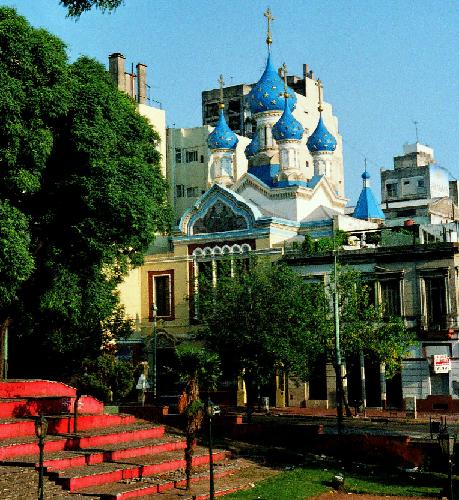
This morning I went for a walk through my neighbourhood, ending up in a nearby park. Along one of the streets lining it stands a Russian Orthodox church, all gold-spagled, onion-shaped cupolas. It looks like a version of the Kremlin designed by Walt Disney.
It had been raining earlier, the grass and the tarmac were still wet, the sky overcast and grey. I'd dressed too warmly, it looked cold but it wasn't.
It was early still, maybe half past seven. A couple of old men were chatting on a bench in the park. There was a woman jogging and a few scattered people walking their dogs before work. A homeless man lay stretched out on a bench, sleeping. A litle further on, a woman in her fifties, or sixties maybe, it was hard to tell but she wasn't young; clearly also homeless, seemed just to have got up. She stood in front of a large clump of reeds where she'd hung some clothes up to air or to dry, as though she was standing in front of an open wardrobe, deciding what to wear.
At night, the cartoneros and cartoneras come out, poeple who lost their work in Argentina's major economic crisis of 2001 and are now scraping a living by sorting through the bins to look for carton, paper, plastic and glass which can be sold for recycling.
There is no systematic sorting of rubbish here; everybody chucks everything in the bin, and then - most often at night - the cartoneros go through the rubbish bags and bins of the city. They use shopping trolleys, carts or giant bags to move their finds around.
I saw a boy of maybe fifteen alseep in a park, lying on a huge sack filled with paper of all sorts.
Walking along Avenida 9 de Julio last night, I saw a family of five, with three small children, sitting on tidily stacked carton, eating ice cream. The youngest child was still in nappies.
Women and men, girls and boys make their living from the rubbish of the city.
It's good that there is recycling, at least, but I don't understand why people don't sort their own rubbish in the first place.
It makes me sad and angry that other human being have to sort through the waste for them, when it isn't necessary.
A good article about the cartoneros can be found here.
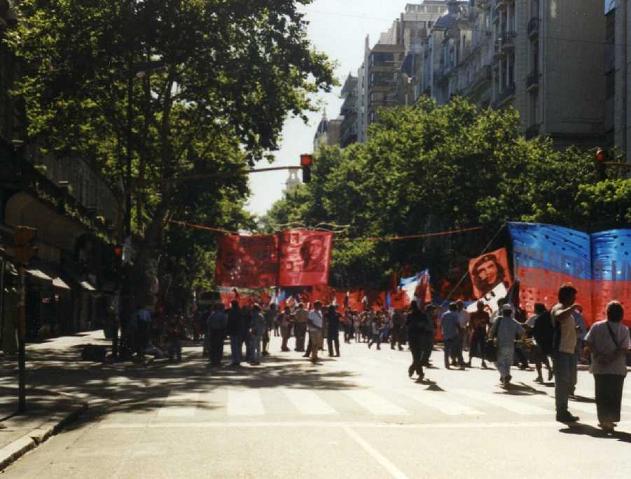
A demonstration in downtown Buenos Aires calling for more social justice
* * *
* * * During a walk, I pass a nondescript café in a side street. The café's door stands open, ceiling fans are whirring in the February heat. A few men are sitting at the scattered tables and chairs, chatting and drinking coffee. In the front window of the café stands a rack on which newspapers and magazine are stacked tidily. On top of them sits as though enthroned a large, somewhat elderly grey cat, blinking occasionally, keeping a proprietary and benevolent eye on the street: its realm.
Week Two
The first couple of weeks have not always been easy. I feel as though I have put out to sea in a rather small boat. Being without my familiar surroundings and without most of my possessions, living in a place where I don't speak the language all that fluently, where I don't always understand the local culture -- all of that makes me feel small and vulnerable sometimes.
I have dreamed about living in this country, in this city, for so long that it had become, in my mind, something of a dream place. Now the fantasy has become reality, and in the real place not all is good, or nice, or easy to accept. Sometimes I almost wish I was back in London, still dreaming of being here in Argentina. Almost.
My flat is on the fringes of downtown, and I enjoy the feeling of being in the middle of things. I can go for an early morning walk along the big avenues, watch the city wake up.
I also like the fact that this is a country of night owls. In the past couple of nights, I have been working late and needed to go out and send emails after 10:00 PM, and it hasn't been a problem at all to find an open locutorio (cybercafé) in my immediate neighbourhood. (One is open until 3:00 AM.) The restaurants are just beginning to fill up at that time. In Patagonia, I once went out for a meal with friends after midnight. That was when we left home. I have been turned away from a restaurant at 9:30 PM because it wasn't open yet. They said to come back in half an hour or so. When I did, I was the only guest for almost the entire duration of my meal.
I can walk about here at night, certainly until midnight, and feel safe. There are so many open cafés and restaurants I could dash into in case someone tried to mug me. Tourists (and residents, too) do get mugged and robbed in Buenos Aires, but so they do in London. There are certain areas I have been warned to avoid after dark, and if I am still out on foot after midnight I will stick to the big, brightly lit avenues, but overall this does not feel like a dangerous place to me.
Buenos Aires is very urban, that's another thing I like. Big houses, skyscrapers, ten-story apartment blocks next to fragile stucco'd buildings from the 19th century. It looks how a city should look in my book. And at the same time, there is a lovely provincial spirit about parts of it, a small-town-ness that I enjoy immensely. In the neighbourhood of San Telmo (very centrally located) people say hello to each other in the street, neighbours stop and chat on the pavement.
There are supermarkets here, but not very many, and they're not the efficient, faceless shopping factories I am familiar with. What there are far more of are small shops - there is a greengrocer on practically every block, at least as many kioscos (cornershops); but also hardware shops, electrical goods shops, haberdashers, locksmiths, delicatessens, cobblers, newspaper stalls, bakeries. None of those that I have seen belongs to a chain. I have yet to see a Mr. Minit here (and I heartily hope I won't).
I must remember not to get impatient with myself when the heat gets to me, or the unfamiliarity, or the fact that I am a few thousand miles away from home. The concept of travelling lightly seems to extend not only to my physical suitcase, but also to personal baggage. I am noticing how much of it I still drag around with me, and I have begun to think of setting down a few of those weighty bags. Guilt, fear - I don't need so much of that.
People have more time, even in the city. The heat of the last few days has been forcing me to slow down when I walk, but even so I overtake most people with my long, impatient strides. I have seen very few impatient people here. There is always someone sitting in a café (and there is at least one of those on every block), not just in the morning for breakfast, but all through the day; people sit and chat, they read the paper or a book, they drink their coffee and smoke a cigarette, and then they don't jump up and rush off.
My friend Violeta's aunt has lived in France for many years, but Violeta has told me that the aunt had considered moving back to Argentina. Why? Because life in France is too hectic.
I love that story. For me, it is a perfect indicator of the pace of life in Argentina. It seems to me that Argentineans have retained the ability to enjoy the small things in life; good food, good coffee, good wine, time spent in agreeable company (be it one's own or that of others). Time spent well doing nothing.
I hope to learn to slow down a little here. I always feel that I ought to be doing something, and I feel ill at ease and obscurely guilty when I do nothing. Buenos Aires strikes me as a good place in which to learn to take things a little easier.
I have decided to try out as many cafés as I can, and to spend much time in each, reading, writing and just sitting, sipping coffee, or wine, and watching the world go by.
On the street outside, a moped clatters past, on it a family: father in the middle, steering; mother on the pillion, and in front stands a little boy of maybe six or seven, holding on to the handlebars.
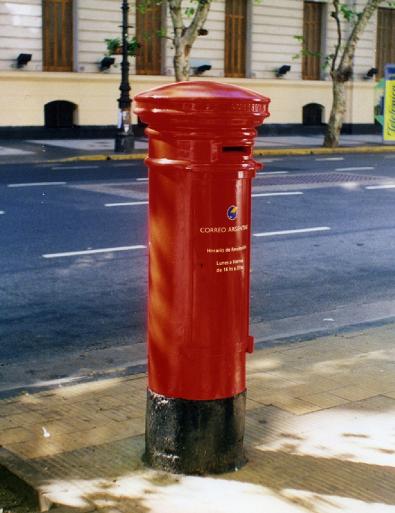
An Argentine postbox. The first one I saw one of those, I was disappointed in the country. I'd travelled all the way round the world, and then they had the exact pillar boxes here as in the UK!
The military dictatorship lasted from 1976 to 1983. Anyone who appeared potentially subversive to the government (first leftist politicians, then students, then anyone who dared ask questions, or read a lot, or had long hair and just looked like a leftie) was highly suspect. People were kidnapped by the security forces, imprisoned and tortured. 30,000 vanished without a trace. In Argentina, the word 'disappeared' has acquired a new grammatical form. Those 30,000 were disappeared. For some of them, their last journey must have started here in Calle Virrey Cevallos. * * *
It is a former industrial wasteland, a part of the river that had been filled with rubble to be built on in the late 1970s, but the project -and the land - was then abandoned. Plants seeded itself there, weeds first, then grasses and trees. Water seeped back into the lower-lying areas and formed a shallow lagoon. Insects bred. Birds followed the insects and started to nest in the trees. And suddenly, there was this huge green space just on the edge of downtown Buenos Aires. It is now a nature reserve, a sort of National Park in the city.
A side street in a downtown barrio, a perfectly ordinary, tree-lined street with alternating ten-storey modern apartment blocks and charming old buildings from the 19th-century with stucco fronts and wrought-iron balconies. The trees cast a dappled shade on the pavement, a dog is sleeping in the entrance of a building. And walking along this perfectly ordinary street I see a building with six or eight storeys, blinds drawn over its windows like closed eyelids. At ground floor level, the front of the building is covered in white, official-looking notices. And there's a plaque too.
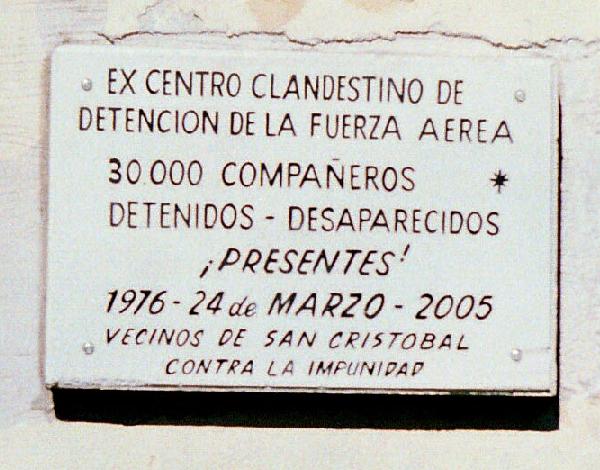
30,000 comrades were detained - disappeared
Are still present!
1976 - 24 March 2005
Residents of San Cristobal against impunity
Houses stand to the left and right of the building; an eight-storey apartment block to the left, painted a brilliant, white, with balconies and open windows. People live there. People were, presumably, living there then, thirty years ago when the building next door was a place of detention and torture.
Did the neighbours turn up the volume of their televisions, their record players or radios; did they look away, tell themselves that those who were brought to the building next door surely must have done something to deserve what was happening to them? Did they tell themselves that this was none of their business, just one of those things?
I remember my German grandmother telling me matter-of-factly how it 1930s Frankfurt people were taken away by lorry in the middle of the night. In the morning, a flat would stand empty and available. She never asked why, or where those that were taken away ended up. I expect it was like that here too. I find it depressing.
The current president Néstor Kirchner, who came to power three years ago, has done much to reverse the official amnesia that the first democratic governments after the dictatorship had ordered. The amnesty laws that had covered everybody, from General Vidala downwards, were reversed, and people have been taken to court and prosecuted for the deaths, kidnappings and disappearances. For all his faults, Kirchner has set a signal from the top that there is at least some intent not to allow these crimes to be swept under the carpet.
And ordinary Argentineans, like the Residents against impunity, are making sure that the past will be remembered.
A few blocks further along the same street, at an intersection, a policeman in a bullet-proof vest is directing the traffic. I'm not sure if the bullet-proof vest is a sign of political tension in the city or a precaution against the possible reaction of enraged motorists. He trills sharply on his whistle and gestures imperiously at drivers. He feels important, a little Napoleon. I am reminded of a sheep dog.
In the same black is the Departamento Central de la Policia Federal Argentina, the national police headquarters. A group of uniformed policemen hang around outside the gate and chat. I eye them from the other side of the street, a little uneasily. Their uniforms look far too military for my liking; black boots into which black combat-style trousers are stuffed, black shirts.
On the next street corner, the first army surplus store I have seen in Argentina. I wonder of the policemen go there buy their uniforms, or whether they bring them there to sell, to bolster up their salaries.
Saturday. I'm fast running out of things to wear. So I scour the streets in my neighbourhood for a launderette. I find one in the end, but before that I come across three men sitting on plastic garden chairs in the shade on the pavement by the side of the road. From a contraption that looks like a metal barrel with legs welded on to it issue smoke and the smell of grilling meat. The men are having an asado, a barbecue, right here in the street. One cuts bread and oversees the cooking cuts of meat while the other two sit and chat. A tinny-sounding radio plays tangos. Every now and then, a neighbour passes and stops to exchange a greeting, or to chat. The whole thing looks like the set for a promotional film from the Argentinean Minister of Tourism (the post does exist), but it's real.
One of my favourite places in Buensos Aires is the Reserva Ecologica.
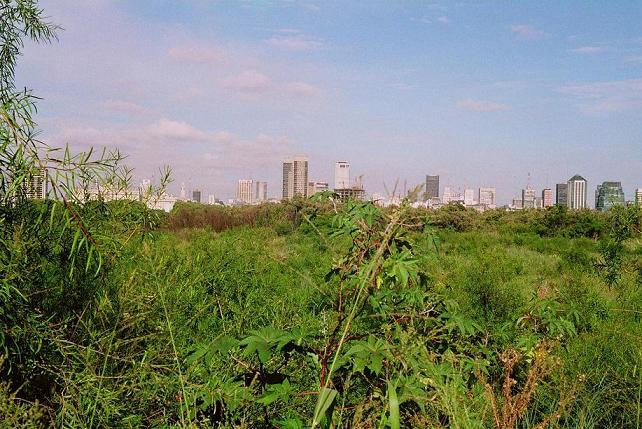
Strange insects live in the trees of theReserva (I think they're insects), they make a sound like miniature circular saws, or a dentist's drill. The tweet for a while, sonding like crickets or unmelodic birds, and then when they've worked themselves up to the right point, that loud whining buzz again.
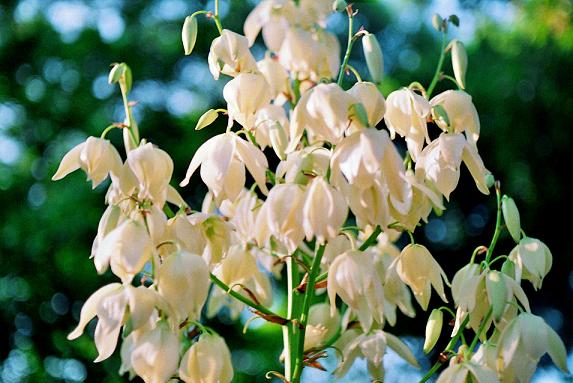
I go for walks there sometimes early in the morning. I love seeing all the shades of green, leaves and branches and grasses swaying in the wind. The other morning I saw my first ever hummingbird! I'm still thrilled.
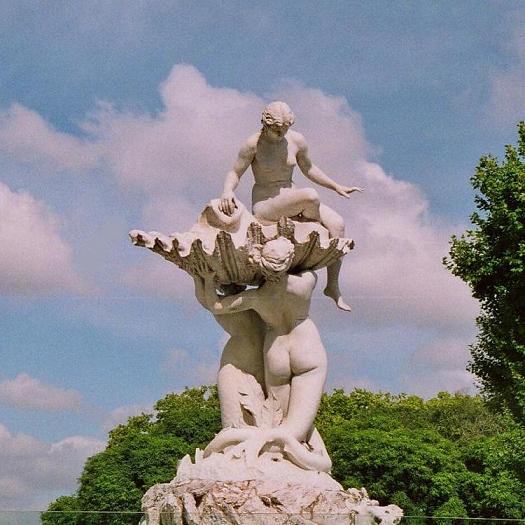
The Fuente de las Nereidas, the Mermaid Fountain by sculptor Lola Mora (Dolores Mora Vega), stands just outside the main entrance to the Reserva.



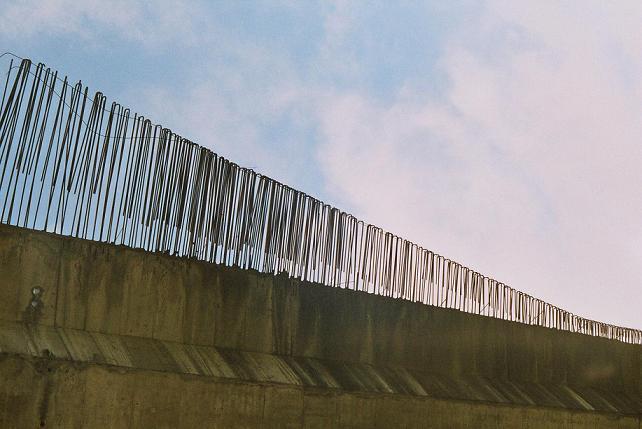
A partially built flyover for Buenos Aires' equivalent of an inner-city spaghetti junction
Week Three
I have come to Buenos Aires partly because I wanted to live here for a while, and patrly because I wanted to have more time to write. With Euros or Pounds Sterling, life in Argentina is cheap since the Peso lost two thirds of its value in the economic crisis of 2001. So I gave up my day job in a London office for half a year and left. I still do the odd translation for the office, and other things that can readily be sent by email, but for the most part, I am free to write.
I do a lot of this in the cafés of the city, sketching out what will happen next in the mystery novel I am writing. And then I will spend the next few days on my computer at home, typing it all out. It's going well and I am getting a lot done, but I'm still not quite used to the waves and troughs of a life whose major occupation is writing. The mystery is nearing its dramatic finish, and after having worked on it and lived with its characters for well over a year, I feel I am getting involved in the plot myself. Sometimes it's hard to disentangle myself from the building dread and danger and return to my own life in South America. At others, the writing touches a raw nerve in myself, throws open old wounds or reawakens old fears, and then I have to re-establish my own equilibrium before I can go on with the story. When that happens, the best thing for me to do is to go for a walk.
This morning, I went to the Reserva Ecologica again.
It has been raining all last night. The heat wave of the past two weeks is over - at least for a few days. The temperature has gone from 33 degrees centigrade yesterday to a refreshingly cool 23 today. For the first time since my arrival here, I can walk without immediately breaking out into a sweat. In the Reserva this morning a beautiful cool breeze is blowing, and the air is full of fresh scents.
I've never seen so many animals there as I have this morning. Right by the entrance and on the first 20 yards or so of the footpath, a multitude of what look like insects is crawling and flitting all over the ground. They're about the size of bluebottles (perhaps a bit smaller) and a mottled greyish-brown colour. At one point I can hardly walk without treading on one. I slow down and pick my way carefully among them, then stop altogether for a closer look.
They're not insects at all. They're tiny frogs, hundreds of them, each one no larger than a fingernail. They hop and run and swarm all over the footpath.
'¡Son todas ranas!' a man exclaims, gingerly looking for where to put his feet. '¡Qué raro!' (All those frogs - how weird!)
It's as though the frogs have hatched in the rain overnight.
The Reserva is bare of people today, I've not yet seen it so empty. Perhaps that's why the guinea pigs are out in force. I think they're guinea pigs -- small, tailless animals with short, dark brown fur, small ears and large brown eyes.
I remember that on my first visit to the Reserva with Violeta, we heard a whistling from the underbrush that sounded like guinea pig to me. I didn't understand the word Violeta used for the animal that made the sound, so I described a guinea pig and she nodded.
'Lots of people keep them,' she said.
'Ah,' I said, 'as pets.'
She looked at me. 'Er, no, actually. To eat them.'
Oooops.
* * * I have been thinking that I should get myself a bit of a social life. Violeta is currently in Paris to see her aunt, the one who finds life in France a bit too hectic. I haven't even seen my other Buenos Aires friend Ceferina yet, because she is still on a very extended Christmas visit in Patagonia, where she is from. She is a retired physiotherapist, and she has kept a small flat in the Patagonian city of Trelew where she lives during those stays. Her sister still lives in the south, and her son has moved back to Patagonia from Buenos Aires. I look forward to seeing them all later on when I will travel south as well, but for the moment, I'm at a bit of a lose end once the writing has loosened its grip on me, and I re-emerge, as it were, blinking into the daylight of Buenos Aires Anno Domini 2006. (c) all content 2006 I.R. Herrad Disclaimer: The Author of this site is not responsible for the content of external websites.
The Buenos Aires Herald (Argentina's English-language daily paper) advertises the meetings of the Buenos Aires International Newcomers Groups for ex-pats. I don't particularly like ex-pats, and I certainly don't consider myself one. I haven't come here to hang out with a load of other foreigners, after all. But getting to know Argentineans takes time, whereas the ex-pat group is here, ready-made and positively welcoming newcomers. So I think I might as well go and have a look. I have sent an email to the co-ordinator about today's meeting, which I assume to be in the evening. An hour later I get a phone call from her: the meetings take place in the afternoon from 2.00 - 4.00 PM, and today's is in a hotel (an exceedingly posh, five-star hotel, it later turns out - but luckily I don't know that yet) at the other end of downtown.
It is now 1:45 PM. I run to catch a bus. Buenos Aires bus drivers (all Buenos Aires drivers) are very, let's say, flexible when it comes to interpreting Argentina's highway code. Zebra crossings are largely considered ornamental. Buses do stop at bus stops, but their drivers are also very obliging about putting you down or letting you get on at street corners, or red lights, or in traffic jams. So I run to the corner, and there is a bus at the red light, and it lets me on.
I make it to the hotel half an hour late, not bad, all things considered. The meeting is in full swing.
I had expected a crowd of youngish people (by that I mean under forty) in, say, a bar or a café, clustered round a table, and chatting. Instead, the five-star hotel. The meeting takes place in its restaurant, all snowy table cloths on tables round which sit maybe three dozen people, most of them definitely over forty, and very few in jeans and trainers, let alone piercings, blue eyebrows or green hair. I feel like a hooligan in this crowd. Eeek. I want to go home.
Instead, I sit down at one of the tables. We are going to get a course in wine tasting. The manager of the hotel is an Argentinean of English extraction. That explains his excellent grasp of the language. And his complexion, which is ruddy rather than tanned, as that of most people in the country. He reminds me of someone, but I can't think who. He has a little brushy moustache, and he talks very seriously indeed about wine. The correct way to hold the glass (no exchanging of body heat with the wine is allowed). The correct way to look at the wine in it, sniff it, and finally taste it. His eyebrows draw together and he opens his eyes wide to indicate that on no account whatsoever should one ever deviate from those rules. It's the faces he makes that finally allow the penny to drop. The man looks like Basil Faulty.
After the tasting is over, I chat a little bit with some of the people here. All of them seem to live in Barrio Norte, the rather posh, modern part of town. I know it's unreasonable, but I feel like a commoner here amongst all the comfortably-off. They're so genteel and seem so self-assured, and I get ever more gauche in response. Honestly. I wish I could relax a bit more sometimes. I don't click with any of them, although one German woman who has been living here for a while already is quite nice, and we end up exchanging phone numbers. I might get the hang of the social life thing yet.
And then I make my get-away. Apart from meeting Bettina, I have also learned that the library of the Instituto Cultural Argentino-Norteamericano (The Argentine - North American Cultural Institute) houses the largest collection of English-language books in all of South America. I've been pining for the hard-boiled woman detective novels I read by the yard wherever I go. Sara Paretzky in Spanish translation just ain't the same. So I go and join the library. Another mile stone passed in becoming a citizen, albeit a temporary one, of Buenos Aires.
Back home, I get back on the computer. On with my own detective novel. A couple of hours later, the phone rings.
'Hey, how are you?' a voice I don't recognise asks in Spanish. '¿
Como le va?'
'Good, good,' I say. Is this someone I met this afternoon?
'It's Pía here,' the voice says.
I can't believe it. She's a singer I interviewed a few years back, on my second trip to Argentina, for a German radio programme, and an article Diva magazine had agreed to publish. She's a reasonably well-known figure in Argentina, and one of very few out lesbians. The Diva editor had left her post in the very month I handed in my finished piece, and the new one did things differently, so the article was in fact never published, although the radio programme was. Pía and I have stayed in touch, exchanging very irregular email messages a few times a year. I'd only met her the once, but I'd liked her a lot. She's short on femininity, a quality most Argentine women possess in abundance. She laughs much and loudly, great shouts of laughter, and she talks a lot, too. She's infatuated with music.
I sent her an email to let her know I am in Buenos Aires, and here she is on the phone. It's about half eight in the evening, I'm feeling a bit down, and tired, and have decided to have an early night.
'How about meeting up?' Pía asks. 'A friend of mine is playing in a jazz club in San Telmo tonight, do you want to come?'
Suddenly, I don't feel so tired any more. I like early nights, but I also like late nights, and going out. I miss the women's bars and clubs of London. Going out in San Telmo with Pía may be just what I need now. You can say what you like about her, but she's not genteel. So I say yes.
'Great,' she says. 'I'll come round to yours later with the car ... say around ten thirty.'
I'd been going to go to bed at ten. My evening has taken a decided turn for the better.
I find jazz difficult to get to grips with, but this evening in the club with Pía and another friend of hers, I find that I enjoy the music. That might be something to do with the lovely Malbec we're drinking. I've already had a couple of small glasses of wine this afternoon at the ex-pat meeting, and although I've had tea since, and although we've got a cheese platter and bread to go with the wine, I feel my head beginning to swim. It doesn't take much with me.
'I'm getting pretty drunk,' I announce, in beautifully correct Spanish, into one of those unaccountable silences. The band is between numbers, and everybody in the club seems to have fallen silent at the same time. My voice echoes round the room. Oh dear.
By the time the music is over, my eyelids need props. I am nicely tipsy and very, very tired. It must be past midnight, I think.
It's 2:00 AM. Welcome to Buenos Aires by night.