Alex's Pet Care
Guinea Pigs
What is a guinea pig?
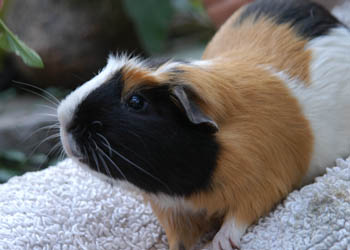
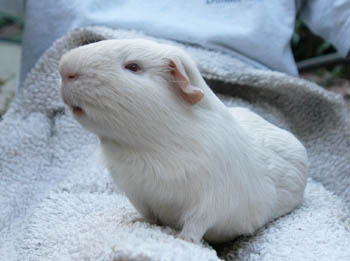
Guinea pigs came from Peru, South America. They called these animals guinea pigs because guinea in Latin means strange and they make noises like pigs. Many people have changed the name to cavy to be more politically correct. Cavies are like gerbils. They are rodents and their teeth grow continuously. Cavies are about 8 to 9 inches long. Pet cavies weigh about 1 to 3 pounds. The largest rodent is the Capybara which weighs up to 150 pounds but looks like a giant guinea pig. Males are generally larger and smellier than females. Guinea pigs come in many different breeds and colors. I have two male cavies: a tortioseshell and a selfs.A cavy is the best pocket pet for children even though they can't fit into your pocket. Guinea pigs are dirunal, meaning they are awake during the day. They are gentle and 1 out of 400 bite when provoked. They squeal and grunt when they are petted and scratched gently. Your cavy will remind you when its hungry or thirsty by letting out high-pitched squeals. They have great temperments and are low maintenance.
What to consider
Before you run out and adopt your pet, you might want to consider a few things. Do you have the time to take care of these pets? How many cavies do you want? Do you want a certain breed? Do you prefer a certain gender? Can you afford keeping guinea pigs for 5-7 years? After you've answered these questions, there are still more things to decide.Guinea pigs are social creatures. They love to cuddle and play. Cavies are the happiest when they are in pairs. Guinea pigs that live alone tend to be depressed. When they don't have a partner, they become become bored, making them very destructive. A large group of guinea pigs usually fight continuously. You should get your cavies when they are about 3-4 weeks old. Siblings make the best pairs and require no introduction. You can pair up two unfamiliar 3-4 week old guinea pigs without them fighting. If you are interested in introducing two cavies older than 4 weeks, read our "Introducing two Cavies."
Age
Your guinea pig will probably reach a ripe old age of 5 to 7. You'll notice some hair loss in your guinea pig as it grow older. Don't worry too much about it unless your guinea pig is the actual one pulling the hair off.Responsibilities
Responsibilites that go for cavies go for all animals. These animals are real and cannot be neglected. They can die because of mistreatment. (Just because they're small doesn't mean they are maintainence free and immortal!)A word on breeding. If you're the average joe cavy lover, don't breed your guinea pigs. Breeding any pocket pet is a dangerous idea. Breeding guinea pigs is especially dangerous because of certain precautions you need to take. You should seriously leave breeding to the experts.
Tip
Before buying your cavy, get your supplies and cage ready. Put food and water in the cage and make sure it's always full for the first couple of days.Selecting your guinea pig
Almost every pet shop sells baby and adult guinea pigs. Even if the shop is only a mile away, you probably want to go to a humane society for your pet. Humane societies usually care for the animals better and the price is much lower! In my city, a pet shop charges $35 to $40 plux tax for one guinea pig. At my humane society, they charge $5 plux tax. Driving the extra mile to go to a humane society makes a difference.If you're lucky enough to find a guinea pig breeder, that may be even better than buying from a humane society. A good breeder should have the cavies in clean homes with plenty of food and water to go around. The guinea pig themselves should look sleek and active. They should have bright eyes and clean rumps. If any cavy in the cage looks ill, don't buy any animals from there. The other guinea pigs will have the illness but are yet to show signs. This goes the same for the humane society.
Buy your cavy at 3 or 4 weeks of age. Younger cavies tend to bond with humans faster. When you reach toward the guinea pigs, they shouldn't skitter away with fright. They should cautiously sniff your hand. All guinea pigs will run away from you when you try to pick them up but after you do, they should purr with delight when you give them a good scratch behind the ears.
Introducing two Cavies
If you've bought two guinea pigs that are 3 or 4 weeks old, this introduction is not needed. If you've bought two guinea pigs that are older than the age above, you should try intoducing them with this method.To start out, you need to buy two seperate cages for each cavy to live in. One cage needs to be large enough to hold at least two guinea pigs and the other cage needs to be able to hold at least one. Place the two cages next to each other. After you've positioned the cages, set up each cage normally. Put food, water, bedding, etc. in both cages.
After the intial setup is done, place one guinea pig in one cage, and the other in the second cage. At first, your two cavies will try to get to each other but eventually they will give up. Every day or two, switch the positions of the two guinea pigs. After you've done this for about a week, take both of them out and place them in a neutral area for them to play in. Putting them in a neutral area means placing them in a vicinity that doesn't belong to either persons. At first, the two cavies will sniff and chase each other around. One cavy might mount the other cavy and this is just normal; one is asserting dominance over the other. If they still fight, place both animals back in the cage and repeat the process. They are fighting when there's blood or they lunge for each other's throat. After they start ignoring each other, put them into the larger of the two cages. They've excepeted each other when they start to sleep together.
Housing
There are many houses available on the market and they do come at a hefty price. There are three kinds of cages for your cavy: a hutch, a hutch with hide-away, and an aquarium tank.At your pet shop, they will probably be housing the cavies in an aquarium-like container. Even though the shop uses this type of housing, you should not! The pet shop isn't looking for caring for the guinea pigs long term. A tank to fit your guinea pig in has to be at least 25 gallons or more. There is little ventilation in a tank and you will need to clean it more often. Once or twice week, you need to haul the tank out to clean the shavings. Once a month, you need to give the whole thing a washdown with soap and water. It's also a lot harder for you to tame your cavy because you'll always need to swoop down from above to pick them up, resembling a bird of prey. You may spend all your cavy playing time cleaning up after them.
It is a lot cheaper and convenient to build your own hutch. You can choose the size and build it to fit your home. The only trouble you have is actually building the hutch. It should be made out of Aspen or Pine wood. You need to coat the wood with some non-toxic wood finish. The floor and sides of the cage should be made out of wire mesh. It can be found in the garden center of your hardware store. It costs about $11 per roll; 5' by 5. It's a bit too complicated for me to put up instructions on this website. If you would still like some instructions, please email me,
 , for the price. I will send you it via what's convenient for you. If you aren't a carpenter, you can check your local newspaper listings for used hutches.
Bedding
Bedding is used for many reasons and corresponds to what cage you have. If you have an aquarium tank cage, which I don't recommend, you'll use the bedding to soak up urine and feces. If you have a hutch, you'll probably have a section closed off for you pet's hide-away. With this setup, you'll put bedding in the hide-away for the comfort of your animal.The best beddings for guinea pigs are Carefresh, Aspen, and Corncob. Some people say that pine bedding causes respiratory infection and others say they've used it with no adverse effects. It depends on your guinea pig and the ventilation in your cage. Some cavies can't stand pine bedding while others can. Ventilation in the cage is essential if you use pine bedding. To be on the safe side, you probably want to stick to Carefresh, Aspen, and Corncob. You can use hay for bedding if it's more convenient.
Depending on what kind cage you have, you should fill it so it's 1/3 full. You need to change it every 2 or 3 days; or maybe earlier if it smells. If you put more bedding, you won't need to change it as often; maybe 3 or 4 days. Many people say that guinea pigs won't go to the washroom in their beds but they will, willingly.
For absolutely no reasons should you use cedar bedding for your cavy. Cedar has fumes that have proven to cause liver damage and respiratory infection. Do not buy any bedding that has been treated with Chlorophyll! Animals have sensitive noses and the Chlorophyl in the bedding can hurt your pet.
Feeding
The best type of food to buy is the commercial lab chow type (also called pellets) supplemented with vegetables. The chow looks like small cylindrical pieces that are dark greenish in color. Refrain from buying premixed food because your guinea pigs will learn to pick out what they like and leave what they don't. You also need to buy some good quality hay from the pet store. Timothy hay is good. Alfalfa is too fattening for adult guinea pigs. You can feed it to young cavies. Buy hay that is green, not yellow. If there is any mold on the hay, don't buy from the pet shop. The spores from the mold are probably on all the hay. Cavies are very sensitive to mold and bacteria. Don't buy food in bulk because the food will lose its vitamin potency.I could never understand why owners don't believe cavies can eat grass! Cavies use to live in the wild and they munched on grass all day. Grass also helps wear down the guinea pig's teeth. If you cavy hasn't been eating grass already, slowly wean your guinea pig on grass by giving it a few strands and increasing everyday. Make sure that your grass hasn't been sprayed by any pesticides or insecticides.
Cavies can't manufacture their own Vitamin C. Vitamin C helps the guinea pig's immune system and without it, your pet will succumb to a variety of diseases. Food you buy from a pet shop is fortified with Vitamin C but it loses its potency after a period of time. Pellets usually don't have enough Vitamin C for your guinea pig so you mustgive your pet a source of Vitamin C. You can give your cavy mineral blocks or liquid or powdered vitamin supplements from the pet shop. But, giving your cavy fruits and vegetables is probably the safest and easiest way. I personally believe that letting your cavy have a constant food source is detrimental to their health. Guinea pigs are rodents and have an urge to chew constantly. Cavies will chew whatever is available, which often times is food. This can be compared to a human's emotional overeating. Concerned, but "green," cavy owners often give their guinea pigs large amounts of food throughout the day because the cavy squeals. Cavies squeal for many reasons. They may squeal when they are: excited, playing, scared, hurt, or they want to play outside of their cage. I recommend using your judgement and feeding about half a handful of cavy food per guinea pig two or three times a day. Watch your cavy eat and when he/she seems to tire of eating, take away the excess food. After watching your guinea pig for a few times a day, you can adjust the amount accordingly. For a young cavy, you should give it 1/4 of a handful of food three or four times a day.
Treats
Many treats can be bought at your local pet shop but I have found that fruits and vegetables were always favored more. Besides, they are also inexpensive. You usually want to give your cavy treats when they are out of their cage and playing. The amout of treats you feed them should correspond with the length of play time. One treat every 30 or 40 minutes. This helps them to look forward to play time with you but does not let them overindulge.Shopping List
Here's a cavy shopping list: Carrots
Parsley (high in Vitamin C)
Apples
Romaine Lettuce
Beans
Turnips
Kale
Oranges
Bananas
Strawberries
Blueberries
Blackberries
Rasberries
Guinea pig pellets
Hay Food you can find in your backyard: Dandelions
Grass
Clovers
Fruit tree leaves (as a treat)
Food Bowl
The food can be dispensed in heavy crock bowls bought at the pet shop. They are excellent because their weight lessens the chance of spills. They come in many different sizes. You can use these for you cavy. Don't buy a bowl that is too big or deep because your guinea pig will tip it over trying to get the food at the bottom.
Water
Guinea pigs neeed a constant supply of water at all times. We haven't figured out why cavies drink so much to piddle so often.Making sure a water bottle works is simple. Fill the bottle with water and screw the spout on tightly. Squeeze the bottle so water spurts out of the spout. Let the bottle slowly suck air in. This should start the suction going. If your bottle keeps dripping water, screw the spout on tighter and squeeze the bottle again. If the water bottle still does not work, it's broken. You can easily attach the bottle to the tank by molding a wire coat hanger into shape. Make sure that the bottle is working properly by tapping it with your finger and a drop or two of water should fall out.
Elevate the water bottle a few inches off the the floor of your cage. Make sure it's level to your cavy's head.
Water Bottle
Bowls of water are messy, unsanitary, and can easily tip over, especially for guinea pigs. The best water carrier is a commercial one that consists of a bottle and a metal spout. Buy one that has a spring in the spout so the ball always stays to in place. Spend some money and don't buy the bottles that have a plastic or glass spout because both can be chewed and broken. The glass tips can be swallowed or cut your cavy's mouth.From my experience, the Critter Keeper brand works well. Buy one that can hold at least 8 ounzes or more. You should rinse and fill it everyday.