Alex's Pet Care
Gerbils
What is a gerbil?
AgeWhat is a gerbil?
Gerbils are rodents, creatures whose teeth grow continuously. They are 3-4 inches long, about the size of a dwarf hamster without the tail. They come in many different colors including black, brown, yellow, white, grey, or a mixture of these colors. You can get a common agouti, white belly with a light golden body, or a "mutt" gerbil. Their tail is about 3/4 the size of their body and has a slight tuft at the end. Their face is a little wider than a mouse's and their body is proportionate to a rat's; just a little plump. Gerbils usually weigh about 2-4 ounzes.Why should I get a gerbil?
Gerbils are great pets for the children and adults. They are diurnal, meaning they are active during the day. Some "pocket pets" are nocturnal, like hamsters, which makes playtime difficult. After gerbils are tame, they love to climb all over you and sit on your shoulder to beg for a treat! Their fun personalities will amaze you! These furry rodents need little care compared to other pets. They are perfect pets for people any age because they can mold themselves to fit your lifestyle! They won't bark for attention or scratch your couch. If you have a pair of gerbils, your constant company will not be missed.What to consider before buying a gerbil
Before you run out and adopt your pet, you might want to consider a few things. Do you have the time to take care of these pets? How many gerbils do you want? Do you want a certain breed? Do you prefer a certain gender? Can you afford keeping gerbils for 3-4 years? Will you breed them? After you've answered these questions, there are still more things to decide. Gerbils are social creatures. Lone gerbils often live shorter, unhealthy lives. They tend to become overweight and are harder to tame. However, large groups of gerbils tend to fight. Gerbils live best in pairs. Two females can live together, but don't do better in groups of three or more. Males tend to live together in large groups without complications. Occasionally, gerbils fight because their personalities. Introduce two gerbils who are 6 to 8 weeks of age (siblings require no introduction, and thus make the best pairs). If you are introducing two new gerbils that are over eight weeks old, read our article on "Introducing two gerbils".Responsibilities to know
1. Gerbils are a commitment. They are not toys that can be disposed of when you tire of their antics or are annoyed by their behavior. They are living animals that require care. Gerbils require the same mental care as any other animal. 2. Parents should be aware of this if buying gerbils for children. When the new-ness wears off, the child will likely go in search of other forms of entertainment. Parents will have to encourage their child to be responsible, but parents, in the end, will have to pick up after their kid. 3. Because of gerbils' small sizes, there is a common misconception that gerbils are virtually "maintenance free" animals. Not true at all. Gerbils require attention and care, including visits to the vet. 4. Gerbils need to have love and affections from their owners. They must be taken out for exercise; most cages aren't large enough. 5. Breeding gerbils is a bad idea. Leave this to experts and professional breeders. I say this because many breeders don't know the consequences of what they're doing: time, vet bills, food. I also strongly stress that breeding is not profitable. You'll just get a whole herd of gerbils running around. If you want more gerbils, go out and adopt some from your local shelter.Age
Gerbils tend to live for about 3 or 4 years. They can live to 5 with love and good care. Gerbils tend to live longer, healthier lives when they are in groups of two. As your pet gets older, he/she will probably lose hair and seem less active. In many cases, one gerbils might die before the other. Your best bet is to get another gerbil 6-8 weeks old. Gerbils are entertaining, no matter what age. But, younger gerbils, 6-8 weeks old, are easier to tame and handle. Older gerbils are more calm and are able to handle stress better than younger ones. Keep in mind how long you are willing to take care of a gerbil and let this be a guideline when you look for one.*TIP*
It is wise to have all your equipment (tank, water, food, bedding, toys, etc.) set up before you adopt your gerbils. Look for the most friendly, amiable gerbils there.Selecting
The best place to adopt a gerbil from is a reputable breeder. You have the chance to see the gerbils' parents and the environment they stay in. I also encourage adopting gerbils from a shelter or rescue agency. There are many homeless gerbils out there; save them from being euthanized! I strongly feel that you should avoid pet stores. Animal stores are only interested in making a profit. They have an untrained staff and untaimed and unhealthy animals. Workers rarely tell or know that they sell dangerous materials for your gerbil. There are breeders in every state. To find one in your area, visit the AGS Breeder Registry. A good breeder or shelter should have healthy gerbils in clean, suitable living conditions. A good breeder should have records of the gerbils' parents and their genetic code. They should know the birth date and age of the pet. Ask the breeder if the gerbils have been sick in the past. Shelters may not have any records of illnesses, age, or temperment. The gerbils themselves should have bright and alert eyes. Coats should be sleek and shiny. There should be water, food, and bedding available. See the cage to make sure that the caretaker is not using pine or cedar shavings. Their rumps or noses should not be wet. The ideal pet will be socialized and show no signs of hostility. No animals in the cage should show any signs of illness. Buy your gerbils when they are 6 to 8 weeks old. Introducing young gerbils (6 to 8 weeks old) together is the easiest. Older gerbils can be introduced slowly by the Split Cage Method. The gerbils you buy should be calm and friendly. They shouldn't run away or bite you!Handling
It is necessary to know how to pick up a gerbil correctly. When you hold your gerbil correctly, it shows the breeder that you are a trustworthy individual. NEVER pick up a gerbil by its tail, even by the base. A gerbil's tail is jointed and can break off easily. Don't swoop down on the gerbil either; they are prey of birds. Use a scooping motion. Usher the gerbil into a corner, cup your hands, and slide them under the gerbil. Lift it out of the cage and quickly hold it to your chest. A frightened gerbil can easily slip off your hand. A drop of just a couple of feet can hurt them! You must turn them over to see if their rump is dirty. To do this, the key is to be gentle! Gerbils will not approve of this and struggle. If you are uncomfortable of this ask the breeder to do this for you. Place your hold hand over the gerbils and gently grasp it, thumb and forefinger around the neck. Flip it over and gently part the tail from its rump. After you're done, quickly flip it back and put it back in the cage so the gerbil can calm down.Introducing two gerbils: Split Cage Method
The Split Cage Method is to get two, and only two, unfamiliar gerbils over eight weeks old to accept each other. Do not keep two already familiar gerbils away from each other for more than a day or two, unless of a medical emergency. If you do this, the gerbils will forget each other and fight. The Split Cage Method is a cage or tank that is split in half. A 10 gallon tank or 8 by 12 inch wire cage is a good sized for 2 gerbils. Securely divide the tank with a divider. Put a lid on the tank so the gerbils can't climb over the wire mesh. After the divider is in, set up the tank normally, with food, bedding, and water on each side. Watch your gerbils for a while to make sure the divider is secure. Put one gerbil in each half of the tank. The gerbils will try to dig and climb to get to each other, but will soon lose interest. Several times a day, switch the gerbils from one side to the other. This allows the gerbils to get used to each other's scent while preventing them from fighting. Keep up this routine for about a week. Then, take out the divider. Do not be alarmed at some boxing; the gerbils are trying to assert their dominance. However, if there is biting, blood, loud squeaking, or chasing relentlessly seperate them and put the divider back in. Keep them for this routine for even longer. With perserverance, this method should work.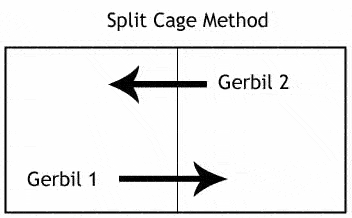 When both of the gerbils have accepted each other, they should groom, sleep together, and share food. This method works for introducing two gerbils. For groups, try to adopt young gerbils.
Housing
There are many kinds of rodent homes on the market and it's hard to choose the best. Some out there are Habitrails, multi-level condos, aquarium tanks, commercial wire cages, and, my favorite, homemade wire cages. Habitrails are aesthetically pleasing but turn out to be very unrealistic. These cages are made out of plastic tops and galvanized wire. It has places for food dishes, running wheels, and water bottles. These accommodations are outnumber by the drawbacks: price, difficulty of cleaning, difficult assembly, setup, and chewed easily. The Habitrail cage offered are over priced and do not come with the accessories. The tubing accessories, which serve as tunnels, need to be bought separately. The tubing is sold for even more than its worth. Cleaning is nearly impossible and a complete hassel. I, from personal experience, had serious issues with the tubes. Gerbils use them as toilets and because of the ridged characteristics of the tubing, I could never clean them out fully. The tubing became unsanitary too quickly. Assembly is a pain: some pieces stuck when you don't want them to and came apart when your needed to keep them together. The cage had a little door you are suppose to drag your gerbil out to play with, which probably will encourage biting. Since the cage is made out of plastic, the gerbils easily chewed holes and escaped. Overall, this cage is a waste of money. Multi-level condos are cages that have more than one level. This setup is average, but is too pricey for the average gerbil caretaker. There are different levels accessable by wire ramps. Since the condos are usually made for all pet rodents, the sides aren't high enough for gerbils. Shavings get kicked out and leave you with a mess. Extermely old and very young gerbils can't live in this setup because they could break their limbs if feet or tails get caught in the ramps. This setup may be more trouble than it's worth. Another setup is an aquarium tank. This cage is better than most, and is recommended by many. It is not as attractive to the eye, but the tank is far more functional. There isn't the danger of broken limbs and flying shavings. Gerbils don't have plastic to chew. Making a tank cover will only cost a few dollars. Cleaning is simple and easy when using a vaccum. You only need to wash the tank once a month. The downsides are the lack of ventilation. You might want to fan the tank once a day to flush out any excess moisture. The weight is also a problem. But, compared to many other cages, this one is an excellent choice. The next cage is a commercial wire setup. I don't recommend this setup. It is a wire cage with a sliding pan for shavings. The sliding pan is easy to empty and is convenient. The con's are: escapability, drafts, and human danger. Many rodents learn how to push the pan out and escape through a little slit in the cage. The cage doesn't have high sides for the shavings. The lack of a high side also allows drafts to flow through the side. The sharp corners on the pan can easily cut humans. The cage I endorse the most is the homemade wire cake-pan rodent home. It has been published in several books, how I learned of it. To learn more about it, see Sarah Stein's book: Great Pets!. There have been many debates on housing for gerbils. Space is up to opinion. If in doubt, bigger is better. Five gallons, for aquarium tanks, for each gerbil is a good guideling.How to make a tank cover
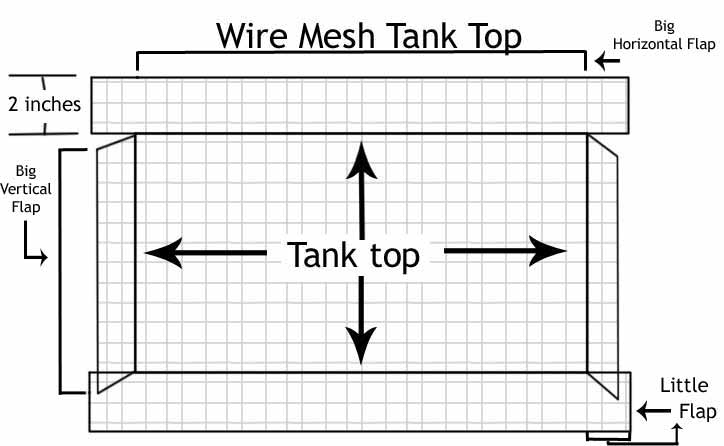
Gerbils can jump very high. You'll need a top for your aquarium tank, if you're using one. You can always buy one at a pet store but they are rather expensive . A homemade cover is only a couple dollars and is easy to make. You need: weight, wire cutters, wire hardware mesh, and a half foot of spare (moldable and thick) wire. Cut a piece of wire mesh two inches larger on each side.Form four little flaps by cutting two inches into all four corners of the mesh.
Place the mesh on top of your tank and bend the extra wire mesh over the edges of the tank.
Weave your four little flaps onto your big vertical flap.
Put masking tape on the edges of the top so you won't hurt yourself when you take the top off.
Weigh the top down with a weight for extra security.
Bedding
Bedding is ment to absorb your gerbils urine and feces. Gerbils came from the deserts of Africa so they absorb much of the water they drink, but still need fresh water available at all times. You only need to change the bedding once a month if you put three or four inches of bedding. There should never be an unpleasant smell. If bedding changes are not frequent enough, ammonia (from the gerbils' urine) will soak in to the bedding and literally burn your gerbils' feet. Breeding gerbils should only have an inch or two. You should probably fill your gerbil tank as much as you can. You can put more if you want them to have a bit of fun (gerbils love digging and burrowing). You can buy bedding at any store store. Aspen, CornCob, and Carefresh are recommended. NEVER buy pine or cedar shavings. Pine and cedar bedding have strong aromas that will cause your gerbil to contract a respiratory infection. Young gerbils are even more susceptible to health issues. Sawdust is one of the worst beddings because it irritates the gerbils' noses and eyes. Some pet owners use shredded paper as bedding, which is fine, but does get soiled faster than wood bedding.Nest Material
It's nice to give your gerbil a little hideout. A small cardboard box or a toilet paper roll will suffice. When I gave my gerbil a toilet paper roll, it was very cute to see them crawl in at night and block both entry ways. If you let your gerbils build a nest out of shavings, you'll soon find out that after they make a nest, it all falls apart (if I were such a gerbil, I would be deeply upset). Some cheap nesting material for your gerbil is unscented toilet paper, paper towls, and blank sheets of printing paper, which sticks together in a nest better. At the pet shop, the commercial wool nest material may look appealing but can be fatal. The fibers could get caught on limbs and accidentally amputate them. Better to be safe than sorry. When you change your bedding, take out the nest and save it so you can put it back after you're done cleaning. You don't want to destroy your gerbil's hard work. However, if the nest starts to smell, throw it away with the bedding and give your gerbils new bedding material to make a new nest.Toys
Gerbils are extremely active and mischevious. If you don't give them an entertaining environment they start to chew everything in sight. The toys you find at a pet shop do entertain your gerbils but they are overpriced and never last very long. You can give your gerbils some branches off a fruit tree; they seem to love sinking their teeth into the soft bark. Leave the leaves on so your gerbils can play, chew, and eat them. Make sure you take branches off an unsprayed fruit tree; insecticides are toxic to all animals. A used toilet paper roll amuses them for a while until they decide to chew the things to shreds. Cardboard boxes allows them to play hide and seek with each other. If you decide to give your gerbil a wheel to run in, try to buy the traditional metal hamster types. If it's plastic, it will be gnawed away in minutes. But, before you give the wheel to your gerbil, you need to cover the outside of the wheel with masking tape. Take some bedding and press it on the inside of the wheel so it sticks to the tape. Doing this prevents your gerbils' tails from breaking. Don't use any plastic or duck tape. Attach the wheel to the cage from the side or top.Litter Training
I know it seems impossible, but, with a little luck, you can be successful in training your gerbils to go to the bathroom in one area. I successfully trained my two gerbils, Dusty and Dusky. I can't guarantee that your gerbils will be litter trained, though, but you can give it a try. It takes little effort. First, choose a corner, preferably secluded, where you gerbil will go. Place a tiny pie plate or a litter box for the gerbil in the corner. If possible, elevate it so that it's off the bedding. Don't put any bedding in the litter box. Wait and see if the gerbils make bowel movements there by themselves. If they don't, get a spoon and manually take some soiled bedding and put it in the litter box. Feed them sunflower seeds in the litter box to entice them to make bowel movements. Wait a week or two and if this doesn't work, switch corners. Remember to elevate the litter box. The whole point of getting a litter box and elevating it is so that the area will be secluded. Keep switching corners until the litter box works or you give up. Don't change the soiled bedding in the litter box too often. If you do, their scent won't remain in the box and they won't use the box anymore. Again, I can't guarantee that you can litter train your gerbils. Some get it and some do not. By following the steps above and some luck, your gerbils may become litter-trained.Food
A commercially prepared mix of food is the best choice. The lab chow type, small cylindrical pieces, is rather boring and doesn't give your gerbil very much variety. The sunflower seeds in your gerbil's premixed food are very fattening. You can pick them out of the food to use for treats because they love them so much. I have raised gerbils successfully on the Encore and Kaytee food brand. It's inexpensive and nutritous. Buying the food at Walmart or your grocery store may be cheaper than a pet store. One dollar for one pound of food is the usual rule for buying rodent food. You should have food for your gerbil 24/7. Gerbils are very active and can easily use up all there energy. Without food, they could collapse or black-out.Treats
You can always give your gerbils little treats off the table. A very occasional peanut will delight them. Don't distribute them too often because peanuts have too much fat and are detrimental to the health of your gerbil. You can try to give them some plain uncooked oatmeal or unsweetened cereal. It's so cute to see your gerbil eat a Cheerio as large as its head. Once a week, you can try to feed you gerbils a slice of apple, a small bit of carrot, or a few sprigs of parsley. Iceberg lettuce may seem like a nice thing to give your gerbils, but lettuce is unnutritious and causes diarrhea. An interesting tidbit to feed your gerbil is live mealworms from the petstore. To some people, it suprises them to know that gerbils also eat bugs in the wild. Two of my gerbils are absolutely in love with mealworms. You can usually buy them from the petstore in 50, 100, and 500 increments, costing from two to eight dollars. I encourage owners to buy from petstores because they are sure to be non-toxic, and you can choose the size of mealworm you want.Food Bowl
The food can be dispensed in heavy crock bowls bought at the pet shop. They are excellent because their weight lessens the chance of spills. The bowls come in a variety in size. Try to buy one of the smaller types so your gerbil can't climb in. Gerbils are known to pass bowel movements while they eat, which is quite unsanitary. Sprinkling the food on their bedding will force them to dig and forage for their food, which is fun and will give them exercise. You do need to clean the cage more often if you decide to do this. Somtimes your gerbil may hoard food in his/her nest and you probably should take it out because the saliva on the seeds will make them rot.Water Bottle
Bowls of water are messy, unsanitary, and can easily tip over, ruining and wetting the bedding. The best water carrier is a commercial one that consists of a bottle and a metal spout. Buy one that has a spring in the spout so the ball always stays in place. Spend some money and don't buy the bottles that have a plastic or glass spout because both can be chewed and broken. From my experience, the Critter Keeper brand works well. It has a blue coating to discourage algae and has a spring in the metal spoutWater
Even though gerbils are desert creatures and need little water they should have fresh clean water at all times. Making sure a water bottle works is simple. Fill the bottle with water and screw the spout on tightly. Squeeze the bottle so water spurts out of the spout. Let the bottle slowly suck air in. This should start the suction going. If your bottle keeps dripping water, screw the spout on tighter and squeeze the bottle again. If the water bottle still does not work, it's broken. Make sure that the bottle is working properly by tapping it with your finger and a drop or two of water should fall out. You can easily attach the bottle to the tank by molding a wire coat hanger into shape. Elevate the water bottle a few inches off the bedding. Otherwise the bottle will leak and you will have wet bedding.Getting to know your gerbil
When you first recieve your gerbil, it may be unsocialized and afraid of you. Get a gerbil that is at least 6 weeks old so that it has been around it's mother and siblings long enough to learn to act like a "gerbil". But, you still want to adopt it at a young age so it can adapt to your lifestyle. When you first get your gerbil, leave it in its cage for a day or two. Then, harmlessly lay your hand on the bottom of the cage. They'll run away at first but they'll soon climb all over your hand to investigate the intruder. They'll taste you by biting or licking you. If this hurts, slowly move your hand away or puff them in the face. If you are scared, go ahead and wear a glove. After they see that your hand tastes nasty they'll stop biting. Rarely will a gerbil bite you unless provoked. If you do get bitten, the gerbil must have had an experience with the previous owners. You might need to spend months taming it so it's probably better to trade it in for another. If you do tame a stubborn gerbil, the bond between you two will be even stronger. Soon, your gerbils will ignore your hand. Now is the time to start to make friends with them. Put a few sunflower seeds in your palm and put your hand in the tank. After a week, your gerbils will go crazy everytime your hand reaches into the tank. When your gerbil stands on your hand to eat the seeds slowly reach it up a few inches. Everyday, lift your gerbil higher and higher until you can get it out of the cage to play. To get your gerbil out of his/her cage, do not grab or chase your gerbil around. It only frightens it and destroys trust between the two of you. Only comfortable gerbils will eat. Try to pet your gerbils while they're in your hand. Some gerbils love having a nice scratch and others are contented to just fall asleep in your hand. They especially like being scratched between the eyes and behind the ears. Don't push the taming too much. In a matter of weeks your gerbils will love the sight of you walking towards them. Always supervise children when they play with the gerbils. Children may accidentally drop the gerbil. Your pet may sustain a fatal concussion or broken bone. The commotion of children grabbing your gerbil might interrupt the taming process. To avoid getting bitten by gerbils, don't sweep down like a hawk and scoop the up from above. If you ever need to grab them in a hurry, get a tube and have them crawl in it. When petting gerbils, wash your hands in between so you don't smell like an intruder. Getting a second gerbil will not make it like you any lesser than if it had a partnerGerbil Behavior
ThumpingGerbils drum their hind legs as a way of communicating. They do this when they think there may be a danger or predator around. Thump a pencil on the ground rapidly to see what your gerbil does. Affection
Gerbils are capable or showing affection to their own species and humans. They will groom each other consistently; it is a way of releasing tension. If you groom your gerbil, you might be lucky enough to have its affection and be groomed back Fighting
Fighting between gerbils usually happen between unintroduced males or females. Gerbil boxing is when two gerbils rear up on their hind legs and 'box' with their fists. This is a sign that your two gerbils may not be getting along too well. If it last more than ten or twenty seconds seperate them immediately and use the Split-Cage Method mentioned above. Digging
Gerbils have burrows in their natural habitats. Digging is a natural way to release energy. They usually scrabble in corners. Territory
Both males and females mark their territories with urine; males more often than females. You can tell this when they drag their rumps against any objects. Run Aways
Even with the best cage there will be a time when you forget to weigh down the top or leave the cage open. There are several methods in which you can find your gerbil. 1. Get a tube and place it near your gerbil. Its inquisitive nature and liking of enclosed spaces will cause it to run up the tube. You can easily tranfer it to the cage from there. 2. Leave sunflower seeds and water in every room and count the number of seeds. The one with less will be the room where your gerbil is. 3. Another way is to get a pail, some books, and food. Obtain a pail large enough so your gerbil won't be able to climb out. Put some of its favorite food in there. Stack the books so it makes a ladder going to the top. Place food leading up the steps so it can see the food at the end of the pail. When the gerbil climbs up the ladder and jumps into the pail for food, it won't be able to get back out. Try to put something very cushy on the bottom of the pale so the gerbil won't hurt itself during the fall. 4. The easiest way to find your gerbil is to trap it. A popular way is to buy a Havahart trap that can be baited and lets your gerbil come in, but not out. You can buy one at your hardware store in the pest section. It's usually under the humane treatment in the aisle. There are usually plastic types that have a flap that closes as the animal walks down a ramp. These don't work as well unless you buy the one ment for rats. Stores usually don't carry Havahart traps, but you can easily buy one over the internet. I want to remind owners to always remember to close cages and secure them tightly. Prevention is the best method for capturing your gerbil. I also want to encourage owners to keep trying to find their lost pet. I had a small pet that was gone for a month before I found it. I left food and water out in the beginning but soon gave up. I soon just left water out in vain. I had seperated the sunflower seeds from the gerbil food mix and had a full plate of it out. It turns out that my pet had hoarded all the food behind the couch and lived off my water and the seeds. The moral of this story is to keep hoping! Your pet may still turn up.
Vets
I want to make a note on vets. Vets do not usually know much about small animals and how to treat them. It is becomming more common now. But to make sure, call your local vet and ask them if they treat small animals. Some may say yes to avoid the look of ignorance. Ask him or her if she has done any cases before for small animals. If your local vet doesn't treat small animals, try to call an exotic animal veterinarian. They usually treat animals more along the lines of reptiles, amphibians, fish, poultry, farm animals, and small animals in addition to dogs and cats.Diseases
Here, I will list common illness that gerbils suffer from. Respiratory IllnessYour gerbil has a respiratory illness when it shows signs of distress. The gerbil will have a ruffled coat, squinty eyes, be inactive, red noses, and may have diarrhea. If your gerbil shows these, know that it is a serious condition. Gerbils don't show signs of sickness until they can to fool predators. To treat this, buy tetracycline, often marketed as Ornacycline for birds. Make one dosage for small birds, mixing it with distilled water. It is recommended that you refresh the dose every day. Keep the gerbil on it for ten days, not the five days recommended on the box. Buy a clamp lamp and shine it on one side of the cage. The gerbil can decide if it wants to go toward the warmer or colder end of the cage. If one gerbil has respiratory illness, treat all the occupants in the cage. Broken Tails
Gerbils usually get this from people holding the gerbil incorrectly or from getting it stuck in a rodent wheel. There is nothing you can really do except wait for it to heal itself. Nose bleeds
The mucus from gerbils are red and sometime seem like a nose bleed. Some nose bleeds or red noses come from allergic reaction to bedding, too dusty of bedding, or respiratory illness. Don't use cedar, pine, or sawdust as bedding. Mites
Mites are usually identified because of excessive itching or the gerbil tilts its head to one side. This usually needs a vet visit. This can't be treated at home because a gerbil's skin is very delicate and can't stand soap and water. The medicine sold at stores is too harsh on small animals and isn't recommended to treat anything. Diarrhea
This is ususally caused by an excess of greens. Iceberg lettuce is usually the cause. But, diarrhea is also a symptom of Typhus disease, a fatal, currently untreatable disease. Bring your gerbil to the vet for strong antibiotics if the diarrhea doesn't go away in several days. Overgrown Teeth
Overgrown teeth isn't uncommon and is usually caused by an inadequate diet. Your gerbil needs to have items to chew on. Fruit twigs and wood blocks can be offered. Buy wood blocks from the petstore so you know that the wood hasn't been treated.
Questions
I want to encourage any owners or future owners to contact me with any questions! I check my e-mail very regularly and can give you advice that isn't here. My e-mail is: .
.