
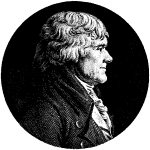
Thomas Jefferson was born on April 13, 1743 at Shadwell, Virginia; he died July 4, 1826, in Monticello. His father Peter was a successful planter and surveyor and his mother Jane Randolph a member of one of Virginia's most distinguished families. Thomas inherited a considerable estate from his father, Thomas was already set for life. When he was twenty-nine he married Martha Wayles Skelton, with whom he lived happily for ten years until her death. Their marriage produced six children, but only two survived to adulthood.
Jefferson inherited slaves from both his father and father-in-law. In a typical year, he owned about 200, almost half of them under the age of sixteen. Jefferson freed two slaves in his lifetime and five in his will and chose not to pursue two others who ran away. All were members of the Hemings family; the seven he eventually freed were skilled tradesmen.
He attended the College of William and Mary and practiced law. He later served in local government as a magistrate, county lieutenant, and member of the House of Burgesses. He was chosen from the members of the Continental Congress to draft the Declaration of Independence. Jefferson left Congress in 1776, and he returned to Virginia and served in the legislature. he was elected governor from 1779 to 1781, and an inquiry into his actions was conducted during his last year in office that, although finally fully dismissed, left him with a life-long embarassment in the face of criticism.
In 1790 he accpeted the position of secretary of state under his friend George Washington. His tenure was marked by his opposition to the pro-British policies of Alexander Hamilton. In 1796, as the presidential candidate of the Republicans, he became vice-president after losing to John Adams by three electoral votes. Four years later, he defeated Adams and became president. During this second term he purchased the Louisiana Territory and tried to avert war with Britain. In 1809 he was succeeded by James Madison, and during the last seventeen years of his life, he remained at Monticello. During this period, he sold his collection of books to the government to form the nucleus of the Library of Congress. Jefferson embarked on his last great public service at the age of seventy-six, with the founding of the University of Virginia.
| George Washington | Thomas Jefferson | Theodore J. Roosevelt | Abraham Lincoln |