| Historically, a woman's sewing kit contained a needlebook to protect her precious needles. In the 19th and 20th centuries, needlebooks were often given as an advertising premium. Today stitcher's are once again creating these valuable tools for their own sewing baskets to show off their needleworking skills, or when trying a new technique. Interior pages should be constructed of wool felt or cotton flannel. Wool will wick moisture away from needles, lubricating them at the same time. If you are allergic to wool, cotton flannel is a fine substitute. Avoid using craft felt as it will draw a small amount of moisture to the pages resulting in rusted needles. Some additional accessories are pockets for thimbles and loops to hold scissors. |
| updated 04/09/08 copyright 2005-2008 Patricia K. Shreiner |
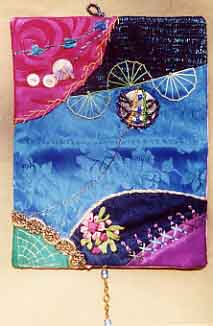
| This crazy quilted needlebook (3.5"x5" when closed) is featured in my workshop "Crazy Quilted Needlebooks." It is a quick and easy way to try this freeform embroidery technique. Six scraps of fancy fabrics including silk, brocade, and velvet were appliqued to muslin. Short lengths of trims were couched down. The embroidery stitches started with the heaviest threads, and proceeded to lighter weight ones to acheive a dimensional effect. The top was finished off with a satin lining and wool pages. Mother of pearl buttons and a shisha mirror were attached with seed beads. The closure was constructed from a loop of beads and a few links from a broken necklace. A button and loop, or two magnets also make very effective closures. |
 |
| Needlebooks |
| A web search on needlebooks will yield a wide variety of kits for sale ranging from $10 to $35. Consider making your first few from some of those UFO blocks hiding in every quilters stash! |
| This sample was stolen in 2004. Please notify the artist if you find this needlebook. Thank you! |