 |
 |
 |
 |
 |
 |
 |
|
|
| Five little pumpkins sitting on a gate. The first one said "Oh my its getting late!" The second one said "There are witches in the air." The third one said "but we don't care." The fourth one said "let's run, let's run!" The fifth one said, Isn't Halloween fun?" Then Wooooooo went the wind And OUT went the lights. And five little pumpkins rolled out of sight. |
 |
 |
 |
 |
 |
 |
 |
 |
 |
| The history of the Jack-o-lantern There's been lots of myths concerning the lantern, but the majority agree it was named after a guy named Jack. Jack was mischeivious and stingy by nature. One day Jack was walking on a deserted road with a big black dog, who proceeded to chase an old man up a tree. When Jack caught up with them, he saw that it wasn't an old man but a demon, who was afraid of big black dogs. Jack started tormenting the demon saying that he'd get a stick and knock the demon out of the tree so the dog could get him. The demon was terrified at the thought of it, so he struck a deal with Jack. If he would let him down without the dog harming him, Jack could be assured that for 10 years no-one from the underworld would harm Jack. Jack made a further condition that he could be safe from angels of all realms as well. The bargain was made, but unfortunately Jack died before the 10 years. Since he made the deal Jack was forced to remain on earth in a semi-ghostly state. Jack begged both realms for a little light. The angels gave Jack a pumkin and the demons gave Jack an eternal burning lump of coal to go into the pumpkin. Since it happened on All Hallow's Eve it was decreed that Jack could have that night to light the way for the underworld as well as souls of humans that travelled back to earth to have a yearly celebration, and Jack could also play pranks of his own on deserving selfish people. The traditional face on the pumpkin represents Jack with his impish smile beaming out light so the souls and other creatures will know that the people inside the house are honoring them and will not be bothered by hauntings. Today its used to let children know the house had candy so they wouldn't be tricked with pranks. |
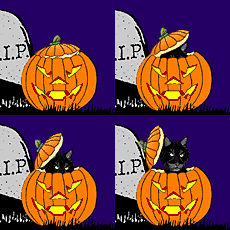
| The history of the Black Cat According to Inquisitor Nicolas Remy, all cats were claimed to be demons. Lombard Witches were said to worship the devil as a cat in 1387. Christians in medieval times put cats to torture and burn in a fire along with witches, as they believed that cats were the median between the witches and the devil. Cats did get even for such torture in a round-about way causing the Black Plague, a form of bubonic plague. If the churches would have left them alone and people kept their cats, the fleas on the rats that overran the cities may not have brought Europe to such a fatal outbreak. By the 1930's and 40's the black cat became a fun and familiar symbol to Halloween, however the superstition of the black cat crossing your path still has some people fearing bad luck. |
|
| Halloween gets a name In the early 5th Century BC,for the Celtic pagan and witch traditions,summer officially ended on October 31, this being the lsat harvest festival of the year. The holiday was called 'Samhain (sowen) or the Celtic New Year. Bonfires were lit, tables were set with alls sorts of delectable foods, and magic prevailed. The people also believed that the bodyless spirits that had passed away the preceeding year to search for living bodies to possess in the upcoming year, believing that this was their only hope for an afterlife. The still-living didn't want to be possessed so as night fell, the clans would extinguish their home fires to make their homes undesirealbe for the spirits to move in. The also dressed up in all sorts of ghoulish costumes and paraded around the village being destructive as the could to frighten away for the spirits that were looking for bodies to posses. The term "Halloween" was given in by the Catholic Church in a round about way. November 1st was "All Hallows Day " in observance to honor the Saints. The mischief making of the night before was called 'All Hallows Eve" and eventually became known as Halloween. |
 |
 |
|
| History of the Hag The Hag or Crone was depicted as a powerful lady with a hideous blue face, wearing a plaid and carrying a staff or walking stick. She would wash her plaid until it was snowy white in the whirlpool of Corryvreckan to bring forth the winter. She was the guardian of the animals and streams and wells and was the figure of winter from Samhain to Beltainne. When angered she is said to unleash the powerful Wolfwind to keep the warmth of spring, or Beltainne, from coming. She personified common sense, intelligence, diplomacy and prudence that is earned from being faced with the older years of age. |
|
 |
 |
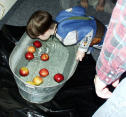
| The history of bobbing for apples With the Romans defeating Britain,they brought with them the apple tree. The apple tree supposedly was to represent their goddess of fruit trees, Pomona. She represented fertility and beauty.. Celts believed that the pentagram, which, when the apple was sliced in half the seeds form a pentagram, the symbol of fertility, thusgiving the apple the power of determining marriages during Samhain. During the annual celebration, young unmarried people tried to bite into an apple either hanging from a string or floating in water. The first person to bite into the apple would be the next to marry. Bobbing for apples today is just a game played for fun. |
 |
|
 |
 
|
