Pakistan International Peace & Human Rights Organization
Nindo Shaher District Badin Sindh Pakistan
 

PHYSICAL FEATURES
Pakistan, situated in the north-western part of the South Asian subcontinent, obtained independence from the British on
August 14, 1947 after the sub-division of the Indian subcontinent. It is a landmass of diversified relief with vast plains in
the Indus basin, a rocky expanse of plateaus in the Southwest and majestic mountains in the north with beautiful valleys,
snow-covered peaks and glaciers. Pakistan extends from 24o to 37o latitude and from 61o to 75o E longitude. On its east
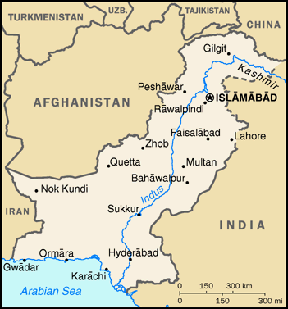
and Southeast lies India, to the north and Northwest is Afghanistan, to the west is Iran and in the south, the Arabian Sea.
It has a common frontier with China on the boarder of its Gilgit Agency. Tajikistan, formerly in the USSR, is separated
from Pakistan by a narrow strip of Afghan territory called Wakhan.
This variety of landscape divides Pakistan into six major regions: the Northern high Mountainous Region, the Western
Low Mountainous Region, the Balochistan Plateau, the Potohar Uplands, large dams like Tarbela, and high mountain
peaks like K2 (Mount Godwin Austin-8611 metres) and Nanga Parbat (8126 metres).
CLIMATE, RAINFALL & SEASONS
Pakistan has a continental type of climate, characterised by extreme variations of temperature depending on the
topography of the country. Pakistan experiences a general deficiency of rainfall. Although it is the monsoon region, it is
arid, except for the southern slopes of the Himalayas and the sub-mountainous tract where the annual rainfall varies
between 76 and 127 cm. Balochistan is the driest part of the country with an average rainfall of 21 cm.
There are four well-marked seasons in Pakistan, namely
Cold season (December to March)
Hot season (April to June)
Monsoon season (July-September)
Post-monsoon season (October-November)
ADMINISTRATIVE DIVISIONS
The total land area of Pakistan is about 796,000 square kilometres. Pakistan is comprised of the provinces of Punjab,
North West Frontier, Balochistan and Sindh and the Federally Administered Tribal Areas (FATA) of the north and northwest.
Each province is divided into administrative divisions, districts, tehsils and talukas. There were 26 Divisions and 106
districts by end of June 2001. Islamabad is the capital of Pakistan, which lies in the northern part of the country at the
bottom of Margalla hills near Rawalpindi, is a well-planned city which was constructed beginning in the 1960s.
PEOPLE, CULTURE, RELIGION & LANGUAGE
Pakistan historically attracted migrants from many nations in the north-west and the north-east. These include Dravidians,
Aryans, Greeks, Turks, Persians, Afghans, Arabs, and Mughals. The dominant racial type in Pakistan is Indo-Aryans.
In the cultural arena, Pakistan has inherited a rich heritage. A highly developed way of life was attained by the people of
Pakistan in the Indus Valley Civilisation about 5000 years ago which came to an end around 1500 B. C. About 500 B. C.,
the northern city of Taxila emerged as a famous centre of Buddhist learning and culture which existed for a thousand
years.
Pakistan is an ideological state, which came into existence as a result of the demand for a separate homeland for the
Muslims of the Indian subcontinent. The Muslim majority areas were mostly carved out into Pakistan. Therefore, the large
majority of the population of Pakistan is comprised of Muslims. A negligible minority of Hindus is settled mainly in the
boarder districts of Sindh. Christians are widely spread throughout the country and form about three percent of the total
population. The Parsis (Zoroastrians), are an economically notable minority, mostly settled in Karachi. The constitution of
Pakistan guarantees the right of minorities to profess, practice, and propagate their religion and every administrative
position is open to them with the exception of the Head of State and the Prime Minister.
Urdu is the language most commonly spoken throughout the country. Barohi and Balochi are spoken in Balochistan,
Pushto in North West Frontier Province (NWFP) and also in some parts of Balochistan, Punjabi in Punjab, and Sindhi in
the province of Sindh. Saraiki is widely spoken in southern Punjab in the districts of Multan, Bahawalpur, Dera Ghazi
Khan and adjoining areas in Balochistan, NWFP and Sindh. The medium of education is Urdu but English continues to be
used in higher education and professional colleges, particularly in scientific and technical fields. English is widely used for
commercial, legal and other official business in the country.
MAP OF PAKISTAN
DECENTRALIZATION & DEVOLUTION
On August 14, 200, the Chief Executive announced an ambitious plan for the devolution of power to local governments
within the country. The basic principals of devolution plan, which was prepared by the National Reconstruction Bureau,
are that it is people- and service-centred, and aims to carry government down to the grass -roots level. The mechanisms
include a bottom-up methodology' consensus building, ownership promotion' and issue-based politics. The plan aims to
bridge the urban-rural divide' and promote human resource development, and empowerment targets of the plan I include
the devolution of political power, the decentralisation of authority and function, the diffusion of the power-authority nexus,
and the distribution of resources.Local government finances will consist of federal and provincial transfers and grants, as well as self-generated funds,
including revenue from taxes, fee and rates, and community contributions. Federal and provincial transfers will be
formula-based, considering fiscal needs, fiscal equalisation on the basis of backwardness, fiscal effort, and the
maintenance of minimum standards of provision of services. Transfers will be determined by a Provincial Finance
Commission.
Each district will have a district government as well as councils at tehsil (sub-district), and union levels. The councils or the
citizens themselves will form voluntary citizens' community boards at all levels. The selected bodies will have general
seats, plus one third reserved for women and five percent each for peasants/workers and minorities.
DISTICT COUNCILS
The Zilla (district) government will include the Nazim (administrative) and Naib Nazim (deputy administrator), the Zilla
council, and the district administration. The Zilla Nazim assisted by the Naib Zilla Nazim, will be the executive head of the
district, and the administration and police will be responsible to him. They will both be indirectly elected as joint
candidates. All heads of the union councils in the district will automatically become members of the district council. The
Zilla Nazim and Naib Zilla Nazim will be elected by the union council members of the districts.
The number of general seats in the Zilla council will vary depending on the number of unions in the district. In addition of
the general seats, the Zilla council will have thirty three percent of its seats reserved for women, five percent for workers /
peasants.
The district administration will be co-ordinated by a District Co-ordination Officer (DCO). There will be twelve departments
in the district government: district co-ordination,; finance and planning; works and services; agriculture; health; education;
community development; information technology; revenue; law; and magistracy.
TEHSIL COUNSILS
The Tehsil (sib-district) government will include the Tahsil Nazim, the Naib Tehsil Nazim, the Tehsil council and the Tehsil
administration. The tehsil council will comprise Naib Union Nazims of all the unions of the Tehsil. Under the Nazim, there
will be a Tehsil Municipal Officer (TMO) who will co-ordinate the tehsil administration. There will be four Tehsil Officers
(TO) reporting to the TMO, each responsible for finance, budget and accounts; municipal standards and co-ordination;
land use control; and rural-urban planning. Functions of the Tehsil council will include provision of municipal services,
regulation of fees and charges, approval of the Tehsil budget, and land use control and master planning.
UNION COUNCILS
The union government will comprise the Union Nazim, the Naib Union nazim, the union council and the union
administration. The union council will have 21 members, 18 of whom will be elected: 12 men and 6 women. Six seats will
be reserved for representative of peasants/workers. The council will be headed by a Union Nazim and assisted by a Naib
Union Nazim. They will be directly elected as joint candidates. Every union will have three secretaries under the control of
the Union Nazim. The union councils will carry out their functions through the union government and the monitoring
committees. At a minimum, there will be monitoring committees for municipal services; finance; public safety; health;
education; literacy; works and services; and justice. The monitoring committees, or the citizens themselves, may facilitate
the creation of Citizens' Community Boards (CCBs) in both urban and rural areas.
VILLAGE COUNCILS
The Zilla council will determine the strength of each village council. Tehsil Nazim will arrange to hold elections for each
village council, through secret ballots. The candidate who secures the highest number of votes will become the
chairperson. The village council will be responsible for assessing finances required for projects and mobilising
contributions of the people; promoting civic education and community learning; organising recreational and youth
activities; and promoting gender issues. It will also facilitate the creation and functioning of Citizens Community Boards.
|
Name
|
Islamic Republic of Pakistan
|
|
Head of the State
|
General Pervaiz Mushraf
|
|
President of Pakistan
|
General Pervaiz Mushraf
|
|
Government Parliamentary System
|
It consists of two houses i. e. the Senate (Upper House) and the National Assembly (Lower House). The Senate is a permanent
legislative body and symbolises a process of continuity in the national affairs. The four Provincial Assemblies, Federally
Administered Tribal Areas (FATA) and Federal Capital form its electoral college. The National Assembly has a total membership
of 350 elected through adult franchise.
|

TOTAL MEMBERSHIP OF NATIONAL ASSEMBLY & PROVINCIAL ASSEMBLIES
|
National Assemblies
|
General Seats
|
Women
|
Technocrats
|
Total
|
|
Baluchistan
|
14
|
3
|
1
|
18
|
|
Federally Administered Tribal Areas (FATA)
|
12
|
__
|
__
|
12
|
Fedral Capital
|
1
|
__
|
__
|
1
|
|
|
North West Frontier Province (NWFP)
|
32
|
9
|
3
|
44
|
|
Punjab
|
147
|
33
|
15
|
195
|
|
Sindh
|
59
|
15
|
6
|
80
|
|
TOTAL
|
265
|
60
|
25
|
350
|
PROVINCIAL ASSEMBLIES
|
|
General Seats
|
Women
|
Technocrats
|
Total
|
|
Baluchistan
|
51
|
11
|
5
|
67
|
|
Sindh
|
130
|
29
|
12
|
171
|
|
Punjab
|
297
|
66
|
27
|
390
|
|
NWFP
|
99
|
22
|
9
|
130
|
|
Provice Admin: Area
|
Divisions/
Sub Diviosns
|
Districts
|
Talukas/
Villages
|
Muncipal Corp/
Muncipal Commit/
Town Committ:
|
Contonment/
Metroploitans
|
Total Urban Area
|
|
Pakistan
|
26/290
|
113
|
427/48349
|
13/158/304
|
40/2
|
515
|
|
NWFP
|
7/46
|
24
|
60/7326
|
1/30/14
|
11/--
|
55
|
|
Punjab
|
8/107
|
34
|
118/25873
|
7/79/141
|
18/1
|
245
|
|
Sindh
|
5/72
|
21
|
88/5875
|
3/35/116
|
8/1
|
163
|
|
Baluchistan
|
6/62
|
26
|
116/6584
|
1/14/28
|
3/--
|
146
|
|
Islamabad
|
--/3
|
1
|
1/132
|
1/--/--
|
--/--
|
1
|

|