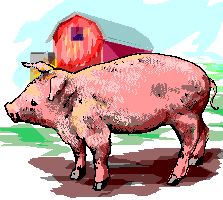
Generally, 8 to 12 piglets are born to a litter. The largest number of piglets born in a single litter was 34. The two-day birth occurred in Denmark in June, 1961.
|
It is believed that the word "pig" comes from the Low German bigge , meaning any domesticated swine.
|
Some pigs are really BIG! The largest was a 2, 552 pound porker named Big Bill, who stood 5' 9" at the shoulder.
|
Pigs have altered history. In 1859, an American-owned pig wandered into a British-owned potato patch on San Juan Island, off the coast of Washington. The pig was shot, touching off a cold war.
|
Pigs are generally extremely intelligent, even more apt at picking up tricks than dogs. Scientists have found their grunts have specific meanings, allowing then to communicate to each other.
|
Despite their penchant for wallowing in mud, pigs are very clean. They always keep their toilet far from their living area. Even newborns do this.
|
Chu is a common Chinese surname meaning "pig." Chinese named themselves this to fool evil spirits into thinking they were animals and therefore not worth bothering.
|
Famous pigs: Miss Piggy, The three little pigs, Piglet (from Winnie the Pooh), Porky Pig, Arnold Ziffle (Green Acres), Babe, Old Major (Animal Farm)� and Remmington!
|
For centuries, pigs have been used to hunt truffles, a rare and delicious mushroom.
|
Different cultures have varying attitudes toward eating pig meat. Judaism and Islam forbid eating pork. A standard Caribbean dish is Pig Knuckles and Rice. In China, sliced pig ears are served alongside duck intestine as an appetizer.
|
Pigs originated from Eurasian Wild boars.
|
World book encyclopedia rates a pig the seventh most intelligent in the animal kingdom.
|
It took 30 some piglets to play the part of "Babe" in the first film because the piglets outgrew the part so quickly.
|
There is proof of the existence of potbellied pigs as pets in 3468 BC, when the first book on the raising of them was written.
|
The 'Piggy Bank' came about because the smallholder always invested his wealth in the family pig. It gave him pork, bacon, sausage and also acted as a refuse bin eating all the scraps. When asked if he had any money the smallholder would reply...'No. All my money's in the pig'. When people stopped keeping pigs they made a replica pig to 'put their money in'. Hence the practice of saving money in a pig and the arrival of the 'Piggy Bank'.
|
I've heard though I don't know if its true that pigs are valued in the south because they kill rattle snakes keeping pastures safe for other farm animals.
|
"Potbellied pigs snore....loudly!!!!"
|