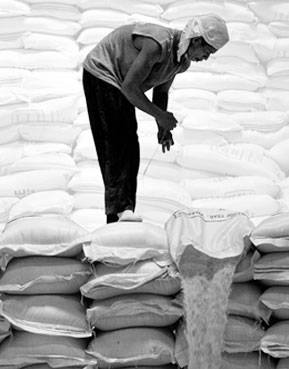
Dozens of people lined up outside
the market, where a National Food Authority (NFA) van
was parked. The queue continued to stretch along the
road, even as the sun burned hotly. Yet, none left the
line—everyone was desperate to buy several kilos
of state-subsidized rice at P18.25.
This scenario has become commonplace worldwide. Riots
and protests broke out in Haiti and Egypt due to rising
food prices. As commercial prices soared, Gloria Arroyo
attempted to cover shortfalls by importing record amounts
of rice. Currently, the NFA plans to double import quotas
from the current 300,000 metric tons (MT) to 600,000.
The current shortage, however, is just the latest among
numerous cases of rice crisis in the Philippines.
Periodic recurrence
During the 1960s, locally-produced rice easily met domestic
demand, leaving enough for exportation from 1968 until
the early 1980s. According to a report by Arze Glipo,
executive director of the Integrated Rural Development
Foundation, this high production rate was due to the
use of new varieties, development of irrigation systems,
and high credit support for farmers and producers.
However, in 1981, Ferdinand Marcos approved the Balanced
Agro-Industrial Development Strategy (BAIDS), which
promoted the shift to export crops, such as sugarcane,
to meet global demand instead of local needs. BAIDS
also deregulated the rice sector, replacing fertilizer
subsidy with tariff subsidy and removing control on
rural credit interest rates. Continued deregulation
resulted in one of the highest production costs in Asia,
making locally-produced rice more expensive than imports.
For instance, Thailand sold rice for P8.89 per kilo
in 2001, as opposed to the P16 to P17 price of Philippine
rice.
Plans for the semi-privatization of the NFA, formed
in 1972, were also formulated during the 1980s. The
Agricultural Tariffication Act, imposed by the World
Bank in 1996, subsequently removed the NFA’s power
to provide incentives and aid for farmers through subsidized
pricing system, and grains procurement and distribution.
Meanwhile, the General Agreement on Tariffs and Trade
(GATT), signed by former President Fidel Ramos in 1995,
required the Philippines to import a minimum volume
of rice with lower tariff rates, even when local rice
production is sufficient for the country’s needs.
As a result, annual rice imports rose gradually from
257,262 MT in 1995 to a projected 2.2 million MT this
year, making Philippines the largest rice importers
worldwide.
With the combined influx of imports and lack of government
support, rice production hit an all time low of 8.55
million MT in 1998. As a solution, then-President Joseph
Estrada opted to increase imports—the same line
being touted by the Arroyo administration today.
Off the mark
Independent research agency IBON Foundation states that
reliance on importation removes the ability of local
rice producers to meet local demand. Burdened by high
production costs, locally-produced rice cannot compete
with cheaper varieties from other countries, leaving
farmers bankrupt, an IBON report claims. For instance,
in 1999, rice production cost in Central Luzon was US$888
per hectare, while in Thailand, rice production cost
as low as US$636.
Meanwhile, the rice shortage is further aggravated
by the presence of a rice cartel in the country. “[They]
seized the opportunity to create an artificial rice
shortage and jacked up prices by as much as 90 to 100
percent,” an IBON report explains. The cartel,
known as Binondo 7, hoards the majority of rice supply
from local farmers, allowing them to raise prices to
exorbitant levels or withhold supply to create an artificial
shortage in the country and further increase prices.
Kilusang Magbubukid ng Pilipinas (KMP) chairperson
Rafael Mariano states that the existence of the cartel,
which currently controls around 45 percent of the rice
needs in Metro Manila, is in part due to the inability
of the NFA to increase procurement of local rice. For
instance, last planting season, NFA procured only one
percent of the local production, leaving the rest to
private traders.
Meanwhile, IBON predicts that Arroyo’s lifting
of rice quota, which will allow imports to flood Philippine
markets, will only aggravate the rice cartel in the
country. “Only the cartel has that much money
to buy rice from the international market,” enabling
them to hoard more rice supply, Mariano explains further.
He adds that this will further raise the local prices,
as presently, imports costs more than locally-produced
rice.
Global calamity
In a report prepared by the United Nations Food and
Agricultural Organization (FAO) on global food situation,
37 countries are in dire need of external assistance,
while 14 countries, including the Philippines, are currently
undergoing food emergencies.
Due to the global food situation, Thailand increased
its rice export volume while doubling prices, whereas
Vietnam has halted export deals for April and May and
will be cutting down export volume by 22 percent this
year. Inevitably, countries that rely mainly on imports
are affected, as they may face either a lack of supply
in the global market or exorbitant prices they cannot
meet.
As a means of battling the crisis, FAO proposed that
states should have regulatory control of the agricultural
sector. This entails the return of government support
for farmers and other measures to protect local producers
against imports.
KMP points the self-sufficiency problem to lack of
facilities and faulty irrigation systems in the country.
Thus, the government plans to restore irrigation and
post-harvest systems to maximize crop yield and ensure
that crops are harvested on time. This, however, is
only one step forward in confronting the rice crisis.
The government should focus on strengthening the agricultural
sector through developing adequate agrarian reform policies
and reinstating government support and trade protection
for local farmers, says IBON Research head Sonny Africa.
Ultimately, removing liberal trade policies and eliminating
the Philippines’s reliance on imports are necessary
steps the government must take to end the rice crisis.
Only upon making these long-term measures can the government
solve the crisis permanently. # Philippine
Collegian
<< back
to home |