|
|
| |
|
|
|
Adobe
Reader is required to access the file. If you don’t
have this application, you may download it
here.
 |
|
|
|
|
|
|
|
|
|
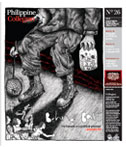
On its 85th year, the Philippine
Collegian looks back at eight decades of
headlines that saw print on its pages &
sent ripples within and outside the university. |
|
|
| |
|
5 Mar 1955 |
|
Collegian
suppression
lifted by
president |
Presses roll as Tan lifts
ban; denies knowledge
of suspension order
The suspension of the
highly controversial
issue of the Philippine
Collegian carrying a
story about charges
being filed by Ms.
Amelita Reysion-Cruz
with the Board of Regents
against President
Vidal Tan, was officially
lifted last March 3,
with the permission
of Pres. Tan to print
the Collegian in full. |
|
|
|
|
|
|
|
|
|
| |
|
|
The 2008-2009 Philippine
Collegian Editorial Exams |
|
|
|
The
prospects and implications on the Philippines of an
Obama win in the November 2008 United States elections |
|
|
|
|
|
Balance of Power |
|
|
|
Larissa Mae Suarez
2nd year, BA Journalism |
| |
|
| |
The die has been
cast. Senator Barack Obama, initially the underdog
in the United States elections, has become the front-runner
in a race most political pundits agree the Democrats
will win. Barring any unexpected turn of events, the
young Democrat will, against the odds, become the first
black President of the U.S.A.
Two major issues have come into play in these elections.
The first is the American economy, vacillating in the
shadow of a looming recession. Another key concern is
the vastly unpopular Iraq War. The resounding defeat
of Republicans in the 2006 midterm elections—and
indeed,
the projected victory of Democrats in the 2008 presidential
elections—has been blamed on the unfavorable perception
of Republican President George W. Bush, who sent American
troops to Iraq. Democrats are quick to note the links
between America’s economic woes, its ballooning
foreign debt, and the billions ill fimds poured by the
Bush administration into the war.
These issues are crucial, for the U.S. elections have
a tremendous global impact. America leads the international
arena in practically every aspect, from economic power
to military strength. The Philippines, then, must focus
on planning a strategy for advancement in this American-dominated
arena,
marked by our status as a developing nation and America’s
supremacy as a global superpower. At the outset, and
even with their current problems, we must learn to operate
at a disadvantage, for the scales of Philippine-U.S.
relations are tipped heavily in the latter’s favor.
Consider how an Obama victory would affect the Philippines.
The presidency of Gloria Macapagal- Arroyo has seen
a rising toll of
victims of extrajudicial killings and enforced disappearances,
a harsh
reality attested to by no less than the United Nations.
Obama, who has
always been a staunch defender of human rights, would
probably prove less forgiving than Bush of the human
rights violations under the Arroyo
administration.
Moreover, part of Obama’s appeal is his firm vow
to immediately end the discredited Iraq War, leading
foreign leaders in the Middle East to express their
support for him. This implies that Obama may be able
to stabilize the
conflict-ridden Middle East, which will in turn help
stabilize spiking oil prices. The Philippines would
definitely benefit from such a situation.
Yet Obama has also been critical of existing trade agreements,
which allow American companies to outsource cheap Asian
labor, resulting in fewer jobs for U.S. citizens. Call
centers have provided plenty of jobs for Filipinos,
and
Obama may push for new policies that will adversely
affect this trend. In addition, should Obama manage
to improve the U.S. economy, it might halt the strengthening
of the peso against the dollar - unless the Philippine
economy improves at the same pace.
Clearly, in this game of politics, every move America
makes ripples out across the world to the Philippines.
Inevitably, Obama shall be staunch and uncompromising
in his protection of American interests. Thus, Filipinos
must be equally staunch, equally uncompromising. in
pushing for our own development.
The die has been cast. Despite the dismal rule of their
current president. Americans are moving forward. Let
Filipinos do the same, working with them, and if necessary,
despite them. Let us establish a balance of power.
<<
back to home |
| |
|
|
|
|
|
|
Claiming the Possible |
|
|
|
Frank Lloyd Tiongson
year and course here |
|
|
|
It is difficult to use hope in a
single sentence without the words persistence
and possibility. In the same way, it is hard to conceive
Barack Obama’s campaign for the United States presidency
without the principle of
empowerment.
For Obama’s candidacy rests on such auspicious ideal.
He has appealed to the aspirations of the grassroots,
the people who have often been marginalized in legislation
and policy-making. And it is due to this that he currently
leads the surveys and the primaries in the US presidential
race.
The world is tuned in. It is the first time that a woman
and an African-American vie for the presidential seat.
For a history that is marred with oppression based on
race and gender, it signifies, most of all, the changing
of the times.
The people of the Philippines, in their quest to realize
the same
democratic ideal, have much to learn from these developments
in the US
presidential elections.
During the early 20th century, women in the US were not
even
allowed to vote. Now, a woman is running for president.
During the 60s, countless African- Americans were brutally
stifled during their campaign to
supplant racial segregation. Now. an African-American
stands with the highest probability of winning the US
elections.
It is persistence that prompted this historical rupture.
It is their steadfast struggle that took them as far as
a probable seat in the White House, touted as the most
powerful position in the democratic world. The Filipino
people.
correspondingly, must not relent in their pursuit of a
more representative and empowering government, especially
during times when such ideals elude us, as shown by the
current political crisis.
An Obama win would entail dramatic shifts in US foreign
policy. His triumph would serve as a critique to the Bush
administration’s policies, particularly its military
intervention in the Middle East. His victory implies the
disillusionment of the American people towards a Republican-
led government—which has siphoned off the country’s
resources to finance a war instead of social services—
especially in light of the US economic recession.
Obama’s presidency then, would also reflect heavily
on the Philippines’ priorities. The country, after
all, was one of the first countries to express support
for Bush’s war against terrorism. It is the same
discourse, however, that has been employed by the Arroyo
administration to silence
legitimate dissent. An Obama win, therefore, would also
serve as a critique of the Arroyo administration, which
has been visibly subservient to the policies adopted by
the Bush administration. It would possibly reflect primarily
in the government’s allocations in the military.
Obama’s campaign, after all, is based on the very
ideal democratic states are based on—empowerment.
The possibility that it prompts is a government that is
truly representative of the people. It is a possibility
that must be continuously imagined. if the people of the
Philippines
persist in hoping that a progressive leadership is still
possible.
<<
back to home |
|
|
|
|
|
Victory as Vindication |
|
|
|
Ryan Oliva
year and course here |
|
|
|
The ascent of a black man into the
highest office of a country where it once had separate
buses, schools and housing for black and white people
is a vindication of faith against disbelief, hope against
despair and peace against war. Sen. Barack Obama’s
victory is not only for the Americans, but for the world
and the Philippines as well.
Our history has been -- and still is -- intimately connected
with the history of the United States. This relationship
has proved to be suffocating at many times, especially
when we enter into unconscionable agreements with the
US. We, as well as the rest of the world, blindly follow
where the US wants us to go. When Pres. George W. Bush
urged us to support the war in Iraq against terrorism,
we heeded his call. Other nations also followed. However,
the US’s moral ascendancy to call for a war was
eroded when it became
obvious that is not a war against terrorism; it is a war
for oil.
On November, Obama’s victory will end that war.
Ending the war in Iraq is a departure from the old Republican
political economy -- the war economy. It will be a message
of faith and hope. For Obama, war is not the answer. And
this simple yet powerful belief can change the way US
deals with the members of the global community.
A change in US economic policy also affects its foreign
policy. The war economy heavily relies on the demand for
arms. For the Bush administration, it was profitable to
engage the world and the Philippines in the anti-terrorism
effort because it amounts to a captive market for its
guns.
Ending the war on terror will diminish the demand for
arms. Thus, an Obama presidency which is averse to war
will instead choose to initiate talks when global tensions
arise.
What is in it for the Philippines when Obama wins? The
Obama presidency will bring peace to Mindanao. This will
be a result of a newUS foreign policy where war is indeed
not the answer. The war in Mindanao only prospers
because the Republicans support it.
The Obama presidency will change the way the US renders
aid to the Philippines. Instead of the Balikatan military
exercises, the US will be more willing to extend assistance
in terms of education, cheap housing and the
preservation of the environment. Obama is determined to
change the way things are done in his country. Definitely,
this will extend to us.
The Obama presidency will change the way the US looks
on us. Recently, Obama expressed support for the bill
on the benefits ofthe Filipino World War II veterans.
This is an acknowledgement that Filipinos deserve respect,
not a mere pittance.
<<
back to home |
|
|
|
|
|
Sanga-sangang daan |
|
|
|
JM Ragaza
3rd year, BA Journalism |
|
|
|
Umiinog tayo ngayon sa isang panahong
magpapasiya kung magpapatianod tayo sa daluyong na pasulong,
o tatahaking muli ang landasing paurong.
Mahigit anim na dekada makalipas ihayag ng Estados Unidos
(EU) ang kalayaan ng Pilipinas, nananatiling mahigpit
ang taling nag-uugnay sa Amerika at sa Pilipinas. Taunang
isinasagawa ang Balikatan Exercises
na diumano’y alinsunod sa pandaigdigang digmaan
ng Amerika laban sa terorismo. Nakasandig din ang ating
pambansang ekonomiya sa mga ipinapadala nating mga manggagawa
sa Amerika na siyang may malaking kontribusyon sa magagandang
numero ng ekonomiya sa nakalipas na taon.
Ang ganitong tunguhin at oryentasyon ng di-mapugtong ugnayang
EU-Pilipinas ang nagbunsod sa nagliligalig na pag-aasam
ng mga Pilipino
na antabayanan ang darating na halalan sa Amerika. Bagaman
hindi tayo tuwirang makikibahagi sa halalan, nasa atin
ding harapan ang maraming mga daang inilatag ng mga kandidato
bilang pangulo, partikular sa nangunguna ngayong si Barack
Obama.
Kapwa ipinapangako ni Obama at ang mahigpit nitong katunggali
na si Hillary Clinton na wawakasan nila ang digmaan sa
Gitnang Silangan. Kapwa sila nagmumula sa isang partidong
pulitikal. Ngunit sa isang aspeto mistulang nakakaangat
si Obama—ang kanyang pagiging African-
American. Kung dadalumatin ang kasaysayan, hindi pa pinangunahan
ng isang African-American ang tinatayang pinakamakapangyarihang
bansa sa daigdig. Hindi pa rin naman pinamunuan ng isang
babae ang EU, ngunit ang
isyu ng kulay at lahi ay tila isang tanikala kung saan
nais makahulagpos ng maraming bansa.
Ang isyu ng diskriminasyon sa lahi ay isa sa mga pangunahing
sagka sa mapagpalayang pagbabago ng maraming bansa. Bagaman
ang isyu ng kababaihan sa ating patriyarkal na lipunan
ay hindi pa rin tuwirang natutugunan, mahalagang tingnan
na maiigpawan lamang ang mapaniil
na kondisyong ito kung mabibigyang solusyon ang pangunahing
mga suliranin ng lipunan.
Hindi maitatatwang ang diskriminasyon, lalo’t higit
sa hanay ng mga manggagawa na bumubuo sa kalakhan ng mga
Pilipinong nagtutungo sa Amerika, ay isang nakakarimarim
na kalagayan. Marami nang mga Pilipino
ang dumanas ng pang-aalipusta mula sa kanilang mga dayuhang
pinaglilingkuran. Ang kasalukuyang krisis pangekonomiya
ng Amerika ay sinasabi ring nagpapahirap sa maraming Overseas
Filipino Workers at magpapahina sa industriya ng call
centers sa bansa.
Sa ganitong mapagpasiyang kalagayan hinahamon ang mamamayan
kung ang daang inihapag ni Obama ang maghahatid sa atin
sa tamang paroroonan.
<<
back to home |
|
|
|
|
|
No victory for the Philippines |
|
|
|
Ma. Rosa Cer dela Cruz
2nd year, BA in Broadcast Communication |
|
|
|
A country’s fate lies on
the hands of its people and the decisions they make.
However, the current emerging culture, especially in
politics, has become geared toward individual and personal
levels. Most politicians choose to define themselves
through affiliations and popularity instead of presenting
their stands in relevant social issues and platforms.
The 2008 US elections demonstrate this emerging trend.
Despite the fact that discriminations based on gender
and race has been abolished in the US, the results of
the current rivalry between Barack Obama and Hillary
Clinton belie the idea of equality in their country.
Clinton is defined as a
woman, Obama as a black American, and their nominations
are considered victories for the aforementioned sectors.
As a result of the sensationalism of the inequality
issues, the US elections remain secluded on the local
level.
However, due to these issues of race and gender inequality,
social issues remain unaddressed. The sensational angle
remains at the individual level of the candidates’
affinity and origin. Popular vote, then, goes to the
one who gets the majority’s sympathy and assent,
not to the one who upholds his principles.
This sensationalism also clouds the relevant issues
and principles the candidates should have been discussirig.
Thus, it is impossible for other countries to see the
essential difference between the two candidates, relevant
to their relationship with the US.
The Philippines, for instance, has little concern for
the currently
sensationalized issues of gender and race inequality
in the US. We
are more concerned with Obama’s political and
economic platforms
for the future, as our country depends on US for economic
growth and stability. Meanwhile. the US considers the
Philippines an important asset as well, as a source
of raw materials. a market for finished products in
economic aspects and a faithful ally in politics.
Thus, whoever is elected to office, acting on the best
interest of the US, will simply forge new ties with
the Philippines and retain the status quo where the
US is at an advantage. Obama’s victory will not
improve or affect the
Philippines’ currently dire state. After all,
a black victory is still an American victory, and not
a Filipino one.
The Philippines will remain in the peripheries of growth
as long as it depends on the US for stability. It should
learn to protect its own interests instead of giving
its service to other countries such as the US and create
its own stability and growth. Its focus should be upon
its own needs and
how to achieve them without outside help, and not on
pondering how to pledge a new alliance on the next leader
of the US to ask for help.
Only upon realizing that it must stand on its own feet
will the Philippines emerge as a powerful nation.
<<
back to home
|
|
|
|
| |
|
| |
 |
| |
Artwork : Archie
Oclos |
| |
|
| |
|
| |
|
| |
|
| |
|
| |
|
|
| |
|
|
|
|