Here's where we can all learn something about Model Trains.
A not so brief history.
The hobby of "playing with toy trains", as some put it, has been going on, and taken quite seriously indeed, for a century and a half.
In the early to late 1800's, they were for the most part child's toys. Funky looking wood and cast iron (the plastic of the 19th century) were a static model pulled by a string along the floor. Some were powered by actual steam. Picture a 7 year old child pouring alcohol into the boiler and lighting it (in the house) to actually produce a steam powered locomotive! Frankly, I would have loved to have seen that!
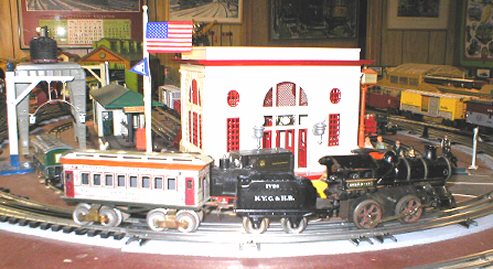
In 1868, the Ives Corporation produced several impressive trains for the time, but they were still just elaborate pull toys. Later Ives trains would use a wind-up clockwork motor, state-of -the-art for the time! At least the toy trains finally ran under their own safe power, on actual rails, even if the wind-up motors didn't run for a very long time. In 1900, they introduced the first "O" gauge clockwork trains that ran on track. The O gauge track, at 1 1/4" rail to rail, is the O scale and gauge standard to this day. Ives was the first to mass-produce trains made of tinplated steel. This, combined with bright shiny paint and lithographed details, produced the distinctive look that we simply call "tinplate trains" to this day. Ives would become a force in the early 20th century.
Near the end of the 19th century, the toy trains finally got rails to run on, but still no efficient propulsion system.
In 1881, a small German toymaker, Earnest Paul Lehmann, was getting his start in business. His flegling company wasn't producing model trains for quite a while though. In another 67 years, his company would have a model train revolution of it's own. I'll get to that in the next page...
By the 1890's the toy trains became more like models in realism, accessories, and operation. They were starting to get less "toy like", and a new market was started.
In 1893, Carlisle & Finch Co. came on the scene. They added an important missing link: electric motor powered locomotives! They didn't look very realistic, but that didn't matter at the time. They rolled down the rails on their own virtually unlimited battery power. Model trains finally started to have a mass market. The market would not be won without a fight. Soon other companies joined in.
Marklin, a German manufacturer, started producing well-detailed model trains with accessories not thought of yet, like full track systems, switches, lights, stations, towers, houses, and other assorted buildings. These "toys" had something they never had before: destinations! Other German manufacturers; Bing, Shoenner, and Issmayer, all produced more elaborate models. They mainly sold large, live-steam-powered locomotives to their home market, and cheap, clockwork versions were imported to the USA. Marklin produced the best trains of the time. Marklin was poised to be the world leader in the model train industry.
Then Joshua Lionel Cowen came along...
He had the vision and the savvy to change everything.
In 1900, Joshua Cowen sold gadgets of all types in New York City. One day, he talked a store owner into placing an odd looking brick with 4 wheels, running around a small oval of track, powered by a battery. That set sold quickly and the orders came in for more. With that, Mr. Cowen became the purveyor of toy trains! Using his middle name, the Lionel Trains Company was born.
Joshua Cowen was a marketing genius. His first trains were not spectacular, and did not run very well, but Lionel's plan was to create a perception his product was superior. For one thing, in the early 1900's, there were about as many different track gauges (widths) as were companies that produced them. The concept was simple: Lionel would market their track gauge (2 7/8"), which no one else was using, so to expand you had to use Lionel's product exclusively. In 1906 he introduced trains that looked more like real trains in another unique track gauge. At 2 1/8" wide, Lionel advertised his new trains as Standard Gauge. Cowen would promote this almost like he was implying everyone else's model trains were inferior. It worked! Lionel trains slowly became the standard of excellence. The high quality of his future lines instilled a confidence in his product that remains to this day.
In 1906, American Flyer introduced O gauge clockwork trains that really didn't challenge anyone, but it is worth noting their arrival. From the 1920's to the 1950's, they would challenge Lionel for market supremacy.
In 1907, the Voltamp Co. introduced 2" gauge trains with surprising detail that had the most significant advance of the era. They ran on household AC current. For the first time, the toy train world had a plug in the wall; electric trains, instead of springs, batteries, and fire-powered steam. The final piece was in place!
In 1922, Horace Boucher, who manufactured model boats at the time, purchased the tooling from Voltamp, and produced some very nice, very underrated standard gauge trains. He widened the gauge to 2 1/8", to be compatible with Lionel and Flyer.
WW I sealed Lionel's success with the boycott of German products. Thanks to the war, the fine German train manufacturers would lose the lion's share of the market, and never get it back.
In 1915, Lionel introduces their O gauge, electric trains. By 1916, Carlyle & Finch went bankrupt. In 1918, American Flyer becomes electric, and the Lionel Corporation was formed, continuing to innovate and dominate the marketplace.
End of chapter 1
Next, I'll go into the rest of the tinplate era. I'll also go into the emergence of the other scales, including the people who brought about changes and improvements that made the hobby what it is today, better or worse!
This site will include illustrated tips, and will follow the construction of my layout. I feel, especially for newcomers, that the history of this grand old hobby is a story that should be told. That's why I chose to start with the history.
|