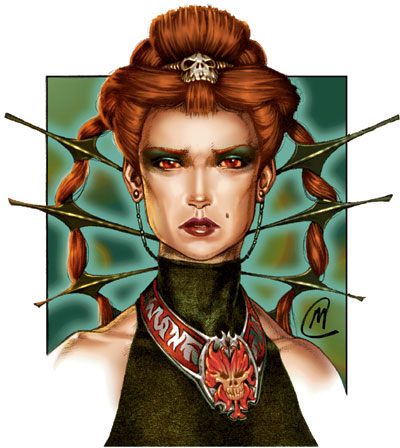
| Who I Am About Me My Interests Family & Friends My Faith What I Do St. Therese School My Desk Other Aspects Art Gallery Fantasy Page News Links Song now playing: "Sanctuary," from Resident Evil 2 This page created July 24, 2000 Last modified March 28, 2004 Picture at right: Wee-jas, goddess of death and magic from Deities & Demigods |
 |
| It depends on what one considers "promoting." Since the game does involve combat, albeit imaginary, as well as the interaction of other people and creatures who inhabit the game's world, one should expect to find some unsavory adversaries or beings at times. A look at the Monster Manual (basically an encyclopedia of many of the game's creatures) will show that many of the monsters are indeed ugly and menacing. Then again, the ugly, menacing monsters also tend to be the evil monsters, which players could argue deserve to be slain anyway. The problem is that certain creatures in the game do fall into the "otherwordly" category, and not just a few of them. Since Dungeons & Dragons takes elements from real-world cultures and mythologies, it includes pantheons of gods that real, historical civilizations worshipped. It also has various legendary beasts from those cultures. Most people would understand that such elements of the game are meant to be imaginary. What I've found disturbing, though, is that D&D has historically included a "Demon" and "Devil" category of monsters. While some of these are clearly legendary, one can find such names as Moloch, Asmodeus, and other Judeo-Christian demons, who are actually said to exist. This particular blend of fact and fantasy, I believe, was ill-advised. Personally, I think they should have stuck with the purely legendary elements, which provide more than enough material for the game's need for monsters. Fortunately, this aspect of the game is a fairly minor one, believe it or not. The game does not revolve around demons. While one can certainly expect to find that element at some point -- usually a plot device to get players to overcome the schemes or influence of such a being -- the game does not "promote" it. As for anything having to do with the occult, D&D does not promote this, either. It is true that players can have characters that use magic; in fact, magic normally plays some part in the game. But it does not involve anything real in the remotest sense. When players "cast spells," what they're really doing is announcing that their characters are using whatever magic they have, and the results in the game are then calculated. For example: Calvin is playing a wizard character named Tidal Majere, whose party has just entered combat. While the rest of his comrades engage the enemy with their weapons (rolling dice to determine hits and misses), Calvin decides that his character will cast a spell at one of the creatures they're fighting. He announces that Tidal will cast magic missile, which produces a magical arrow that darts from the caster's fingertip and unerringly strikes its target. Since the spell automatically hits, all Calvin has to do is roll some dice for the damage it causes. When he's done that, the Dungeon Master (the person running the game) subtracts that amount from the health of the creature struck by it. That's it. No actual incantations, no gestures necessary (although Calvin could have made those up for effect, if he wanted), just some dice-rolling. Other spells are treated similarly. The game itself does not promote the occult; it involves imaginary magic that causes imaginary effects. Again, those with healthy imaginations should not have a problem understanding that. Next: I've heard stories over the years about strange goings-on during the game. Does D&D encourage that? Just what goes on during a game? |
 |
| "Does the game promote anything to do with the occult, or with satanism?" |
 |